
Posted on

Made to Measure Table Top UK: How It Works (Sizes, Edge, Finish, Delivery)

Made to Measure Table Top UK How It Works (Sizes, Edge, Finish, Delivery)-Tablemaker

Made to Measure Table Top UK: How It Works (Sizes, Edge, Finish, Delivery)

What does “made to measure” mean for a table top?

A made-to-measure table top is one that is built to specific size requirements rather than standardised dimensions. Unlike fully bespoke furniture, which may involve one-off design for shape or structure, made-to-measure focuses on precision sizing, edge style and finish, offering flexibility within an established construction format. This approach allows the table top to fit particular spaces or bases without the cost or wait associated with full custom builds.

Sizing flexibility without full customisation

Standard furniture often comes in fixed lengths and widths, typically rounded to the nearest 10 or 20 centimetres. While convenient for large-scale production, this puts constraints on real homes and working environments. A made-to-measure table top, by contrast, is dimensioned to fit the needs of the customer, down to the centimetre.

Key points of contrast:

  • Standard sizing: Predefined sizes, limited variation, not designed to fit specific frames or spaces.
  • Made-to-measure: Adjustable in 1cm increments, compatible with existing bases, adaptable to awkward layouts.

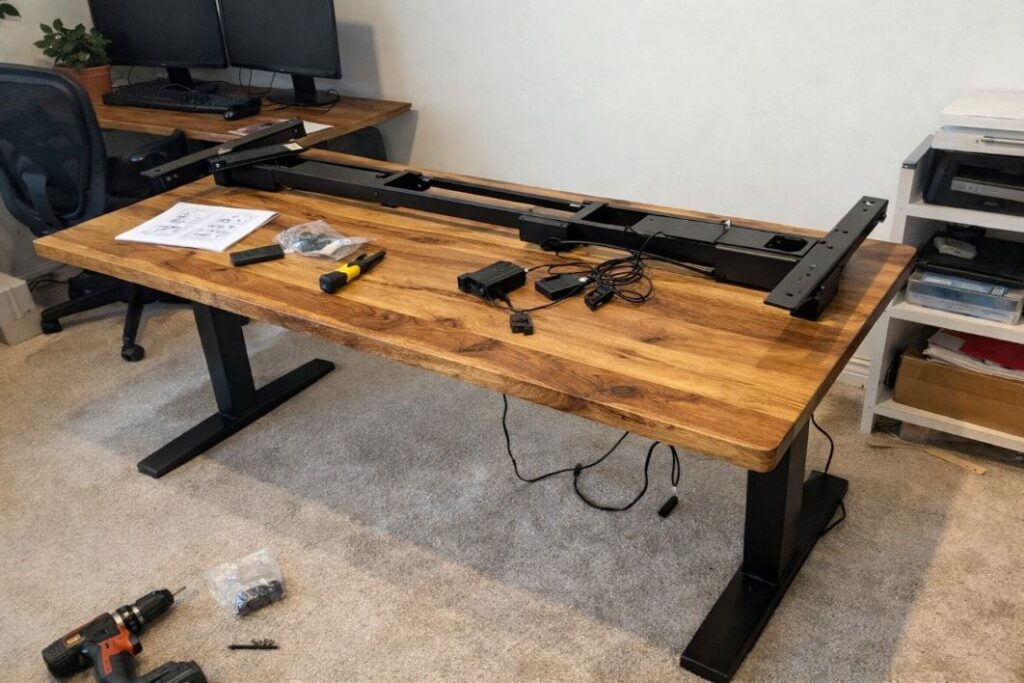
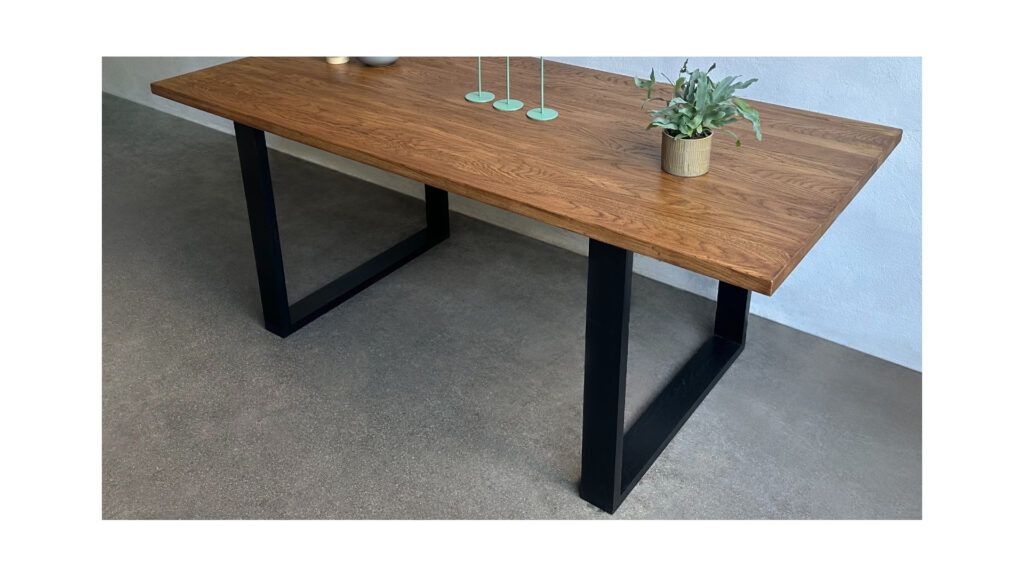
This approach proves especially useful where dimensions are constrained by radiators, alcoves or shared desk configurations. Tablemaker, for instance, regularly produces tops for fixed metal frames, sit-stand desks or irregular spaces where off-the-shelf solutions fall short.

Accuracy in fit helps improve function and longevity. Poor sizing can lead to overhangs that cause instability or bases that interfere with knees. A made-to-measure surface supports how the piece will actually be used, not just how it looks.

Table of Contents
Choosing the Right Size: What You Need to Know

A table top that is correctly sized feels natural in the space and supports its intended use. Whether it is for dining, daily work or collaborative tasks, getting the dimensions right is a straightforward process once you understand the key factors.

Key considerations for sizing

  1. Width and depth For dining and desks, depth affects how much usable surface you have. A dining table should usually allow around 60cm per person along its edge. For desking, 70 to 80cm depth allows for screens and writing. Width varies more but should leave space for movement on all sides.
  2. Overhang and frame fit On most bases, the top should extend slightly beyond the frame for comfort and proportion. Overhangs of 2 to 5cm per side are common. Measure your base first, particularly for metal or sit-stand frames, to ensure compatibility.
  3. Leg clearance and seating If legs are placed toward the ends of the table, legroom becomes important. Think about how many people you plan to seat regularly and whether chairs will tuck under comfortably.
  4. Made-to-measure increments Unlike fixed collections, Tablemaker allows ordering in 1cm increments across a broad size range, which means you can match your existing frame or fit tight nooks without compromise.

Sizing checklist:

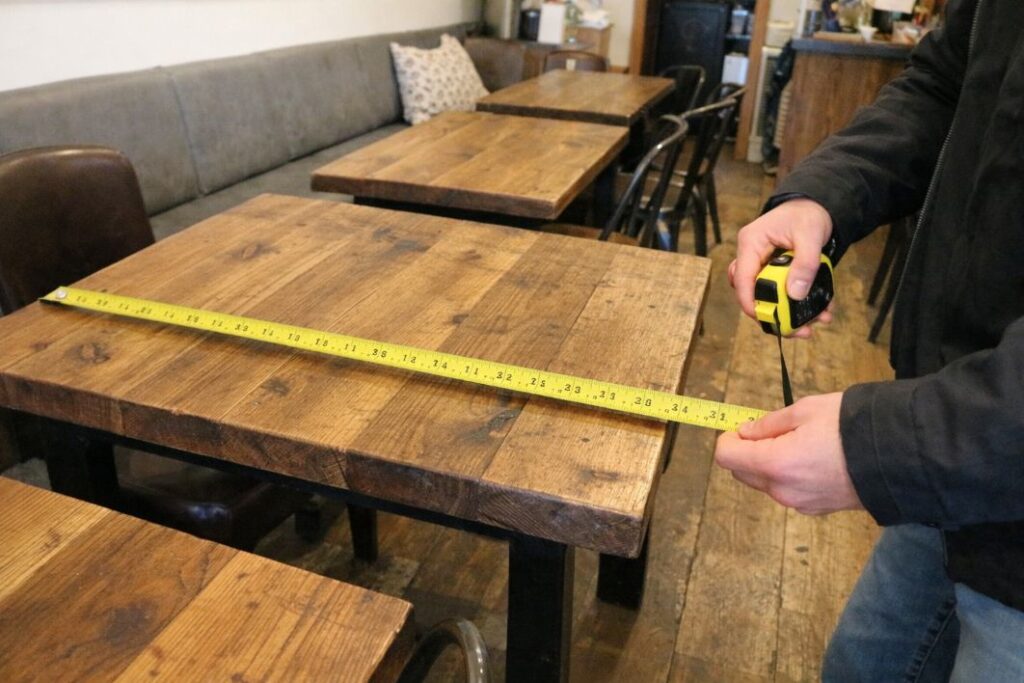
  1. Measure your existing base including width between legs.
  2. Consider adjacent furniture or walls.
  3. Decide if overhang is mainly aesthetic or functional.
  4. For shared desks, ensure enough width for each user.
  5. Account for plug access or cable routing if placing against a wall.

A well-proportioned top supports the longevity of the frame and helps avoid common sizing regrets.

Pro Tip: Measure to the nearest centimetre and always check for wall plugs or sockets that may restrict placement.

Pro Tip: Choose a matte or satin finish in family homes or shared spaces to minimise the visibility of marks.

Edge Profiles: Subtle Details That Change the Look

The edge shape of a table top plays a modest but often underestimated role in how the piece looks and feels. It also affects perceived thickness, comfort and how the surface fits with other elements in a space.

Common edge styles explained

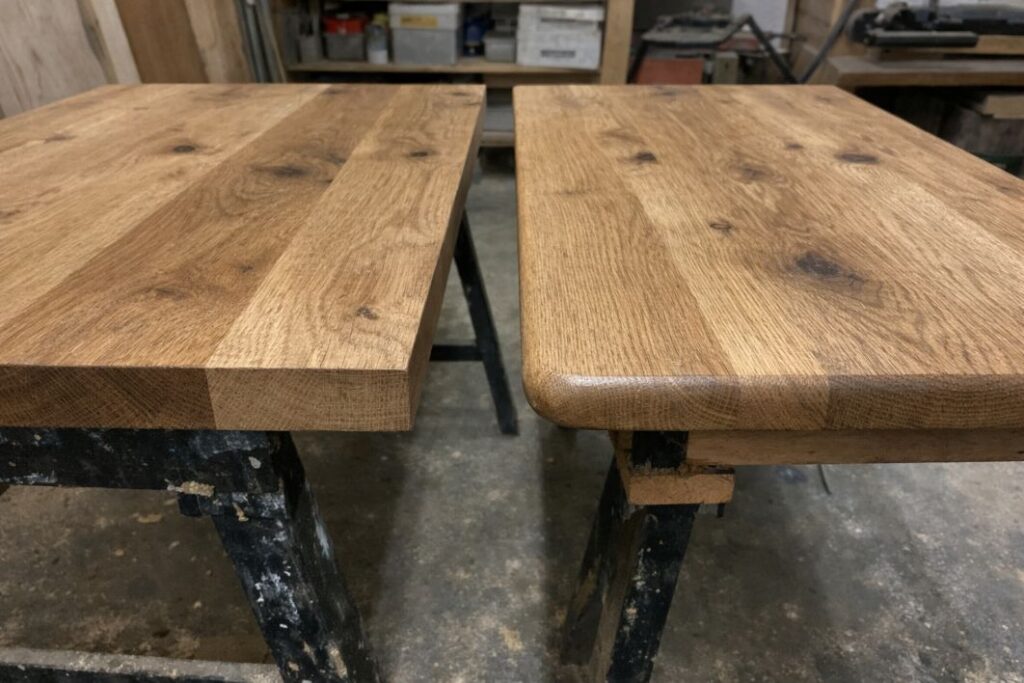
Square edge Clean and minimal, this shape has a 90-degree transition from surface to face. It suits modern or architectural interiors. The line is precise and can feel sharp to the touch, which some find less forgiving in high-traffic areas.

Chamfered edge Angled back underneath, this creates a lighter profile when viewed at a distance. It draws less attention to the thickness of the top and blends easily into styles. It’s a popular choice for both desks and dining tables.

Roundover edge Gently softened at the top corner, this profile is comfortable under hand and reduces the chance of chipping on high-use surfaces. It works well in family homes or collaborative environments where touchpoints are frequent.

Each style has its merits depending on context. A sharp edge may suit a minimal interior but feel less forgiving over time. Slight rounding, even if subtle, often improves the lived-in experience.

Tablemaker offers a range of edge options selected during the ordering process. The finish is shaped by hand and sanded smooth to preserve the natural grain and avoid breakage at the corners.

Finish Options: Protection, Colour and Maintenance

The finish of a table top protects the timber, affects how it feels under hand, and defines its visual tone. Selecting the right finish involves balancing appearance, durability and future care.

Why hardwax oil is used

Tablemaker applies hardwax oil as standard to all solid wood table tops. This finish penetrates the wood while also forming a light protective film, allowing the surface to remain breathable and repairable without peeling or flaking over time. It offers a durable middle ground between natural feel and practical resistance to everyday wear.

Appearance and colour tone

The type of oil and number of coats affect colour and grain contrast. Most finishes deepen the wood’s natural grain slightly, but options are available for those preferring a paler or more neutral tone. Satin and matte sheens are more common than gloss due to their ease of upkeep and reduced reflections.

Repair and refinishing

One of the strengths of solid wood finished with hardwax oil is its longevity. Unlike lacquer or veneer, it can be spot-sanded and re-oiled as needed. Scratches and dents can usually be repaired without replacing the surface, which supports long-term ownership.

Upkeep and cleaning

General maintenance requires only a non-abrasive cloth and a mild cleaning solution. No specialist products are needed. Re-oiling every year or two, depending on use, keeps the surface sealed and looking its best.

What to expect:

  • Finish enhances but does not mask the wood’s character.
  • Light routine care is sufficient for most environments.
  • Top can be re-oiled or sanded locally if wear occurs.
  • Matte and satin options hide marks better than gloss.
  • Colour depth varies slightly across boards due to natural variance.

Request a Quote

Send us your dimensions and preferences to get a tailored quote for a made-to-measure table top.

Get My Quote

Delivery and Lead Times: What to Expect

Made-to-measure does not always mean waiting months. Tablemaker produces nearly all orders within two to three weeks at its UK workshop. This pace is maintained by handling production in-house rather than outsourcing or batch manufacturing.

Production and packing

Each table top is built from kiln-dried timber selected for grain and stability. After cutting and gluing, the top is planed, sanded, straightened and finished before packing. Straightening bars are fitted where needed across the underside to reduce movement from humidity changes. Packaging is designed to protect corners and edges, with clear indications for the delivery team.

Delivery process

Once finished and packed, the top is shipped via a UK courier, with most deliveries booked at a weekday time slot. Access notes can be provided during ordering. Tops are usually handled by two-person teams due to weight and size.

For customers close to the workshop, collection is sometimes available by appointment. The dispatch team will advise on safe transport and lifting if collecting personally.

Before delivery:

  1. Measure doorways, stairs or tight passages carefully.
  2. Clear space indoors for unpacking and inspection.
  3. Check that your base or frame is ready to receive the top.
  4. Have two people available to lift, especially for larger sizes.

A made-to-measure top should arrive aligned with its intended use and space, not treated as a decorative object. With proper sizing, protective finish and timely delivery, it is designed to serve as a practical surface for years, with the option to adapt as life or layout changes.

View Edge Profiles

Explore our available edge styles and see how each profile changes the look and feel of your table.

Explore Edge Options

Tablemaker

55 High St, London N8 7QB

02083416334

HVQM+58 London

 

Posted on

Solid Oak Table Top Cut to Size UK: What to Send for a Quote

Solid Oak Table Top Cut to Size UK What to Send for a Quote-Tablemaker

Solid Oak Table Top Cut to Size UK: What to Send for a Quote

What information should you provide to get an accurate quote for a solid oak table top cut to size in the UK?

To receive a precise quote for a made-to-measure solid oak table top in the UK, you will need to provide detailed information about dimensions, intended use, mounting method, edge and corner preferences, finish, and any site-specific constraints. This enables the workshop to assess material needs, construction approach and compatibility with your space or base.

Table of Contents

Why Accurate Information Matters Before Requesting a Quote

Getting a custom oak table top made to size involves more than choosing dimensions. From a workshop’s perspective, clear details at the outset make every stage smoother, from quoting to production.

For example, consider two quote requests:

  • Enquiry A: “Looking for a desk top around 140cm. Can you quote?”
  • Enquiry B: “Looking for a solid oak desk top, 140cm wide, 70cm deep, 27mm thick, for a sit-stand frame, rounded corners preferred, natural finish, fixing via brackets.”

Enquiry B allows the workshop to give a meaningful quote quickly, including fitting considerations, delivery estimation and suitable finishing. Enquiry A will likely need a follow-up request for more information, which delays the process.

Providing clear and specific details reduces ambiguity, improves accuracy and avoids unnecessary back-and-forth.

Dimensions: What to Measure and How to Present It

Dimensions directly influence production feasibility, fit and cost. Precise measurements are important, especially when fitting to an existing frame or into a defined space.

When measuring:

  • Width and depth: Always provide the finished size required, measured in millimetres. This avoids confusion and ensures alignment with workshop standards.
  • Thickness: Typical thicknesses in UK workshops range from 25mm to 40mm. Thicker tops may be heavier and more expensive, but also offer greater rigidity.
  • Space allowance: If fitting between walls or within a recess, allow for clearance. A snug fit sounds ideal but can lead to swelling issues if timber expands.
  • Non-square shapes: For angled spaces or cut-outs, include a sketch with labelled dimensions.
  • Frame compatibility: If the top must align with a specific frame, measure fixing bracket positions if relevant.

Using metric units helps maintain consistency with most UK-based joinery workshops.

Pro Tip: For snug-fitting areas, subtract 3 to 5 mm from your exact wall-to-wall measurement to allow for wood movement.

Pro Tip: When matching to an existing desk frame, photograph the underside to show bracket layout and avoid misalignment.

Intended Use: Dining, Desk, Commercial or Other

How a table top will be used directly affects construction decisions. Material finishing, joint strength and reinforcement placement can all vary depending on intended function.

Typical scenarios include:

  • Dining tables: These usually require food-safe finishes with strong surface protection against heat and moisture. Rounded corners may be preferred for comfort and safety.
  • Desks (home or office): May need cable allowance, monitor risers or a satin finish that reduces glare. Sit-stand compatibility also affects bar placement.
  • Commercial settings: Tops for cafés or restaurants often need additional reinforcement due to high turnover use. Durability and ease of maintenance are key.
  • Multi-use or shared desks: These may require dual cable channels or modified edge cuts for adjacent seating.

Knowing the use case allows the maker to recommend features that improve longevity and practicality.

Mounting Plans: How the Top Will Be Fixed or Supported

How your table top will be secured matters just as much as its size or timber type. Proper mounting influences both structural integrity and aesthetic outcome.

You should consider and communicate:

  1. Type of base: Is it a fixed frame, a modular desk, trestles or a sit-stand mechanism? Include brand, if available, especially for sit-stand frames.
  2. Fixing method: Will you screw directly in, use brackets, or keep the top floating? Each method has implications for movement allowance and cupping resistance.
  3. Straightening bars: Most solid wood tops include internal or underside bars to counteract warping. Their placement may be adjusted depending on fixing plans.
  4. Undrilled preference: Many workshops, including Tablemaker, supply tops undrilled to let customers align holes precisely to their base. Pre-drilling is possible but should be based on accurate specifications.

Mounting should be taken seriously during planning, not treated as an afterthought.

Request a Custom Solid Oak Quote

Send your dimensions and preferences to receive a precise quote for a made-to-measure solid oak table top.

Get Your Quote

Edge Profile and Corner Preferences

Edge and corner specifications impact visual impression, touch sensation and even safety, especially in households with young children or tight walkways.

Common options include:

  • Edge profiles:
  • Square: Clean and simple, with sharp lines.
  • Chamfered: Lightly angled for a softened modern edge.
  • Rounded: Smooth edge that feels softer to the hand.
  • Corner radius:
  • Minimal radius: Suits formal dining or rectangular aesthetics.
  • Softened corners: Practical for smaller spaces or child-friendly environments.

To specify your preference, you might describe it as “soft profile with rounded corners” or “sharp minimal lines with defined edges.” You do not need to use technical terminology, and plain requests work well when paired with photos or references.

If uncertain, you may request a quick sample or drawing to clarify edge feel.

Finish Type and Colour Preferences

The finish applied to a solid oak top does more than affect appearance. It influences protection, durability and ease of maintenance.

Most UK workshops use hardwax oil as a standard choice due to its practical benefits. This type of finish penetrates the wood while providing a smooth surface that is resistant to spills and heat. It also allows for refinishing over time without needing to replace the whole piece.

When choosing:

  • Colour:
  • Natural: Keeps the original tone of the oak, showing the grain fully.
  • Tinted: Available in light, mid or dark tones. Useful for matching to floors or existing furniture.
  • Finish sheen:
  • Matte: Low gloss, understated feel.
  • Satin: Slight sheen, offers a subtle lift without looking polished.

If colour matching is important, request a small finished sample in your preferred tone.

Any Constraints, Challenges or Special Requests

Unusual situations are common in furniture projects. Sharing them early helps the maker accommodate constraints without need for costly revisions.

Consider mentioning:

  • Fitted spaces: e.g. Between fixed walls or under a window sill
  • Cable needs: e.g. Pre-drilled cable holes or grommet placement
  • Base quirks: e.g. Fixed metal base that limits bracket positions
  • Shared use: e.g. Table shared by two workstations
  • Visual concerns: e.g. Matching an existing leg colour or aligning with nearby furniture

You do not need to send perfect drawings. A phone photo with handwritten notes is often enough to provide context. Sketches are welcome if angles or curves are involved.

Clear communication of these aspects helps produce a top that does not just fit but functions practically in your space.

Speak with a Woodwork Specialist

Unsure about your measurements or finish options? Our specialist team is here to guide your custom order.

Contact a Specialist

Tablemaker

55 High St, London N8 7QB

02083416334

HVQM+58 London
 

Posted on

Can You Make a Solid Oak Table Top to My Measurements in the UK?

Can You Make a Solid Oak Table Top to My Measurements in the UK-Tablemaker

Can You Make a Solid Oak Table Top to My Measurements in the UK?

What does “to my measurements” mean for a solid oak table top?

Having a solid oak table top made to your measurements in the UK usually means specifying the length, width and, in some cases, thickness to suit your particular space or base. Unlike off-the-shelf pieces, these tops can often be produced in millimetre-specific sizes, giving you tight control over fit and proportion. However, there are real limits imposed by the nature of the material and workshop capabilities.

What Can Usually Be Customised?

  1. Length and width Most solid oak table tops can be made to exact dimensions, with flexibility typically offered in 1cm increments. Whether it’s a 178cm desk top for a sit-stand frame or a 93cm-wide dining surface, precision is part of the service.
  2. Thickness Workshops may offer a small range of standard thicknesses, such as 2.5cm or 3cm, based on what provides stability without excessive weight. Thicker tops can sometimes be made but will involve material and support considerations.
  3. Edge overhang and shape If you are working with an existing frame, overhangs matter. A 3cm edge on all sides is common, but custom tops can tighten or loosen these proportions to suit.

That said, physical limitations remain. Timber boards have maximum widths and lengths based on available stock and how much movement the wood will tolerate over time. It’s helpful to think in terms of the space you have, the base you are using and how the table will behave through seasonal changes. Communicating clear, metric-based measurements early on shortens production time and avoids design issues later.

Table of Contents

How Solid Oak Behaves at Different Sizes

Compared with engineered wood, solid oak is both responsive and resilient. It expands and contracts slightly with changes in humidity and temperature, meaning larger pieces need structural support to resist warping over time.

Grain Direction Boards are laid to run grain lengthwise. This works with the grain’s natural movement patterns and reduces the chance of twisting.

Support Bars For wider tops, especially those over 90cm, straightening bars are fitted across the underside. These hold the surface flat and help resist cupping. Tablemaker uses removable wood or metal bars so the top can adapt to different mounting needs.

Thickness and Weight A thicker piece often means more durability but also more weight. A 3cm oak top across 200cm may require two people to move safely. If the top is going on a lightweight frame, thickness needs balancing with the base’s capacity.

These build decisions are not decorative extras. They form part of disciplined furniture making. Every dimension affects the joinery choices behind it. By understanding how material size, moisture response and structural stability link together, you’re more likely to receive a surface that lasts and performs as expected.

What Affects Lead Time for a Made-to-Measure Oak Top?

Made-to-order furniture does not have to mean long delays. Some UK workshops, including Tablemaker, produce custom oak tops within two to three weeks, depending on specifications.

Timing Factors

  • Measurement challenge Simple rectangle tops move through the queue faster. Curved edges or cable cutouts may increase build time.
  • Finish requirements Oil finishes are usually quicker to apply than multiple layers of stain or lacquer.
  • Frame fit details If the top needs to align with pre-drilled brackets or unusual base shapes, more time is needed for checks and adjustments.
  • Workshop load Production scheduling affects all lead times. Even fast workshops can experience peaks around bank holidays or late-year planning cycles.

Planning ahead helps, particularly if the top needs to arrive before a specific deadline. A clear brief with accurate sizes, finish preferences and base compatibility keeps the process moving efficiently.

How to Ensure Your Table Top Will Fit Your Base

You’ve got the frame, and now you need a top that fits it. Correct sizing is only part of the equation. Compatibility with your base is important for function and safety.

To Do Before Ordering:

  1. Measure overall size Include width and length, but also think about how much overhang you want or can allow. Overhang should not exceed 10 to 15cm without additional bracing.
  2. Check bracket positions If your frame has pre-fitted brackets, measure the distance between them. Share this with the workshop to confirm alignment.
  3. Note any obstructions Crossbars, legs and motor housings under sit-stand frames can create clearance issues. Sketch or photograph the frame underside to help explain.
  4. Decide on drilled or undrilled Desk tops from Tablemaker are usually supplied undrilled, allowing clients to position screws based on their frame. Pre-drilling is only advised when exact bracket positions are confirmed in advance.

Working with the workshop early on avoids mismatches and ensures your base can support the top properly. If you’re unsure, providing photos or a link to the frame model can bridge the gap between standard sizing and real-world fit.

Pro Tip: Ask your workshop if they offer underside straightening bars for larger tops to prevent future warping.

Pro Tip: Request a sample of finished oak if colour tone is crucial, especially for matching existing furniture.

Finish, Edges and Other Customisation Options

Beyond measurements, a table top’s finish and edge profile determine how it complements the space and withstands daily use.

Finish Tablemaker uses hardwax oil as the standard surface treatment because it provides a balance between protection, renewability and a natural feel. Unlike lacquer, which forms a plastic-like coating, hardwax oil penetrates the wood and can be spot-repaired if scratched.

Edge Profile Options often include:

  • Square: clean and minimal
  • Chamfered: subtle slant adds dimension
  • Rounded: softened edges for shared or family use

Colour Tone Oak naturally ranges from pale blonde to warm biscuit hues. Most workshops avoid artificial staining, preferring tones derived from the wood itself and subtle pigments in the oil.

Texture Smooth sanding is standard, though a brushed finish can bring out grain texture with slightly more character under touch.

Many of these choices do not alter lead time significantly, but unusual requests may require extra planning. Most clients stick to clear oil and square or chamfered edges, which suit both domestic and commercial settings.

When a Custom Oak Top Makes Sense, and When It Doesn’t

Custom oak tops are ideal when standard dimensions simply do not work. However, in some cases, a ready-made option may bring the same results with less challenge.

Useful Reasons to Go Custom

  • You have an existing table base with uncommon bracket spacing
  • The piece must fit inside a specific alcove, corner or shared desk environment
  • You want matching tops for a series of built-in or connected units

When a Standard Size May Be Enough

  • The space allows for flexibility and you’re buying the frame at the same time
  • Precise dimensions are not noticeable or functionally necessary
  • You’re working to a tight timeframe or budget

Custom does not mean better by default. In settings where the table may be temporary, frequently moved or sold later, standardised sizing ensures wider compatibility. On the other hand, if you expect the surface to live in one space for many years, getting the sizing right from the start often pays off.

A custom top also holds long-term value through its repairability. Solid oak can withstand daily wear and still be sanded or re-oiled years down the line, extending its use across changes in furniture or layout.

Start Your Custom Table Top Order

Send your measurements and base details to get a no-obligation quote from our UK workshop.

Request a Quote

How to Start the Process with a UK Workshop

Beginning a made-to-measure order in the UK is usually straightforward. A good workshop will guide you through the process and clarify any details that affect the final result.

What to Prepare

  1. Accurate measurements Record your length and width needs in millimetres. Include thickness if known.
  2. Base details Share the type of base or frame you are using. Include dimensions between brackets or special requirements.
  3. Finish preferences Indicate if you want a particular texture, tone or edge profile beyond the default.
  4. Photos or sketches If fitting to a specific space or object, quick photos or basic drawings help avoid confusion.
  5. Lead time considerations Let the workshop know if you have a preferred delivery window.

At Tablemaker, most orders begin with an initial message confirming feasibility, followed by a quote and build schedule. Samples are also available to support finish selection or colour matching. Once confirmed, the top is built, finished and shipped directly from the UK workshop, reducing both transport time and potential damage in transit.

Starting with clear, thoughtful information ensures a better outcome at every stage.

Explore Finish and Edge Options

See how hardwax oils and edge profiles affect the look and feel of your oak top. Samples available.

View Finishes

Tablemaker

55 High St, London N8 7QB

02083416334

HVQM+58 London
 

Posted on

How to Standardise Mixed Tables in One Venue (So It Looks Intentional, Not Random)

How to Standardise Mixed Tables in One Venue (So It Looks Intentional, Not Random)-Tablemaker

How to Standardise Mixed Tables in One Venue (So It Looks Intentional, Not Random)

How can you make mismatched tables look intentional within one venue?

By coordinating elements such as material, height, surface finish and layout, it is possible to create cohesion without replacing all tables. The goal is to guide the eye through visual consistency, making mixed tables appear deliberate and functional.

Table of Contents

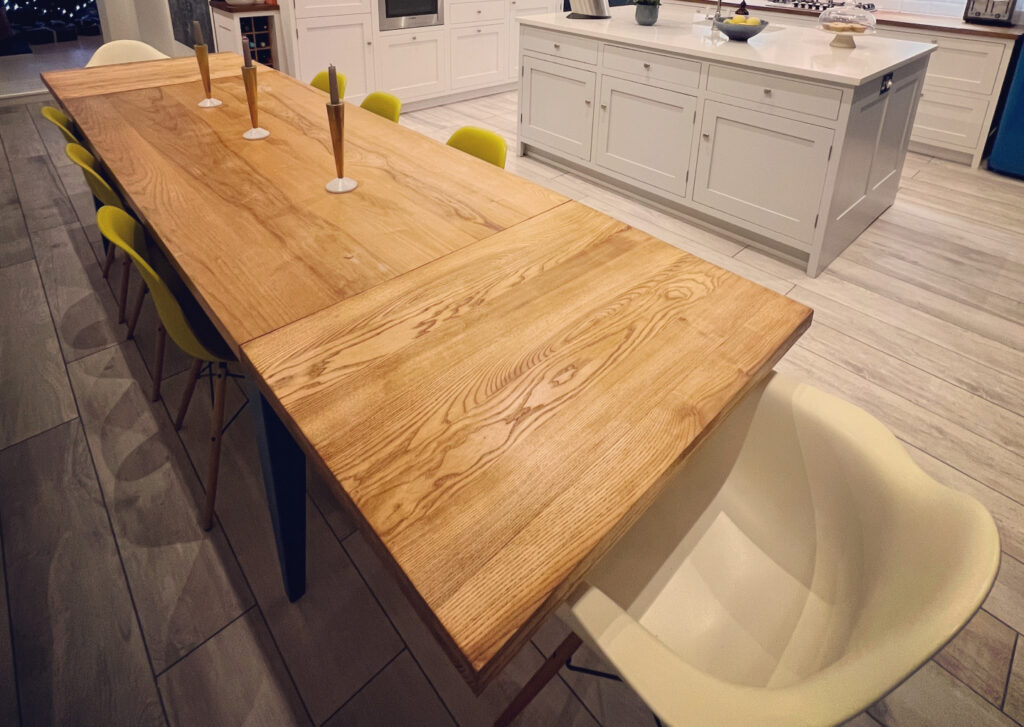
An AI photo of commercial-grade solid oak tables

Understand Why Mixed Tables Happen in the First Place

Mismatched tables are more common than most venue owners would like to admit. They tend to surface over time, especially in spaces that grow, adapt or shift their offering.

Some typical reasons for a mixed table line-up include:

  • Inherited furniture from previous tenants or pre-opening purchases
  • Expansion phases that added tables without revisiting design choices
  • Piecemeal replacement following damage or increased footfall
  • Budget constraints requiring reuse of what is available
  • Layout experiments in response to customer flow or seasonal changes

Left unchecked, these changes create a visual patchwork that feels unintentional. Tablets vary in height, colour, scale or finish, and the result resembles improvisation rather than composition.

By contrast, intentional mismatching can be functional and attractive, but only when it follows a visual logic. That logic does not require identical tables throughout, but it does rely on consistency in the right places.

Choose a Visual Anchor That Unifies the Space

Even with different shapes or styles, a repeated design cue can bring clarity to the room. The aim is not uniformity, but recognisable cohesion.

Common visual anchors include:

  • Consistent timber tone: Choosing tables in the same wood species or shade helps tie together variations in structure.
  • Matching finishes: A uniform oil or lacquer finish across tables makes the surface feel considered, even if the bases differ.
  • Similar leg colour or material: Powder-coated black steel legs, for example, can run across multiple styles and still feel coherent.
  • Edge profiles: A simple square edge or soft rounded finish repeated across tables will subtly link pieces together.
  • Unified table height: Discussed in the next section, but visually relevant when deciding anchors.

Lighting and flooring also affect how well these anchors hold. Tables placed below the same pendant or against the same floor material often read as related. Choose one primary visual connector, then build from there.

Pro Tip: Use a pendant light centred over each table group to draw visual boundaries in mixed table layouts.

Pro Tip: Always compare tabletop sheen levels under venue lighting before committing to a finish.

Standardise Table Heights and Proportions

Height mismatches do more than interrupt visual rhythm. They create functional problems. Guests may struggle to share food or move between surfaces smoothly. Staff may find cleaning or layout shifts more difficult.

To prevent this:

  • Measure all existing tables from floor to top surface. A 2cm difference may seem minor but becomes obvious when tables are adjacent.
  • Assess top thicknesses to balance visual proportions. A thick top on one side and a slim one opposite can look awkward in communal settings.
  • Use discreet risers or adjust bases to align heights. Many cafes and restaurants retrofit feet or select custom bases to correct this.
  • Consider bespoke tops made to match legacy bases. Workshops such as Tablemaker can produce solid wood tops sized and proportioned to fit families of different structures while equalising height and overhang.

Even if styles vary, consistent dimensions create usability and visual unity.

Use a Consistent Surface Material or Finish

Uniform surface material does much of the visual work in a mixed-table environment. Even if legs or shapes vary, our eyes register the continuous plane of a tabletop first.

Points to consider:

  • Use a single wood species for all surfaces. Oak is a common choice for its durability and tonal adaptability across settings.
  • Stick to one finish sheen. Whether matt or satin, the same level of light reflection across tops helps avoid a jumbled look.
  • Refinish existing tops where possible. Hardwax oils can be stripped and reapplied across different pieces, creating a shared finish even on previously mismatched items.
  • Install made-to-measure tops on existing bases that differ. Solid wood tops from workshops such as Tablemaker can unify varied tables while retaining useful features like cable grommets where needed.
  • Watch for uneven wear. Highly used surfaces may dull over time. A periodic refinishing cycle keeps tone and sheen consistent.

Matching tops across tables, even if subtle in difference, is one of the most effective strategies for cohesion.

Group Tables by Function or Zone

Spatial grouping is just as important as appearance. A well-zoned layout creates rhythm and avoids chaos.

Some grouping strategies include:

  • By table size or seating: Keep two-seaters separate from communal styles where possible.
  • By use pattern: If some tables are primarily for laptop users and others for diners, separate these zones to match their furniture styles.
  • By visual similarities: Cluster tables with matching tops or legs closer together.
  • By layout orientation: Tables facing the same direction or lined up in consistent ways will read as intentionally placed.
  • Allowing space between style shifts: Visually different tables can sit closer together if separated by planters, rugs or aisle space.

Sketching a plan of your venue can help to visualise these zones. Grouping by use as well as style often brings both practical and aesthetic clarity.

Plan a Table Refresh with Experts

Get tailored guidance on how to unify your table layout using finishes and custom pieces without full replacement.

Book a Consultation

Repeat Key Details Across Different Tables

Visual repetition works best in small doses. The average guest may not consciously notice each table leg or bevel, but the overall impression of harmony depends on these cues.

Repeatable details include:

  • Edge profiles: A rounded edge or flat chamfer used across several tables is quietly effective.
  • Corner radii: Uniform rounded corners give safety and consistency, especially when pushing tables together.
  • Leg angles or materials: Metal frames, turned wood or tapered legs, and identical, and create rhythm.
  • Top thickness: A uniform thickness looks cohesive even if the tables vary in size.
  • Hardware finish: Using black steel brackets or brushed brass bolts across tables ties disparate styles together.

Workshops can often replicate these details if given an example or sketch. Matching every detail is unnecessary, but repeating one or two across the set increases visual unity without overdesign.

Use Lighting and Accessories to Tie It All Together

Furnishings do not exist in isolation. The surrounding objects can help support cohesion even if the tables themselves differ.

Some accessories that create unity:

  • Overhead pendant lights centred over table groupings help define zones.
  • Identical placemats or runners across different tables offer surface consistency.
  • Coordinated seating such as matching chairs or upholstered benches softens visual variety in the tables.
  • Rugs under certain clusters signal grouping and dampen acoustic difference.
  • Shared tableware or serving vessels offer a unifying layer on the surface itself.

Accessories should not mask or overwhelm mismatched elements. Their purpose is to bridge gaps and reinforce what is already coherent, not distract from inconsistencies.

By planning your layout through function and visual logic, even a varied collection of tables can feel composed and purposeful. Cohesion often depends less on what the tables are, and more on how they are used, arranged and framed.

Custom Table Tops for a Cohesive Look

Bring consistency to your seating with made-to-measure solid wood tops designed to fit your existing bases.

Explore Custom Tops

Tablemaker

55 High St, London N8 7QB

02083416334

HVQM+58 London

 

Posted on

Commercial Table Refinishing: When Re-Oiling Works vs When You Need a Full Refinish

Commercial Table Refinishing When Re-Oiling Works vs When You Need a Full Refinish-Tablemaker

Commercial Table Refinishing: When Re-Oiling Works vs When You Need a Full Refinish

What is the difference between re-oiling a table and fully refinishing it?

Re-oiling is a maintenance step that refreshes the existing finish by replenishing surface oils, restoring sheen and feel. Refinishing is a more involved process that removes the old finish entirely through sanding, then reapplies a new one. The right choice depends on the condition of the table and the depth of the damage.

Table of Contents

An AI photo of a solid oak desk

Understanding the Basics: What Re-Oiling and Refinishing Actually Mean

Re-oiling and refinishing are often confused, but they serve very different functions. Understanding the distinction is key to protecting, restoring or extending the life of a commercial tabletop.

Re-oiling involves applying a fresh coat of oil, typically hardwax oil or similar, to a table that has become dry, dull or slightly worn. The existing finish remains intact, and the new oil simply fortifies what is already there. It does not alter the surface structure and requires only basic cleaning and light preparation beforehand.

Refinishing, by contrast, means stripping or sanding back the table surface to remove the original finish entirely. This is followed by a complete reapplication of protective oils or coatings. Refinishing addresses more detailed issues such as staining, top-layer discolouration or surface degradation.

A few common misconceptions blur the issue. Surface dullness is often mistaken for finish failure, leading people to overcorrect. Meanwhile, tables with deep damage are sometimes re-oiled repeatedly in the hope that lustre will return, which rarely helps.

Solid wood tables such as those made by Tablemaker respond well to either treatment, provided the right one is chosen. Unlike veneered MDF tops, solid wood can be sanded back several times and still retain integrity, which makes refinishing a viable long-term solution.

When Re-Oiling is Enough: Surface Wear, Not Structural Damage

Re-oiling is suitable for tables that show general signs of use but are otherwise in good condition. High-footfall venues, meeting rooms and cafés often notice stratified wear, where only the top layer of protection has worn away without penetrating the timber below.

A few indicators suggest that re-oiling is likely sufficient:

  1. The surface looks dry or feels slightly rough to the touch.
  2. The colour has faded slightly, with no major staining.
  3. Water no longer beads on the surface but instead soaks in slowly.
  4. There are no deep scratches, gouges or white water rings.
  5. The grain pattern is still visible and not masked by buildup or grime.

Hardwax oil finishes, commonly used by workshops such as Tablemaker, are designed with this maintenance process in mind. These finishes cure into the upper fibres of the wood while remaining workable, meaning they can be topped up locally or across the whole surface.

A simple water droplet test can be useful. If the droplet beads up neatly, the finish is still performing. If it absorbs immediately, a re-oil could be due. In commercial spaces, scheduling this as part of a quarterly care routine can help extend table life without the cost or disruption of refinishing.

Pro Tip: Always clean the surface thoroughly before re-oiling, as trapped debris can affect oil absorption.

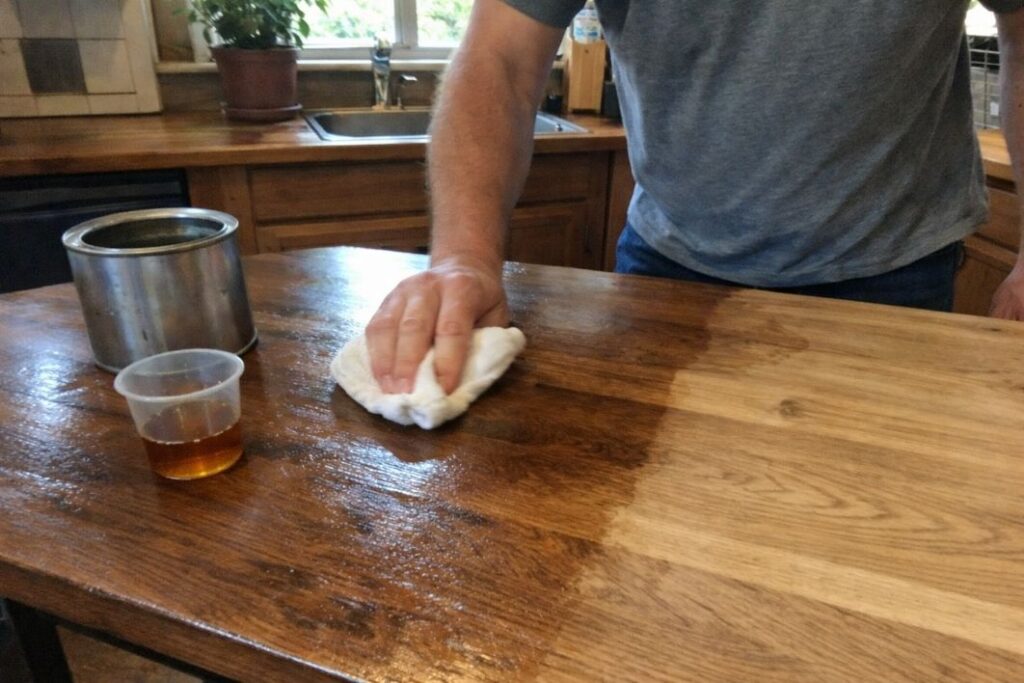
An AI photo displaying an oak table being treated

Pro Tip: Re-oil only in controlled conditions with low dust and stable temperatures to avoid uneven curing.

When Re-Oiling Won’t Work: More detailed Damage and Finish Failure

There are clear signs that re-oiling alone will not improve the table and might even trap problems underneath.

Watch for these conditions:

  • Dark stains or rings that have soaked deep into the wood: These cannot be lifted with oil. They require sanding and possibly spot treatment before refinishing.
  • Finish lifting or peeling: Oil cannot adhere to flaking areas and will not restore seal integrity.
  • Sticky or cloudy textures: This typically indicates finish degradation due to cleaning chemicals or moisture, which oiling will not neutralise.
  • Surface scratches that break the grain: Oiling may darken these marks, but it cannot disguise or seal them.
  • Patching or uneven absorbency: If some areas drink oil immediately while others resist, the surface structure has likely broken down.

In each case, sanding back to clean timber is necessary to restore an even, stable base. Repeated layers of oil without preparation can lead to dulling, buildup or uneven finish behaviour.

Surface Type Matters: Solid Wood vs Veneered Tops

Before deciding how to treat a table, it helps to know how it is constructed. Solid wood and veneer behave very differently under oil and sanding.

  • Solid wood: Can be re-oiled repeatedly and sanded back several times. Ideal for long-term use and repair cycles. The grain runs through the full thickness of the board.
  • Veneered MDF or chipboard: A thin wood layer is bonded to a lower-grade core. Sanding through the veneer exposes the substrate below, ruining the surface. Re-oiling is possible but has limited impact if the finish is worn through.

To check what you have:

  • Look at the edge of the tabletop. A continuous grain that wraps over the side typically indicates solid wood.
  • If a different material is visible at the edge or underneath, it may be veneer.
  • Tap the surface lightly. Veneer often sounds more hollow or uniform compared to the more resonant tone of solid timber.

Knowing your surface type helps avoid irreversible damage and allows for appropriate treatment planning.

Frequency and Context: How Usage Patterns Influence the Right Approach

Condition alone does not dictate whether re-oiling or refinishing is right. Usage patterns often matter more, especially in commercial settings.

High-traffic commercial tables, such as those in cafés, restaurants or coworking hubs, and take regular wear from moisture, heat, cleaning agents and constant use. They may require re-oiling every few months and full refinishing on a predictable schedule depending on exposure.

Home dining tables used for family meals and occasional entertaining rarely need refinishing, unless something unusual has occurred. Light re-oiling once or twice per year is often enough.

Desks and worktables, particularly those exposed to laptops, stationery, monitors or hot drinks, develop wear zones. Localised re-oiling may suffice, unless scratching or staining occurs.

Shared spaces can sometimes become over-maintained, with well-meaning intervention doing more harm than good. Knowing whether a stain is superficial or if the finish has reached its useful end helps guide the right response.

Context shapes the right approach far more than surface appearance alone.

Book a Workshop Assessment

Let our workshop assess your table to recommend the best route for longevity and appearance.

Arrange a Consultation

Tools, Time and Skill: What Each Option Involves Practically

The choice between re-oiling and refinishing often comes down to what is realistic given available tools, time, space and experience.

Re-Oiling: What You’ll Need

  • Soft lint-free cloth or sponge applicator
  • Suitable oil (usually hardwax oil or maintenance oil recommended by the original maker)
  • Light abrasive pad or high-grit sandpaper (optional)
  • Clean, dry environment free of dust

Basic re-oiling takes one to two hours including drying time, depending on environment. The process usually involves wiping on the oil, letting it absorb, and buffing off any excess.

Refinishing: What It Takes

  • Orbital sander with dust control
  • Selection of sanding grits (starting from coarse to fine)
  • Vacuum cleaner or air extraction
  • Clean cloths and oil finish system (primer, oil, optional wax)
  • Patience and ventilation

Refinishing is more demanding. Each sanding stage must be thorough and consistent across the surface to avoid patches. Dust must be fully removed. Oil layers may require overnight drying. The process can span several days in total, from prep to cure.

Refinishing is best attempted in a controlled space, not a busy kitchen or dining area. If equipment or confidence is lacking, involving a workshop is often the more efficient solution.

When to Involve a Workshop: Beyond Surface Fixes

Some situations extend well past maintenance and begin to require structural or functional decisions.

Professional workshop support may be warranted when:

  • The table is being resized, reshaped or adapted to fit a new use or frame.
  • Surface issues are paired with movement problems, such as cupping or warping.
  • The original finish or design needs to match new furniture or installation standards.
  • Multiple tables need coordinated attention, common in hospitality renovations.
  • There is long-term value in the piece that justifies proper restoration.

In such cases, workshops like Tablemaker can carry out full resurfacing, structural corrections and waterproofing upgrades. Visible straightening bars can be concealed or upgraded depending on requirements, and bases can be accounted for during redrilling or resizing.

A good workshop will assess what is salvageable, explain the proposed method plainly, and execute with materials consistent with the original construction. For commercial operators, this often means less downtime and a longer interval before the next intervention is needed.

Explore Hardwax Oil Options

Find out which oils are compatible with your table and suitable for commercial upkeep.

View Oil Products

Tablemaker

55 High St, London N8 7QB

02083416334

HVQM+58 London

 

Posted on

How to Choose Table Tops That Stay Stable Under Daily Heat Lamps and Hot Plates

How to Choose Table Tops That Stay Stable Under Daily Heat Lamps and Hot Plates-Tablemaker

How to Choose Table Tops That Stay Stable Under Daily Heat Lamps and Hot Plates

What makes a table top stable under constant heat exposure?

A stable table top in a heated environment combines the right wood, construction, finish and base compatibility. Solid hardwoods like oak, when joined with precision and protected with durable finishes, provide resistance to warping and discolouration, especially when paired with heat-aware mounting and thoughtful maintenance.

Table of Contents

An AI photo of a solid oak table being treated.

Heat Exposure and Solid Wood: What Actually Happens

Heat changes wood. It may not always be visible straight away, but over time, daily exposure to hot plates and overhead heat lamps can alter how solid wood behaves. Knowledge this helps explain why some table tops warp, crack or degrade while others remain stable.

Here is what happens when heat is applied:

  • Thermal expansion causes the fibres in the wood to stretch. Repeated heating and cooling can lead to distortion or cupping, especially if the grain direction is not aligned with the stress.
  • Moisture loss from heated air or direct contact dries the wood at the surface faster than the middle, increasing internal tension.
  • Surface checking (small cracks) or splits may form, particularly on poorly dried timber or coated finishes that don’t move with the wood.
  • Delamination is common with veneered boards, which separate from their base as heat weakens the adhesive layer.
  • Finish degradation, including bubbling, white rings or discolouration, tends to occur with heat-reactive coatings.

It is worth noting that ambient warmth is less damaging than direct heat. A table under a heat lamp for hours each day, or one that regularly holds hot pans, faces much greater stress than one placed in warm air.

Common misconceptions persist around hardwoods. While oak, ash and walnut are all durable, none are immune to heat improperly applied. Proper construction and finish choices matter just as much as wood selection.

Best Wood Species for Heat-Prone Table Tops

Oak remains one of the most reliable woods under thermal stress. Its density, grain structure and moisture retention balance make it a strong choice for both domestic and commercial settings.

Why oak performs well:

  • Dense and stable grain reduces excessive movement when exposed to fluctuating temperatures.
  • Consistent kiln-drying allows the wood to settle properly before fabrication.
  • Good surface resilience against marking from hot plates or pans.

Other possible choices include:

  • Ash, which is slightly more open-grained than oak but still adapts well when properly treated.
  • Walnut, which offers natural density though costs and softness may limit suitability for very high-use zones.

Softwoods, such as pine or fir, struggle under repeated heat due to lower density and a higher tendency to mark or deform.

Engineered boards with wood veneers should also be approached with caution. These products often delaminate or trap steam beneath surface layers, particularly when adhesive bonds weaken through exposure.

Pro Tip: Position heat lamps at least 30 cm above wooden tops to avoid uneven drying and surface damage.

An AI photo displaying a solid oak cafe table.

Pro Tip: Use rubber grommets between metal bases and wood to reduce heat transmission and stress cracks.

Construction Details That Keep a Table Top Flat

How a table top is built affects its ability to stay flat over time. Material choice is important, but construction errors can still lead to cupping, bowing or cracking.

Several practices support stability under repeated heat:

  • Full-stave boards, which use continuous strips of solid wood joined side by side, offer better long-grain stability than narrow offcuts or finger joints.
  • Straightening bars, made from wood or metal, are fitted beneath the top across the grain. These help counter expansion forces without restricting movement.
  • Grain direction is selected deliberately. Boards should run in a way that disperses tension evenly.
  • Floating components, rather than rigid glue fixings or screws, allow slight movement as wood naturally expands and contracts.

At Tablemaker, full-stave solid oak is used as standard, with straightening bars fitted on the underside of each top. These bars are removable and can be repositioned during mounting, which supports longevity and adjustability.

Edge-glued panels, especially from smaller offcuts or mixed grain directions, tend to struggle in heated conditions. Over time, these may warp even if the surface appears stable at first.

Choosing a Finish That Resists Heat

The final layer matters more than many realise. Even well-built and well-mounted tops can show signs of wear if the finish reacts poorly to daily heat.

Hardwax oil is a preferred finish for heat-exposed furniture. It penetrates the surface rather than sitting as a sealed layer. This allows the wood to breathe and move naturally while offering protection against common forms of damage.

Benefits of hardwax oil:

  • Resistant to peeling or bubbling when exposed to moderate heat.
  • Easy to maintain with spot repairs or full re-oiling.
  • Less likely to show heat rings from cups, bowls or equipment.

By contrast, sprayed lacquers and some polyurethane coatings often harden into layers that crack under expansion or show thermal blemishes.

Warning signs of poor finish performance include:

  • White rings or patches after using hot plates or leaving warm mugs.
  • Flaking at surface edges.
  • Dull or sticky patches where heat has softened the coating.

Tablemaker uses hardwax oil across its range due to its balance of protection and repairability. This keeps tops looking consistent even as they age.

Matching Your Table Top to the Heat Equipment

Not all heat is delivered the same way. Knowledge how your equipment works makes a noticeable difference in surface durability.

Heat-generating elements behave differently based on type, focus and installation:

  • Heat lamps produce radiant heat from above. Over time, they dry the top layer of wood unevenly if mounted too close.
  • Hot plates and warming trays apply direct heat. If left on for hours, they create intense thermal zones that strain grain structure.
  • Buffet setups often combine both, layering ambient and direct heat exposure.

To reduce risk:

  • Maintain sufficient clearance between heat lamps and wood surfaces. Mounting height should allow even dispersal, not concentrated hotspots.
  • Use heat diffusers or insulating pads under any electrical warming equipment that touches the wood.
  • Rotate surface items to prevent permanent heat zones in one area.

For commercial settings like cafés or hospitality counters, consistent awareness of these variables helps avoid long-term damage.

Order a Heat-Ready Table Top

Choose a handcrafted solid oak top built to perform under daily heat exposure across commercial or domestic environments.

View Table Top Options

Good Mounting: The Table Base Also Matters

Even the best top will suffer if mounted too rigidly or on a base that transmits heat inefficiently.

Important points to check include:

  • Allow movement: Solid wood expands and contracts. Fixings should let the top breathe. Expansion slots or floating mountings reduce stress.
  • Metal bases may conduct heat directly into the mounting zones. A thermal break, such as wooden cleats or rubber grommets, improves performance.
  • Flatness and support across the entire surface help prevent sagging or shifting over time.

Pre-drilled tops may seem convenient, but they can limit how the piece integrates with various frame types. Tablemaker supplies desk tops undrilled for this reason, allowing precise positioning based on each base.

A checklist for assessing base compatibility:

  1. Does the mounting method allow for seasonal movement?
  2. Is there a thermal barrier between the base and the underside of the wood?
  3. Are screws or fixings centred in slotted brackets, not tight holes?
  4. Is the support structure rigid across the full length?

Planning for Repair, Maintenance and Change

With regular heat being part of the environment, maintenance becomes an embedded requirement. The advantage of solid wood is that it can be renewed.

Signs that maintenance is needed include:

  • Dull or faded finishes
  • Slight cupping or unevenness at corners
  • Localised surface marks or stains

Fortunately, repair is usually straightforward:

  • Re-oiling restores lustre and re-seals the surface. This is typically needed once or twice a year in high-use areas.
  • Light sanding followed by fresh oil can erase minor scorch marks or heat damage.
  • Adjustable construction, such as removable straightening bars, allows corrections to be made if wood movement appears.

Modular designs also make it easier to adapt the furniture as surroundings change. For example, if a new piece of equipment is larger or hotter, the table top can be rehung or repositioned without complete replacement.

Investing in solid wood made with thermal awareness provides a long-lasting surface that can evolve with needs. With careful pairing and upkeep, even heat-intensive environments can be managed with confidence.

Request Custom Mounting Advice

Ensure optimal performance by getting expert guidance on heat-aware base mounting and top compatibility.

Get Mounting Support

Tablemaker

55 High St, London N8 7QB

02083416334

HVQM+58 London
 

Posted on

Resizing Existing Table Tops for a New Layout: What’s Possible and What Isn’t

Resizing Existing Table Tops for a New Layout What’s Possible and What Isn’t-Tablemaker

Resizing Existing Table Tops for a New Layout: What’s Possible and What Isn’t

Can an existing table top be resized to suit a new space or purpose?

Yes, many solid wood table tops can be resized to better fit a new layout or use, but the feasibility depends entirely on the original construction, materials and how much change is required. Not all tops are suitable, and those that are must be handled with care to avoid damage or loss of functionality.

Table of Contents

Why Resize a Table Top?

Circumstances change. A table that once felt right in one space may no longer suit a new room, a different base, or an altered purpose. Resizing offers a way to adapt rather than replace, though it is not always straightforward or cost-saving.

Reasons people consider resizing include:

  • Moving to a smaller or differently shaped room
  • Swapping to a new leg system or base with different fixing points
  • Shifting use from dining to office, or shared to individual use
  • Maintaining a piece that has sentimental value, such as a family table
  • Improving proportions that never quite felt right from the start

In some instances, resizing is driven by appearance, with the aim of better alignment to a space or aesthetic. In others, it is purely practical, especially if workspace clearance or seating comfort is affected. Understanding which of these applies is key before looking at whether resizing is even possible.

What Can Be Resized: Materials and Construction That Allow It

Not all table tops can be trimmed down safely. Those that can tend to follow a few shared build characteristics.

Solid wood Full-thickness, solid hardwood tops are the most suitable candidates. These can usually be reduced in size with care, while retaining strength and functionality. Oak is commonly used due to its stability and ability to be reworked over time.

Full-stave or wide-plank construction Tops made from long, continuous staves are typically better suited for alteration than those using finger-jointed or laminated layers, which may delaminate or behave unpredictably when cut.

Simple edge profiles A squared or lightly bevelled edge can be replicated or cleaned up more easily than ornate or deeply rounded edges. Consistency along the perimeter is important for both aesthetics and tactility.

Grain direction aligned for movement control Grain should run consistently along the length or width. This allows reshaping without disturbing natural wood behaviour. Tablemaker, for example, aligns grain for structural stability and includes straightening bars to help resist warping and cupping.

Here is a short checklist of construction types likely to be suitable:

  1. Solid wood (oak, ash, walnut) in full-stave format
  2. No major inlays or integrated features
  3. Edges with simple profiles that can be re-created
  4. Tops at least 20mm thick for trimming and re-finishing
  5. Straightening bars that can be removed and refitted

If a table meets these standards, resizing is often workable with the right tools and experience.

Pro Tip: Always measure your new space fully before considering resizing, including doorways and clearances, to confirm fit.

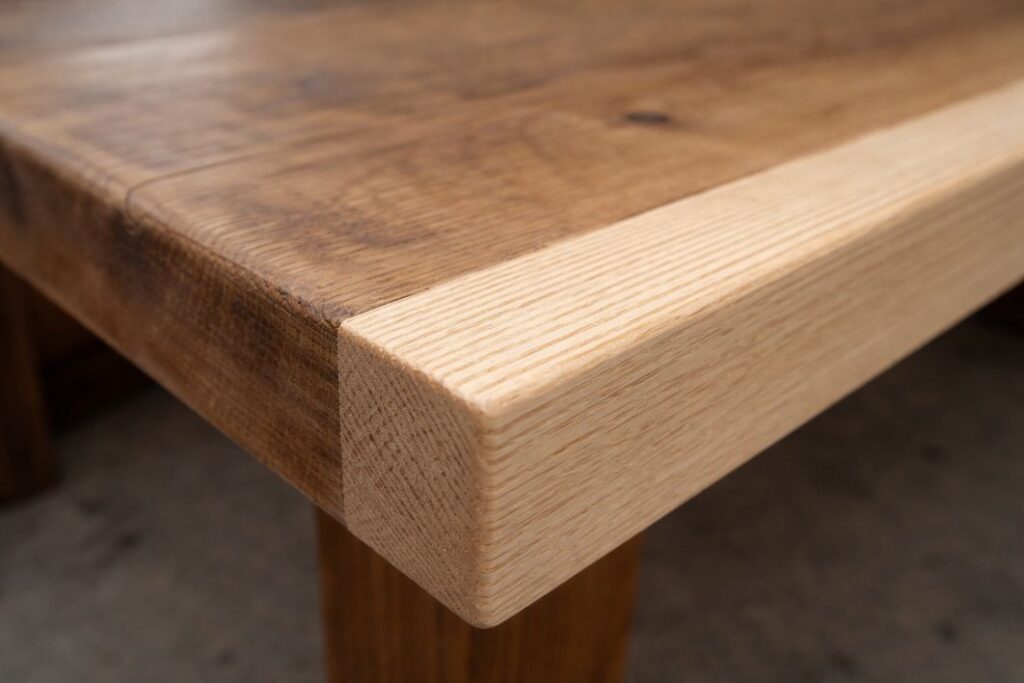
An AI photo displaying a solid oak table edge

Pro Tip:For consistent visual results, request sample finishes to test how new cuts will blend with your existing top.

What Can’t Be Resized: Limits Set by Design and Use

Some tops are simply not built for resizing. Attempting to do so can damage the piece or leave it unsuitable for use.

Non-resizable features and materials include:

  • Veneered MDF or chipboard: These often have a thin wood layer over a particle core. Cutting them risks splintering and exposing the raw middle, which does not accept finishing or moisture well.
  • Live edge designs: Trimming a live edge undermines the key visual appeal and balance of the piece.
  • Integrated features like cable ports or resin inlays: Resizing may misalign these features or render them unusable.
  • Prefixed mounting systems: Tops that rely on embedded or obscured fixings can be difficult or impossible to reconfigure without weakening the structure.
  • Edge detail too complex to replicate: Hand-carved or multiple-profile edges can become asymmetrical or mismatched after cutting.

In any of these cases, a table top may need to be preserved as-is or replaced entirely. Recognising these limits early prevents unnecessary risk and expense.

How Much Can You Resize? Practical Size Constraints

Even with a solid wood top, there are limits to how much material can be removed without creating issues with function or appearance.

Key constraints include:

  • Minimum depth and width: Dining tables benefit from a surface depth of at least 80cm for central serving space, while desks typically require at least 60cm for monitor and keyboard use.
  • Edge symmetry: Removing too much from one edge can make the piece look unbalanced. Aim to size down from all sides evenly if possible.
  • Legroom and overhang: Reductions can impact how chairs fit, especially if the base is fixed and legs no longer align well with the new proportions.
  • Thickness loss: Cutting and refinishing often removes up to 5mm from the outer edge. Tables under 20mm thick after resizing may feel or look insubstantial.
  • Straightening bar refitting: Some tops rely on internal bracing to stay flat. Resizing must factor in refitting these at appropriate points, or the surface may warp over time.

It is worth noting that visual balance matters just as much as function. A table that technically fits in a room may still feel undersized if the scale is off relative to other furniture or architectural features.

Get a Table Top Resizing Assessment

Unsure if your current table can be resized? Our team will evaluate the construction and condition before advising next steps.

Request Assessment

What Tools and Expertise Are Required?

Resizing a table top is a skilled task. While it might seem similar to cutting a shelf to length, the risks are far greater. Precision, stability, and surface quality are all important.

Professional workshops use:

  • Track saws or cabinet saws for straight, clean cuts
  • Edge planers to true up the perimeter after cutting
  • Orbital sanders and grain matching tools for blending the exposed areas
  • Colour-matched hardwax oils to blend any refinished areas with the original surface

Beyond the refinishing itself, understanding of wood movement and bracing is necessary to maintain the top’s long-term shape. This includes refitting straightening bars or resupporting the base if fixings shift due to the new size.

Attempting this work without the right experience risks:

  • Ravelling the veneer or pulling fibres unevenly
  • Creating unsquare edges that affect how the table sits or feels
  • Mismatched finishes that are visible in certain light
  • Warping due to improper sealing or bracing

At Tablemaker, resizing projects are treated as custom commissions. Each adjustment is assessed based on the table’s structure, use case, and expected handling over time.

What Happens to the Finish and Edges?

Changing the size of a table top means interrupting its surface and finish. These elements are restorable, but not always to their original state.

Finish Most solid wood tops are protected with hardwax oil, which penetrates the grain while leaving a natural texture. When edges are cut, the bare wood must be re-oiled to match the rest of the surface. While colour and sheen can be closely approximated, perfect blending is not always possible due to age, wear and light exposure on the original finish.

Edge profile Replicating a simple bevel or chamfer is usually straightforward. However, if the table had a non-standard or heavily sculpted edge, a perfect match may not be feasible, especially if machinery used in the original build is no longer accessible.

Colour and grain Cut edges reveal fresh grain, which can appear lighter until oxidised or oiled. Over time, exposed cuts will mellow, but initial colour contrast is a reality. For some clients, this marks a welcome sign of the table’s evolution. For others, it may be a distraction.

Typical outcomes that are restorable:

  • Edge finish and protection
  • General surface sheen uniformity
  • Structural integrity

Outcomes that are harder to match exactly:

  • Colour tone at newly exposed edges
  • Specific grain or texture pattern
  • Unique wear patterns and patina

When Is It Better to Replace Than Resize?

Resizing offers flexibility, but replacement is sometimes the more logical route. Knowing when to start fresh can save time, expense and ongoing frustration.

Reasons to consider replacement:

  • Cost similarity: Labour and refinishing involved in resizing can approach or exceed the price of a new top, especially for straightforward configurations.
  • Design opportunity: A new top can be sized, proportioned and adapted more precisely to its intended use or space.
  • Material upgrade: Swapping a softwood or veneer top for solid hardwood may improve longevity and usability.
  • Functional rethink: Changes in use, such as moving from casual dining to office work, often come with new ergonomic or storage needs best served by a redesign.
  • Preserving the original table elsewhere: In some cases, the current table may be better kept intact and relocated to another space, while a new table is created for the new fit.

Tablemaker often supports clients through this decision by discussing both resize potential and replacement advantages, depending on the construction and use case.

Ultimately, the best route is the one that respects both the table’s qualities and the user’s needs going forward. Whether resized or renewed, the goal is a piece that functions well and lasts for years to come.

Explore Custom Table Top Options

 If resizing is not viable, we can design and build a new top to your exact size, use, and finish preferences.

Start Custom Design

Tablemaker

55 High St, London N8 7QB

02083416334

HVQM+58 London
 

Posted on

Best Table Top Edge Profiles for Busy Venues (Comfort, Durability, Cleaning Reality)

Best Table Top Edge Profiles for Busy Venues (Comfort, Durability, Cleaning Reality)-Tablemaker

Best Table Top Edge Profiles for Busy Venues (Comfort, Durability, Cleaning Reality)

Which edge profiles are most suitable for high-traffic venues like cafés and restaurants?

The most suitable edge profiles for high-traffic venues prioritise comfort, long-term durability and ease of cleaning. While the visual finish matters, function tends to dominate these settings due to intensive daily use and frequent contact from both staff and guests.

Practical impact of edge profiles in busy venues

In a busy café or restaurant, each table might be wiped clean over 30 times in a single day, while edges face constant contact from trays, chairs and guests’ clothing. This frequency of use reveals limitations that might not be obvious in a showroom or domestic setting.

Edge profiles directly influence:

  • Wear resistance: Rounded or angled edges tend to mask wear better than crisp corners, which are prone to chipping.
  • Comfort: Arm placement, chair movement and cleaning all interact with the edge, especially in close quarters.
  • Cleaning efficiency: Crevices or sharp transitions can trap debris or resist cloth glides, slowing routine upkeep.
  • Visual perception: A softer edge can come across as more informal or accessible, which may suit venues aiming for a relaxed feel.

Edge details are often overlooked, yet their performance plays a central role in the usability and upkeep of commercial surfaces.

Table of Contents

An AI photo of a commercial-grade solid oak table

Square Edge: Clean Look, Hard Corners

The square edge offers a sharp, modern profile that pairs well with minimal or industrial interiors.

Pros:

  • Clear, defined lines that create a contemporary look
  • Flat sides make surface cleaning straightforward

Cons:

  • Corners are vulnerable to chipping, even with solid wood
  • Elbows, thighs and tray edges frequently come into hard contact
  • Less forgiving when chairs or stools knock into table sides

Square edges may suit fixed wall-mounted tables or counters with limited direct contact. Where aesthetics must take precedence and wear is lower, it remains a valid choice. Tablemaker can reinforce corners where needed to mitigate common impact points.

Radius Edge: Softened for Safety and Comfort

In a setting where children might run past tables or where staff move quickly between close-set seats, rounded edges offer peace of mind. A radius profile softens both the top and underside of the edge, removing harsh angles.

Functional benefits include:

  • Reduced risk of knocks or grazes for guests and staff
  • Easier cloth glide during cleaning, with no sharp corners
  • Improved resistance to visible wear on high-contact points
  • Widely compatible with family-oriented or informal venues

A smaller radius retains a relatively structured feel, while a larger radius leans toward a more casual and softened presence. Tablemaker can adjust the radius to suit both look and utility.

Some buyers may view this as less refined than a crisp square finish. However, when comfort, speed and safety guide the brief, the radius edge is often the most balanced option.

Pro Tip: In tight seating layouts, avoid undercut profiles like sharknose to reduce the risk of lower limb knocks.

An AI photo displaying various solid oak cafe tables.

Pro Tip: For venues with rapid table turnover, a radius or hybrid edge can cut down daily cleaning time significantly.

Chamfer Edge: Subtle Angles, Mixed Results

A chamfer is an angled cut along the edge, typically about 30 to 45 degrees, which eases the transition between horizontal and vertical planes.

Benefits:

  • Visually reduces the thickness of a table top
  • Slightly softer to the touch than sharp edges
  • Feels refined while remaining relatively subtle

Limitations:

  • Can wear quickly at the angled plane if heavily impacted
  • Not all chamfers are equal, depth and angle vary widely
  • May hinder cleaning if cloths snag or skip over the bevel

Chamfers work well in formal dining settings or commercial interiors where table turnover is lower and presentation is important. Tablemaker adjusts chamfer depths to balance visual simplicity with daily use considerations.

Bullnose Edge: Fully Rounded, Fully Practical?

Imagine the edge of the table smoothed like a river-worn stone, rounded all the way from top to bottom. That image captures the bullnose profile.

Pros:

  • Exceptionally forgiving on bumps, knocks and grazes
  • Comfortable for seated users and high-contact environments
  • Good fit for education spaces, informal dining or family pubs

Cons:

  • Food and residue may collect beneath the underside curve
  • Traditional styling may not suit modern or linear interiors
  • Cleaning requires more attention to follow the curve fully

For comfort-first venues, particularly those catering to children or high seating turnover, bullnose edges have ongoing value. Tablemaker offers adaptations with reduced curvature to balance visual weight and practicality, especially where a fully rounded edge might appear overly soft.

Request a Bespoke Table Edge Design

Our team can tailor edge profiles to suit your venue’s layout, safety needs and cleaning routines.

Enquire Now

Sharknose Edge: Sleek but Serviceable?

The sharknose profile creates a dramatic, undercut bevel on the underside of the edge. Visually, it gives the illusion that the table top is floating, especially when viewed side-on.

Advantages:

  • Creates a refined, architectural appearance
  • Reduces visual thickness of heavier tops

Drawbacks:

  • Underside angle can bruise knees or shins in tight spaces
  • Cleaning cloths struggle to reach the full undercut
  • Delicate edge may be more exposed to chips or scuffs

This profile belongs in lower-contact environments or where visual impact outweighs operational practicality. It can work for statement pieces, reception counters or quiet lounges. Tablemaker can produce modified versions that soften the underside cut to improve access and reduce edge fragility.

Custom Hybrid Profiles: Matching Use to Context

Standard options do not always meet the needs of complex or compact spaces. Some venues benefit from edge profiles that blend characteristics to suit their specific workflow, layout or audience.

Hybrid solutions may include:

  • A radius top with a chamfered underside for comfort and clarity
  • Shallow bevels that reduce sharp transitions without compromising cleaning
  • Profiles tuned to match custom bases or minimise wall proximity gaps

Tablemaker specialises in adapting edge designs to real-world layouts, such as shared workspaces, joined tables or rooms with architectural constraints. The aim is not unnecessary challenge, but a precise function, edges that meet context with purpose.

In spaces where clients move through frequently, where bags might scrape past or where cleaning routines must be quick and thorough, these seemingly small adjustments make day-to-day operations smoother and safer.

Explore Commercial Table Top Options

Browse our table top finishes and edge styles made for busy cafés, pubs and restaurants.

View Range

Tablemaker

55 High St, London N8 7QB

02083416334

HVQM+58 London


Posted on

The Commercial Table Top Ordering Checklist: Measurements, Edge, Finish, Fixing

The Commercial Table Top Ordering Checklist Measurements, Edge, Finish, Fixing-Tablemaker

The Commercial Table Top Ordering Checklist: Measurements, Edge, Finish, Fixing

What must you consider before ordering a commercial table top?

To ensure your commercial table top fits, functions and lasts, you need to plan carefully across several dimensions. These include accurate measurements, edge selection, finish type, fixing method and allowances for solid wood behaviour. Each choice affects performance, appearance and ease of installation.

Table of Contents

An AI photo of a commercial-grade solid oak table

Confirming the Right Measurements for Your Space and Base

In high-traffic environments, measurements are non-negotiable. A few centimetres in either direction can mean the difference between efficient movement and persistent bottlenecks.

Before ordering, check the following:

  1. Table footprint: Measure both length and width based on available floor space, including nearby fixtures and access routes.
  2. Overhang and legroom: Ensure enough space for legs and chairs. Aim for 30cm of overhang on long sides when seating is planned.
  3. Clearances: Allow at least 90cm walkway behind seated diners in restaurants or cafés, and 120cm in areas used for circulation or accessibility.
  4. Base compatibility: Compare the footprint and fixing points of your base with the intended top dimensions.
  5. Seating vs. spacing: A six-seater setup may demand different dimensions in a co-working space than it does in a casual bistro.

Commercial layouts often require more precise planning than domestic ones. Fixed seating, shared working zones and fire regulations leave little room for guesswork. Where off-the-shelf increments do not sit comfortably within your available space, made-to-measure tops provide important flexibility.

Choosing the Right Edge Profile for Function and Feel

Edge selection is not just aesthetic; it shapes how a table feels in use and how it performs over time.

Common options include:

  • Square edge Pros: Clean modern look, precise lines. Cons: Sharper corner feel, more prone to knocks.
  • Chamfered edge Pros: Softens the visual weight, offers chip resistance. Cons: Slightly more complex to clean along the angle.
  • Rounded edge (radius or bullnose) Pros: Safer in public or child-friendly spaces, smooth to touch. Cons: More relaxed appearance may not suit all interiors.
  • Bevelled edge Pros: Adds refinement without bulk, reduces edge wear. Cons: Less tactile for high-traffic environments.

In a busy café, where tables are cleaned regularly and moved often, a chamfered or rounded edge reduces impact and wear. In a quieter workspace, a square or bevelled edge might suit minimal visual setups while maintaining usability. Consider how the table will be used, cleaned and approached daily.

Pro Tip: Use paper templates cut to size in your space to visualise overhang and movement areas before confirming table dimensions.

An AI photo displaying a solid oak table edge comparison

Pro Tip: If reusing an existing base, photograph the mounting points and bring dimensions to consultation to avoid misalignment issues later.

Selecting a Finish That Withstands Commercial Use

Finish influences appearance, yes, but more critically it governs how the wood responds over time.

Comparison of common finishes:

  • Hardwax oil Resists spills, allows spot repairs, food safe. Suited to cafés, restaurants and offices needing cleanable yet repairable surfaces.
  • Lacquer Glossy or matte, forms a protective film. Tough initial barrier but harder to renew locally once damaged.
  • Polyurethane Highly water-resistant, plastic-like finish. Durable but often non-breathable, which can trap moisture and reduce repair options.

Many commercial clients expect water resistance but find later that a scratch or stained patch may require full refinishing. Hardwax oil achieves a practical balance, offering solid protection alongside the option to renew specific areas without heavy equipment or downtime. Tablemaker applies this finish as standard for that reason. It performs well while respecting the material beneath.

Understand Fixing Options and Base Compatibility

How your table top is secured to its base matters more than many expect. Poor fixing can result in cupping, instability or limits on future reuse.

Common methods include:

  • Brackets: Often used with metal frames, these secure directly into the underside but may limit movement if positioned incorrectly.
  • Threaded inserts: Allow for repeat fixings and reassembly, useful for relocatable furniture or modular layouts.
  • Straightening bars: Supplied with many Tablemaker tops, these counteract wood movement. They may also influence where fixings can be placed.

Undrilled tops are often preferred in commercial contexts because they can be matched to existing or non-standard bases on site. Drilling in advance without precise base data risks misalignment or weakening the structure. Compatibility checks should happen early, especially if using a third-party frame or reusing existing bases.

Before ordering, check:

  1. Base size and mounting point positions
  2. Intended fixing method
  3. Movement allowance needs
  4. Whether the base accommodates straightening bars
  5. Delivery of top and base in the correct sequence for safe fitting

Factoring in Wood Movement and Stability Over Time

Solid wood tables respond to humidity and temperature. This is not a fault but a characteristic of the material.

How movement is managed:

  1. Grain direction is chosen to support long-term stability.
  2. Kiln-dried timber lowers the risk of excessive expansion.
  3. Straightening bars help resist cupping, especially on wider tops.
  4. Finish choice impacts moisture protection without sealing the wood too tightly.
  5. Fixing allowances are important to enable natural expansion and contraction.

Warpage concerns often arise when tops are rigidly fixed with no room to shift. This is especially problematic in heating-rich or air-conditioned interiors. Simply understanding that solid wood will move, and planning for it, avoids most issues before they occur.

Explore Made to Measure Table Tops

Choose a size, finish and edge profile that fits your exact space and specification. Designed and built for high-traffic commercial use.

Browse Made to Measure

Matching Table Tops to Commercial Use Cases

Every setting places different demands on a table top. What suits a fast-turnover coffee shop may not suit a shared hot-desk setup.

Use cases compared:

  • Café / Restaurant: Needs a durable, easy-clean top with edge protection. A 32mm thickness gives a sturdy impression. Hardwax oil suits frequent wipe-downs.
  • Co-working / Offices: Prioritises leg space, cable clearance and minimal edges that allow for close seating. Rounded or bevelled edges improve comfort. Tops must work with sit-stand frames or mobile legs.
  • Formal dining venues: Often choose wider tops with generous overhangs. A bevelled or square edge maintains visual definition without being aggressive.
  • Multi-use spaces: Flexibility and easy repositioning matter most. Lighter finishes and standard base compatibilities become desirable.

Thickness plays both structural and visual roles. A 26mm or 32mm board offers strength and heft. For longer spans or thicker looks, tops at 36mm or above may suit, especially where presence matters.

Clarifying Lead Times, Delivery and Installation Readiness

Made-to-order furniture demands a little planning. Nearly all Tablemaker commercial orders are produced and delivered within two to three weeks, but the whole process benefits from early clarity.

To prepare for installation:

  1. Confirm base specifications and ensure they arrive on time.
  2. Measure access routes including lifts, doorways and stairwells.
  3. Arrange suitable storage if installation will not happen immediately.
  4. Decide who is responsible for drilling and fixing on site.
  5. Inform delivery contacts about commercial access issues or timing restrictions.

Undrilled tops mean greater adaptability but do require forethought. Installation is smoother when fixing methods are decided in advance, particularly when using bespoke or imported bases. If a table is needed for an event or opening, build in margin for fixing and levelling.

Few businesses enjoy surprises during a fit out. Accurate information, shared early, prevents delay and damage, making the entire process smoother from workshop to workspace.

Talk to a Specification Adviser

Unsure about measurements, fixing or finish? Our team can guide your order to ensure perfect fit and lasting performance.

Request a Consultation

Tablemaker

55 High St, London N8 7QB

02083416334

HVQM+58 London

 

Posted on

Hot-Desking Surfaces: What Specs Matter When Desks Get Abused Daily

Hot-Desking Surfaces What Specs Matter When Desks Get Abused Daily-Tablemaker

Hot-Desking Surfaces: What Specs Matter When Desks Get Abused Daily

What physical demands do hot-desking surfaces face that affect their durability?

Hot-desking surfaces endure constant turnover, unpredictable use, and minimal personal responsibility, which exposes them to more wear and stress compared to private desks. This includes frequent cleaning, varied mounting frames, and near-daily interactions that cumulatively affect desk longevity.

Table of Contents

An AI photo of a commercial-grade solid oak desk top

What Hot-Desking Surfaces Actually Endure

Shared desks are often judged by how they look in a showroom, but the reality in use is far less forgiving. Facilities managers often find that surfaces fail not from one major event, but from persistent, low-level stress.

Here are some of the most common wear patterns in hot-desking setups:

  • High-frequency contact: Users slide laptops, bags, and coffee cups across the surface repeatedly throughout the day. Unlike a personal desk, there is no consistent handling that slows wear.
  • Mixed mounting environments: Sit-stand frames, clamp-on accessories or monitor arms apply varied stress to the surface, especially when multiple users adjust them in different ways.
  • Daily cleaning routines: Sanitising wipes, alcohol sprays and general wet cleaning slowly degrade finishes not built to cope with them. Glossy or plastic-like coatings often show streaking or degrade unevenly.
  • Impersonal use: Users typically show less care than they might with personal furniture. That translates into more dropped items, increased edge bangs and improperly mounted peripherals.

Office layouts with floating or repositionable desks introduce additional pressures, including frequent reconnections to different frames or loosely fitted mounts. Over time, screw holes may widen, edges may fray and finish layers may peel, particularly on thinner or synthetic surfaces.

Why Solid Wood Outlasts Veneers

First impressions can be misleading. Veneered chipboard or MDF might appear similar to solid wood when new but respond differently after six months of constant use.

Solid wood tops offer advantages that go beyond appearance:

  • Repairability: Scratches, dents and edge dings can be sanded back and refinished. Veneer, which is often less than 1mm thick, won’t tolerate this.
  • Moisture resilience: Wood reacts to spills by absorbing into the grain, which can be addressed through refinishing. Veneers typically bubble or delaminate.
  • Longevity under impact: Solid boards, especially full-stave sections, handle repeated knocks better and show graceful wear rather than sudden material failure.
  • Grain behaviour: With correct construction techniques such as grain orientation and drying standards, solid wood resists warping more effectively in varying conditions.

The perception that all wood is soft or vulnerable overlooks how different grades and cuts perform. Oak, for example, combines strength with the capacity to be resurfaced repeatedly. This makes solid wood desk tops suitable for shared spaces, where surface integrity matters every day rather than only at point of delivery.

Pro Tip: Avoid mounting hot-desking tops with fixed drill holes unless you are certain the frame style will remain unchanged long term.

An AI photo displaying various solid oak desks.

Pro Tip: A desk top with rounded corners or edge radius can significantly reduce visible wear and damage from repeated multi-user contact.

Surface Finish: Protection Without Plasticity

The ideal finish in a hot-desking environment needs to protect without forming a hard, non-repairable shell. Tablemaker uses hardwax oil on its desk surfaces for this reason.

Compared to polyurethane or lacquer, a hardwax oil:

  • Penetrates into the wood instead of sitting on top
  • Is less prone to cracking or peeling under cleaning routines
  • Can be refreshed in sections without fully stripping the surface

This means that after the inevitable coffee spill or scuff from a metal laptop stand, the damage can often be corrected without removing the desk from use. Recoating is typically a light-touch process that preserves function and appearance.

A finish with a lower sheen also distributes surface reflection more evenly, making finger marks or scratch paths less visible. In offices where cleaning is regular but not always gentle, avoiding a plasticky buildup helps maintain a consistent look over time.

Thickness and Stability: Why Millimetres Matter

Desk tops under hot-desking conditions are rarely treated gently. They support equipment, absorb friction, and span variable gaps between frame points. Structure becomes just as important as surface.

Thickness For commercial or high-turnover use, anything under 22mm may eventually flex, especially on wider tops. Tablemaker offers tops beginning at 22mm but often supplies 25mm or thicker for sit-stand compatibility and heavier use.

Straightening bars Longer or more detailed tops benefit from additional support beneath the grain. Tablemaker fits wooden or metal straightening bars to stabilise the top without compromising its ability to move naturally with seasonal changes.

Grain direction Orientation is chosen for both look and performance. Boards are joined to minimise differential movement, reducing the chance of cupping or bowing that can occur in unstable humidity conditions.

Mounting stress When tops are attached to adjustable frames, uneven distribution of weight and torque can result in gradual distortion. Reinforcement combined with appropriate thickness helps resist this over time.

Structural integrity is invisible but important. Thickness and grain alignment directly influence lifespan in unsupervised, multi-user conditions.

Mounting Compatibility: Undrilled Isn’t an Oversight

In shared work environments, desks may need to be re-mounted multiple times over a year. Yet factory-drilled holes can become a source of future problems when frames change.

Tablemaker supplies desk tops undrilled as a deliberate measure to support reuse and precision. This avoids:

  • Faulty alignment: Pre-drilled holes rarely match varied frame designs, especially for sit-stand bases or custom setups.
  • Weakening over time: Screws reused in the same poor-fit holes can strip or fail to hold.
  • Constraint during maintenance: A top can’t be rotated or moved to even out wear patterns if locked into a fixed drill pattern.

Compatibility also includes features like cable trays, clamps, and data units. Offices change configurations more frequently than they used to. An undrilled top extends the lifespan and allows facility teams to decide when and how to mount.

For hot-desking setups, flexibility extends beyond the staff. The fixtures need to adapt without causing damage.

Discuss a Custom Desk Project

Speak to our team about your hot-desking needs and see how we can create surfaces suited to your exact space and usage.

Start Your Project

Size and Shape: Fitting the Space, Not Just the Frame

Mass-produced desk sizes rarely account for radiators, wall gaps, uneven alcoves or cable management. Shared spaces demand more than standard dimensions.

Custom sizing helps avoid issues such as:

  • Clearance issues behind monitors due to wall proximity
  • Clashing with window handles or sockets in tight layouts
  • Inaccessibility caused by oversized depth or poor leg clearance

Tablemaker offers sizing in 1cm increments, which supports creative layouts and shared benches that feel intentional rather than improvised. Tabletops can also be shaped to account for pipe cutouts, curved walls or corner skews.

Common adjustments include:

  • Reducing depth while maintaining width for laptop-only zones
  • Angle-cut corners to allow passage in narrow corridors
  • Slotting for cable trays or capability access grommets

The better a surface fits its environment, the less likely it is to suffer accidental damage, tipping or disuse. In hot-desking setups, fit contributes directly to function.

When Desks Can Be Refinished, Not Replaced

Hot-desking surfaces wear fast because no one user owns the wear. The best answer is not perfection, but reversibility.

Refinishing allows worn or scratched surfaces to be sanded back and restored. Compared with the cost of full replacement, this represents a significant saving over time, especially when factored across multiple desks in commercial settings.

For example:

  • A full desk replacement may cost several hundred pounds and take weeks to coordinate.
  • A professional re-oil or sand-back can often be completed in a few hours at a fraction of the cost.

Solid wood, particularly oak, supports this cycle. Tablemaker’s workshop sees many surfaces return after five to ten years for a full resurface, not because they failed, but because re-use was prioritised over waste.

In procurement and sustainability planning, the ability to restore is no longer a bonus. It is a responsible baseline for any surface expected to endure daily, indifferent use. A well-made, well-fitted, repairable surface is not just an object. It is an asset.

Request a Sample Finish

Unsure how our finishes hold up? Request a sample to see the texture and durability in your own hands before you commit.

Request a Sample

Tablemaker

55 High St, London N8 7QB

02083416334

HVQM+58 London