

Commercial Table Refinishing: When Re-Oiling Works vs When You Need a Full Refinish
What is the difference between re-oiling a table and fully refinishing it?
Re-oiling is a maintenance step that refreshes the existing finish by replenishing surface oils, restoring sheen and feel. Refinishing is a more involved process that removes the old finish entirely through sanding, then reapplies a new one. The right choice depends on the condition of the table and the depth of the damage.
Table of Contents
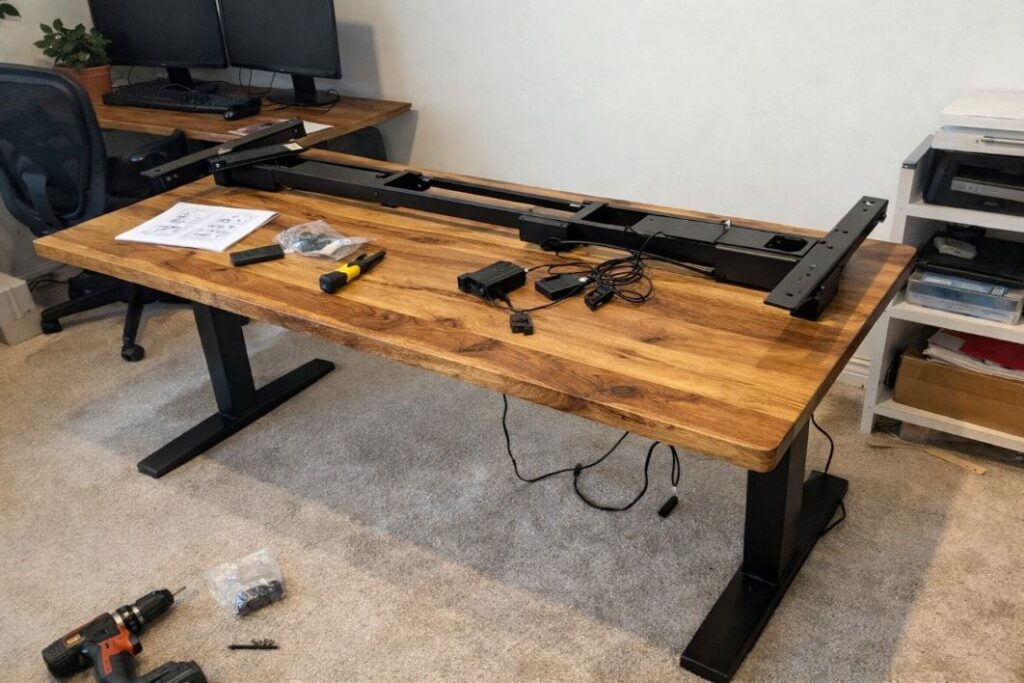
An AI photo of a solid oak desk
Understanding the Basics: What Re-Oiling and Refinishing Actually Mean
Re-oiling and refinishing are often confused, but they serve very different functions. Understanding the distinction is key to protecting, restoring or extending the life of a commercial tabletop.
Re-oiling involves applying a fresh coat of oil, typically hardwax oil or similar, to a table that has become dry, dull or slightly worn. The existing finish remains intact, and the new oil simply fortifies what is already there. It does not alter the surface structure and requires only basic cleaning and light preparation beforehand.
Refinishing, by contrast, means stripping or sanding back the table surface to remove the original finish entirely. This is followed by a complete reapplication of protective oils or coatings. Refinishing addresses more detailed issues such as staining, top-layer discolouration or surface degradation.
A few common misconceptions blur the issue. Surface dullness is often mistaken for finish failure, leading people to overcorrect. Meanwhile, tables with deep damage are sometimes re-oiled repeatedly in the hope that lustre will return, which rarely helps.
Solid wood tables such as those made by Tablemaker respond well to either treatment, provided the right one is chosen. Unlike veneered MDF tops, solid wood can be sanded back several times and still retain integrity, which makes refinishing a viable long-term solution.
When Re-Oiling is Enough: Surface Wear, Not Structural Damage
Re-oiling is suitable for tables that show general signs of use but are otherwise in good condition. High-footfall venues, meeting rooms and cafés often notice stratified wear, where only the top layer of protection has worn away without penetrating the timber below.
A few indicators suggest that re-oiling is likely sufficient:
- The surface looks dry or feels slightly rough to the touch.
- The colour has faded slightly, with no major staining.
- Water no longer beads on the surface but instead soaks in slowly.
- There are no deep scratches, gouges or white water rings.
- The grain pattern is still visible and not masked by buildup or grime.
Hardwax oil finishes, commonly used by workshops such as Tablemaker, are designed with this maintenance process in mind. These finishes cure into the upper fibres of the wood while remaining workable, meaning they can be topped up locally or across the whole surface.
A simple water droplet test can be useful. If the droplet beads up neatly, the finish is still performing. If it absorbs immediately, a re-oil could be due. In commercial spaces, scheduling this as part of a quarterly care routine can help extend table life without the cost or disruption of refinishing.
Pro Tip: Always clean the surface thoroughly before re-oiling, as trapped debris can affect oil absorption.
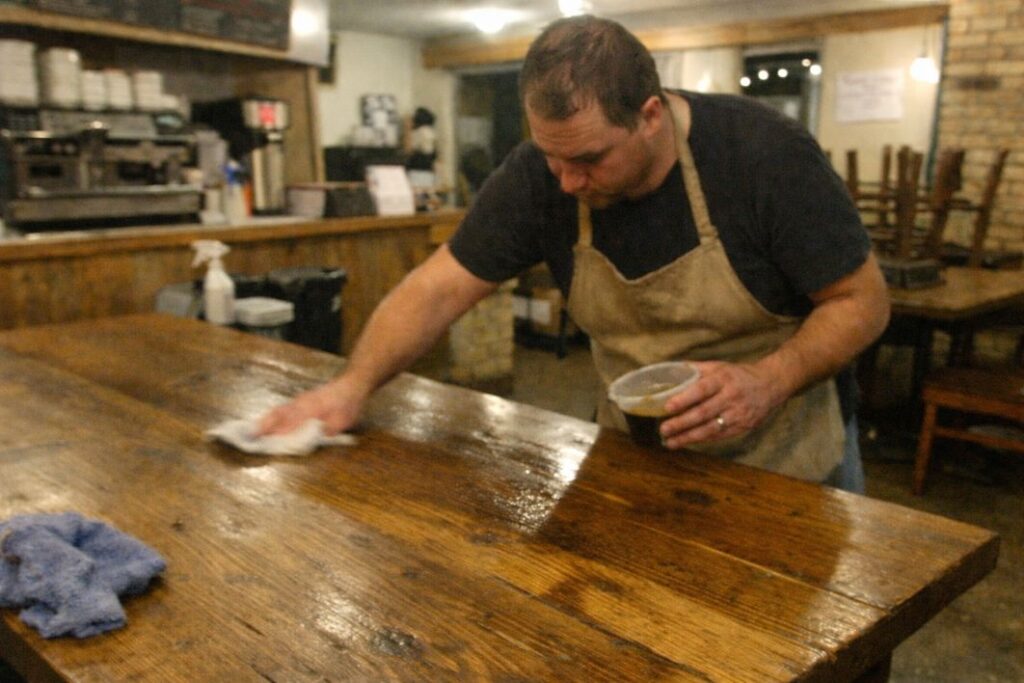
An AI photo displaying an oak table being treated
Pro Tip: Re-oil only in controlled conditions with low dust and stable temperatures to avoid uneven curing.
When Re-Oiling Won’t Work: More detailed Damage and Finish Failure
There are clear signs that re-oiling alone will not improve the table and might even trap problems underneath.
Watch for these conditions:
- Dark stains or rings that have soaked deep into the wood: These cannot be lifted with oil. They require sanding and possibly spot treatment before refinishing.
- Finish lifting or peeling: Oil cannot adhere to flaking areas and will not restore seal integrity.
- Sticky or cloudy textures: This typically indicates finish degradation due to cleaning chemicals or moisture, which oiling will not neutralise.
- Surface scratches that break the grain: Oiling may darken these marks, but it cannot disguise or seal them.
- Patching or uneven absorbency: If some areas drink oil immediately while others resist, the surface structure has likely broken down.
In each case, sanding back to clean timber is necessary to restore an even, stable base. Repeated layers of oil without preparation can lead to dulling, buildup or uneven finish behaviour.
Surface Type Matters: Solid Wood vs Veneered Tops
Before deciding how to treat a table, it helps to know how it is constructed. Solid wood and veneer behave very differently under oil and sanding.
- Solid wood: Can be re-oiled repeatedly and sanded back several times. Ideal for long-term use and repair cycles. The grain runs through the full thickness of the board.
- Veneered MDF or chipboard: A thin wood layer is bonded to a lower-grade core. Sanding through the veneer exposes the substrate below, ruining the surface. Re-oiling is possible but has limited impact if the finish is worn through.
To check what you have:
- Look at the edge of the tabletop. A continuous grain that wraps over the side typically indicates solid wood.
- If a different material is visible at the edge or underneath, it may be veneer.
- Tap the surface lightly. Veneer often sounds more hollow or uniform compared to the more resonant tone of solid timber.
Knowing your surface type helps avoid irreversible damage and allows for appropriate treatment planning.
Frequency and Context: How Usage Patterns Influence the Right Approach
Condition alone does not dictate whether re-oiling or refinishing is right. Usage patterns often matter more, especially in commercial settings.
High-traffic commercial tables, such as those in cafés, restaurants or coworking hubs, and take regular wear from moisture, heat, cleaning agents and constant use. They may require re-oiling every few months and full refinishing on a predictable schedule depending on exposure.
Home dining tables used for family meals and occasional entertaining rarely need refinishing, unless something unusual has occurred. Light re-oiling once or twice per year is often enough.
Desks and worktables, particularly those exposed to laptops, stationery, monitors or hot drinks, develop wear zones. Localised re-oiling may suffice, unless scratching or staining occurs.
Shared spaces can sometimes become over-maintained, with well-meaning intervention doing more harm than good. Knowing whether a stain is superficial or if the finish has reached its useful end helps guide the right response.
Context shapes the right approach far more than surface appearance alone.
Book a Workshop Assessment
Let our workshop assess your table to recommend the best route for longevity and appearance.
Arrange a ConsultationTools, Time and Skill: What Each Option Involves Practically
The choice between re-oiling and refinishing often comes down to what is realistic given available tools, time, space and experience.
Re-Oiling: What You’ll Need
- Soft lint-free cloth or sponge applicator
- Suitable oil (usually hardwax oil or maintenance oil recommended by the original maker)
- Light abrasive pad or high-grit sandpaper (optional)
- Clean, dry environment free of dust
Basic re-oiling takes one to two hours including drying time, depending on environment. The process usually involves wiping on the oil, letting it absorb, and buffing off any excess.
Refinishing: What It Takes
- Orbital sander with dust control
- Selection of sanding grits (starting from coarse to fine)
- Vacuum cleaner or air extraction
- Clean cloths and oil finish system (primer, oil, optional wax)
- Patience and ventilation
Refinishing is more demanding. Each sanding stage must be thorough and consistent across the surface to avoid patches. Dust must be fully removed. Oil layers may require overnight drying. The process can span several days in total, from prep to cure.
Refinishing is best attempted in a controlled space, not a busy kitchen or dining area. If equipment or confidence is lacking, involving a workshop is often the more efficient solution.
When to Involve a Workshop: Beyond Surface Fixes
Some situations extend well past maintenance and begin to require structural or functional decisions.
Professional workshop support may be warranted when:
- The table is being resized, reshaped or adapted to fit a new use or frame.
- Surface issues are paired with movement problems, such as cupping or warping.
- The original finish or design needs to match new furniture or installation standards.
- Multiple tables need coordinated attention, common in hospitality renovations.
- There is long-term value in the piece that justifies proper restoration.
In such cases, workshops like Tablemaker can carry out full resurfacing, structural corrections and waterproofing upgrades. Visible straightening bars can be concealed or upgraded depending on requirements, and bases can be accounted for during redrilling or resizing.
A good workshop will assess what is salvageable, explain the proposed method plainly, and execute with materials consistent with the original construction. For commercial operators, this often means less downtime and a longer interval before the next intervention is needed.
Explore Hardwax Oil Options
Find out which oils are compatible with your table and suitable for commercial upkeep.
View Oil Products
Tablemaker
55 High St, London N8 7QB
02083416334
HVQM+58 London