
Resizing Existing Table Tops for a New Layout: What’s Possible and What Isn’t
Can an existing table top be resized to suit a new space or purpose?
Yes, many solid wood table tops can be resized to better fit a new layout or use, but the feasibility depends entirely on the original construction, materials and how much change is required. Not all tops are suitable, and those that are must be handled with care to avoid damage or loss of functionality.
Table of Contents
Why Resize a Table Top?
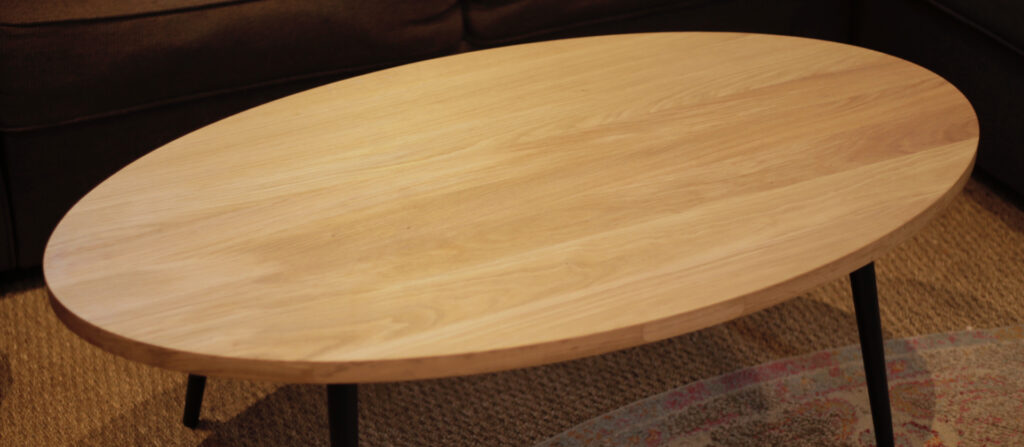
Circumstances change. A table that once felt right in one space may no longer suit a new room, a different base, or an altered purpose. Resizing offers a way to adapt rather than replace, though it is not always straightforward or cost-saving.
Reasons people consider resizing include:
- Moving to a smaller or differently shaped room
- Swapping to a new leg system or base with different fixing points
- Shifting use from dining to office, or shared to individual use
- Maintaining a piece that has sentimental value, such as a family table
- Improving proportions that never quite felt right from the start
In some instances, resizing is driven by appearance, with the aim of better alignment to a space or aesthetic. In others, it is purely practical, especially if workspace clearance or seating comfort is affected. Understanding which of these applies is key before looking at whether resizing is even possible.
What Can Be Resized: Materials and Construction That Allow It
Not all table tops can be trimmed down safely. Those that can tend to follow a few shared build characteristics.
Solid wood Full-thickness, solid hardwood tops are the most suitable candidates. These can usually be reduced in size with care, while retaining strength and functionality. Oak is commonly used due to its stability and ability to be reworked over time.
Full-stave or wide-plank construction Tops made from long, continuous staves are typically better suited for alteration than those using finger-jointed or laminated layers, which may delaminate or behave unpredictably when cut.
Simple edge profiles A squared or lightly bevelled edge can be replicated or cleaned up more easily than ornate or deeply rounded edges. Consistency along the perimeter is important for both aesthetics and tactility.
Grain direction aligned for movement control Grain should run consistently along the length or width. This allows reshaping without disturbing natural wood behaviour. Tablemaker, for example, aligns grain for structural stability and includes straightening bars to help resist warping and cupping.
Here is a short checklist of construction types likely to be suitable:
- Solid wood (oak, ash, walnut) in full-stave format
- No major inlays or integrated features
- Edges with simple profiles that can be re-created
- Tops at least 20mm thick for trimming and re-finishing
- Straightening bars that can be removed and refitted
If a table meets these standards, resizing is often workable with the right tools and experience.
Pro Tip: Always measure your new space fully before considering resizing, including doorways and clearances, to confirm fit.
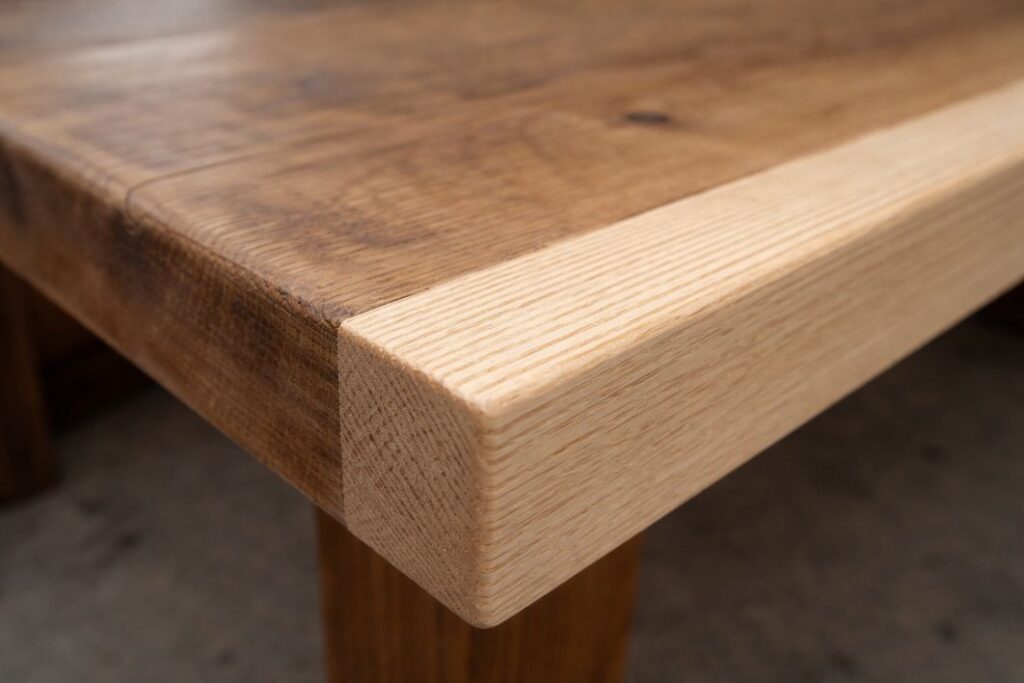
An AI photo displaying a solid oak table edge
Pro Tip:For consistent visual results, request sample finishes to test how new cuts will blend with your existing top.
What Can’t Be Resized: Limits Set by Design and Use
Some tops are simply not built for resizing. Attempting to do so can damage the piece or leave it unsuitable for use.
Non-resizable features and materials include:
- Veneered MDF or chipboard: These often have a thin wood layer over a particle core. Cutting them risks splintering and exposing the raw middle, which does not accept finishing or moisture well.
- Live edge designs: Trimming a live edge undermines the key visual appeal and balance of the piece.
- Integrated features like cable ports or resin inlays: Resizing may misalign these features or render them unusable.
- Prefixed mounting systems: Tops that rely on embedded or obscured fixings can be difficult or impossible to reconfigure without weakening the structure.
- Edge detail too complex to replicate: Hand-carved or multiple-profile edges can become asymmetrical or mismatched after cutting.
In any of these cases, a table top may need to be preserved as-is or replaced entirely. Recognising these limits early prevents unnecessary risk and expense.
How Much Can You Resize? Practical Size Constraints
Even with a solid wood top, there are limits to how much material can be removed without creating issues with function or appearance.
Key constraints include:
- Minimum depth and width: Dining tables benefit from a surface depth of at least 80cm for central serving space, while desks typically require at least 60cm for monitor and keyboard use.
- Edge symmetry: Removing too much from one edge can make the piece look unbalanced. Aim to size down from all sides evenly if possible.
- Legroom and overhang: Reductions can impact how chairs fit, especially if the base is fixed and legs no longer align well with the new proportions.
- Thickness loss: Cutting and refinishing often removes up to 5mm from the outer edge. Tables under 20mm thick after resizing may feel or look insubstantial.
- Straightening bar refitting: Some tops rely on internal bracing to stay flat. Resizing must factor in refitting these at appropriate points, or the surface may warp over time.
It is worth noting that visual balance matters just as much as function. A table that technically fits in a room may still feel undersized if the scale is off relative to other furniture or architectural features.
Get a Table Top Resizing Assessment
Unsure if your current table can be resized? Our team will evaluate the construction and condition before advising next steps.
Request AssessmentWhat Tools and Expertise Are Required?
Resizing a table top is a skilled task. While it might seem similar to cutting a shelf to length, the risks are far greater. Precision, stability, and surface quality are all important.
Professional workshops use:
- Track saws or cabinet saws for straight, clean cuts
- Edge planers to true up the perimeter after cutting
- Orbital sanders and grain matching tools for blending the exposed areas
- Colour-matched hardwax oils to blend any refinished areas with the original surface
Beyond the refinishing itself, understanding of wood movement and bracing is necessary to maintain the top’s long-term shape. This includes refitting straightening bars or resupporting the base if fixings shift due to the new size.
Attempting this work without the right experience risks:
- Ravelling the veneer or pulling fibres unevenly
- Creating unsquare edges that affect how the table sits or feels
- Mismatched finishes that are visible in certain light
- Warping due to improper sealing or bracing
At Tablemaker, resizing projects are treated as custom commissions. Each adjustment is assessed based on the table’s structure, use case, and expected handling over time.
What Happens to the Finish and Edges?
Changing the size of a table top means interrupting its surface and finish. These elements are restorable, but not always to their original state.
Finish Most solid wood tops are protected with hardwax oil, which penetrates the grain while leaving a natural texture. When edges are cut, the bare wood must be re-oiled to match the rest of the surface. While colour and sheen can be closely approximated, perfect blending is not always possible due to age, wear and light exposure on the original finish.
Edge profile Replicating a simple bevel or chamfer is usually straightforward. However, if the table had a non-standard or heavily sculpted edge, a perfect match may not be feasible, especially if machinery used in the original build is no longer accessible.
Colour and grain Cut edges reveal fresh grain, which can appear lighter until oxidised or oiled. Over time, exposed cuts will mellow, but initial colour contrast is a reality. For some clients, this marks a welcome sign of the table’s evolution. For others, it may be a distraction.
Typical outcomes that are restorable:
- Edge finish and protection
- General surface sheen uniformity
- Structural integrity
Outcomes that are harder to match exactly:
- Colour tone at newly exposed edges
- Specific grain or texture pattern
- Unique wear patterns and patina
When Is It Better to Replace Than Resize?
Resizing offers flexibility, but replacement is sometimes the more logical route. Knowing when to start fresh can save time, expense and ongoing frustration.
Reasons to consider replacement:
- Cost similarity: Labour and refinishing involved in resizing can approach or exceed the price of a new top, especially for straightforward configurations.
- Design opportunity: A new top can be sized, proportioned and adapted more precisely to its intended use or space.
- Material upgrade: Swapping a softwood or veneer top for solid hardwood may improve longevity and usability.
- Functional rethink: Changes in use, such as moving from casual dining to office work, often come with new ergonomic or storage needs best served by a redesign.
- Preserving the original table elsewhere: In some cases, the current table may be better kept intact and relocated to another space, while a new table is created for the new fit.
Tablemaker often supports clients through this decision by discussing both resize potential and replacement advantages, depending on the construction and use case.
Ultimately, the best route is the one that respects both the table’s qualities and the user’s needs going forward. Whether resized or renewed, the goal is a piece that functions well and lasts for years to come.
Explore Custom Table Top Options
If resizing is not viable, we can design and build a new top to your exact size, use, and finish preferences.
Start Custom Design
Tablemaker
55 High St, London N8 7QB
02083416334
HVQM+58 London