

Hot-Desking Surfaces: What Specs Matter When Desks Get Abused Daily
What physical demands do hot-desking surfaces face that affect their durability?
Hot-desking surfaces endure constant turnover, unpredictable use, and minimal personal responsibility, which exposes them to more wear and stress compared to private desks. This includes frequent cleaning, varied mounting frames, and near-daily interactions that cumulatively affect desk longevity.
Table of Contents
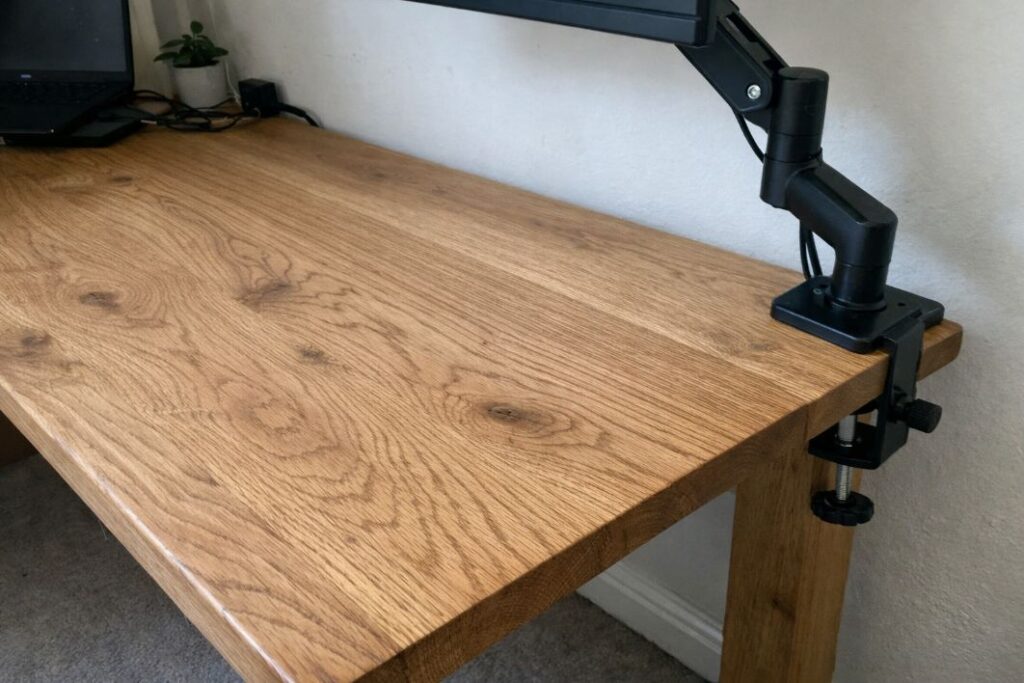
An AI photo of a commercial-grade solid oak desk top
What Hot-Desking Surfaces Actually Endure
Shared desks are often judged by how they look in a showroom, but the reality in use is far less forgiving. Facilities managers often find that surfaces fail not from one major event, but from persistent, low-level stress.
Here are some of the most common wear patterns in hot-desking setups:
- High-frequency contact: Users slide laptops, bags, and coffee cups across the surface repeatedly throughout the day. Unlike a personal desk, there is no consistent handling that slows wear.
- Mixed mounting environments: Sit-stand frames, clamp-on accessories or monitor arms apply varied stress to the surface, especially when multiple users adjust them in different ways.
- Daily cleaning routines: Sanitising wipes, alcohol sprays and general wet cleaning slowly degrade finishes not built to cope with them. Glossy or plastic-like coatings often show streaking or degrade unevenly.
- Impersonal use: Users typically show less care than they might with personal furniture. That translates into more dropped items, increased edge bangs and improperly mounted peripherals.
Office layouts with floating or repositionable desks introduce additional pressures, including frequent reconnections to different frames or loosely fitted mounts. Over time, screw holes may widen, edges may fray and finish layers may peel, particularly on thinner or synthetic surfaces.
Why Solid Wood Outlasts Veneers
First impressions can be misleading. Veneered chipboard or MDF might appear similar to solid wood when new but respond differently after six months of constant use.
Solid wood tops offer advantages that go beyond appearance:
- Repairability: Scratches, dents and edge dings can be sanded back and refinished. Veneer, which is often less than 1mm thick, won’t tolerate this.
- Moisture resilience: Wood reacts to spills by absorbing into the grain, which can be addressed through refinishing. Veneers typically bubble or delaminate.
- Longevity under impact: Solid boards, especially full-stave sections, handle repeated knocks better and show graceful wear rather than sudden material failure.
- Grain behaviour: With correct construction techniques such as grain orientation and drying standards, solid wood resists warping more effectively in varying conditions.
The perception that all wood is soft or vulnerable overlooks how different grades and cuts perform. Oak, for example, combines strength with the capacity to be resurfaced repeatedly. This makes solid wood desk tops suitable for shared spaces, where surface integrity matters every day rather than only at point of delivery.
Pro Tip: Avoid mounting hot-desking tops with fixed drill holes unless you are certain the frame style will remain unchanged long term.

An AI photo displaying various solid oak desks.
Pro Tip: A desk top with rounded corners or edge radius can significantly reduce visible wear and damage from repeated multi-user contact.
Surface Finish: Protection Without Plasticity
The ideal finish in a hot-desking environment needs to protect without forming a hard, non-repairable shell. Tablemaker uses hardwax oil on its desk surfaces for this reason.
Compared to polyurethane or lacquer, a hardwax oil:
- Penetrates into the wood instead of sitting on top
- Is less prone to cracking or peeling under cleaning routines
- Can be refreshed in sections without fully stripping the surface
This means that after the inevitable coffee spill or scuff from a metal laptop stand, the damage can often be corrected without removing the desk from use. Recoating is typically a light-touch process that preserves function and appearance.
A finish with a lower sheen also distributes surface reflection more evenly, making finger marks or scratch paths less visible. In offices where cleaning is regular but not always gentle, avoiding a plasticky buildup helps maintain a consistent look over time.
Thickness and Stability: Why Millimetres Matter
Desk tops under hot-desking conditions are rarely treated gently. They support equipment, absorb friction, and span variable gaps between frame points. Structure becomes just as important as surface.
Thickness For commercial or high-turnover use, anything under 22mm may eventually flex, especially on wider tops. Tablemaker offers tops beginning at 22mm but often supplies 25mm or thicker for sit-stand compatibility and heavier use.
Straightening bars Longer or more detailed tops benefit from additional support beneath the grain. Tablemaker fits wooden or metal straightening bars to stabilise the top without compromising its ability to move naturally with seasonal changes.
Grain direction Orientation is chosen for both look and performance. Boards are joined to minimise differential movement, reducing the chance of cupping or bowing that can occur in unstable humidity conditions.
Mounting stress When tops are attached to adjustable frames, uneven distribution of weight and torque can result in gradual distortion. Reinforcement combined with appropriate thickness helps resist this over time.
Structural integrity is invisible but important. Thickness and grain alignment directly influence lifespan in unsupervised, multi-user conditions.
Mounting Compatibility: Undrilled Isn’t an Oversight
In shared work environments, desks may need to be re-mounted multiple times over a year. Yet factory-drilled holes can become a source of future problems when frames change.
Tablemaker supplies desk tops undrilled as a deliberate measure to support reuse and precision. This avoids:
- Faulty alignment: Pre-drilled holes rarely match varied frame designs, especially for sit-stand bases or custom setups.
- Weakening over time: Screws reused in the same poor-fit holes can strip or fail to hold.
- Constraint during maintenance: A top can’t be rotated or moved to even out wear patterns if locked into a fixed drill pattern.
Compatibility also includes features like cable trays, clamps, and data units. Offices change configurations more frequently than they used to. An undrilled top extends the lifespan and allows facility teams to decide when and how to mount.
For hot-desking setups, flexibility extends beyond the staff. The fixtures need to adapt without causing damage.
Discuss a Custom Desk Project
Speak to our team about your hot-desking needs and see how we can create surfaces suited to your exact space and usage.
Start Your ProjectSize and Shape: Fitting the Space, Not Just the Frame
Mass-produced desk sizes rarely account for radiators, wall gaps, uneven alcoves or cable management. Shared spaces demand more than standard dimensions.
Custom sizing helps avoid issues such as:
- Clearance issues behind monitors due to wall proximity
- Clashing with window handles or sockets in tight layouts
- Inaccessibility caused by oversized depth or poor leg clearance
Tablemaker offers sizing in 1cm increments, which supports creative layouts and shared benches that feel intentional rather than improvised. Tabletops can also be shaped to account for pipe cutouts, curved walls or corner skews.
Common adjustments include:
- Reducing depth while maintaining width for laptop-only zones
- Angle-cut corners to allow passage in narrow corridors
- Slotting for cable trays or capability access grommets
The better a surface fits its environment, the less likely it is to suffer accidental damage, tipping or disuse. In hot-desking setups, fit contributes directly to function.
When Desks Can Be Refinished, Not Replaced
Hot-desking surfaces wear fast because no one user owns the wear. The best answer is not perfection, but reversibility.
Refinishing allows worn or scratched surfaces to be sanded back and restored. Compared with the cost of full replacement, this represents a significant saving over time, especially when factored across multiple desks in commercial settings.
For example:
- A full desk replacement may cost several hundred pounds and take weeks to coordinate.
- A professional re-oil or sand-back can often be completed in a few hours at a fraction of the cost.
Solid wood, particularly oak, supports this cycle. Tablemaker’s workshop sees many surfaces return after five to ten years for a full resurface, not because they failed, but because re-use was prioritised over waste.
In procurement and sustainability planning, the ability to restore is no longer a bonus. It is a responsible baseline for any surface expected to endure daily, indifferent use. A well-made, well-fitted, repairable surface is not just an object. It is an asset.
Request a Sample Finish
Unsure how our finishes hold up? Request a sample to see the texture and durability in your own hands before you commit.
Request a Sample
Tablemaker
55 High St, London N8 7QB
02083416334
HVQM+58 London