
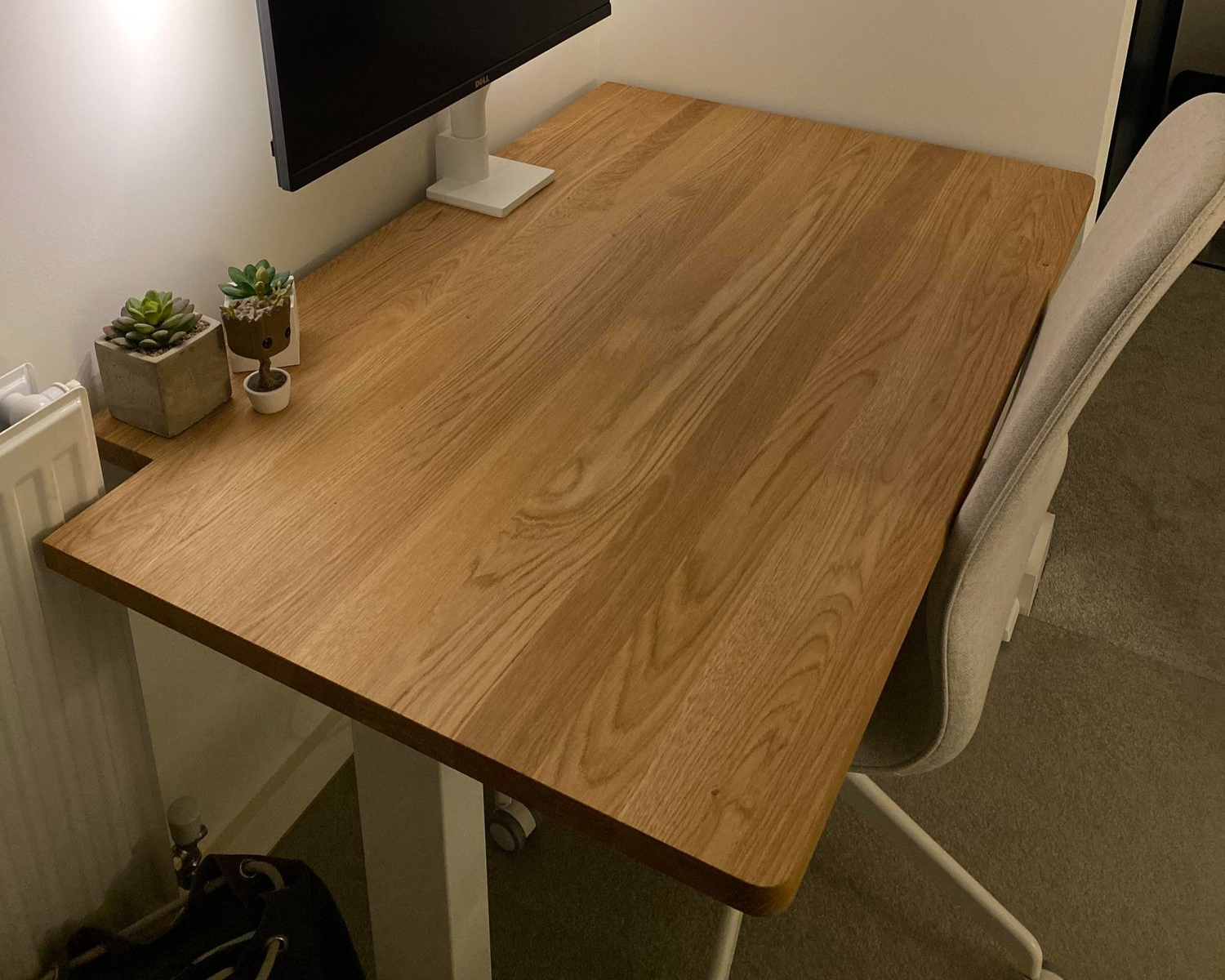
What is the real difference between a UK workshop desk top and a retailer desk top?
Yes, it can be worth buying a desk top from a UK workshop if size, material, lifespan or compatibility matter to you. A big retailer often suits straightforward, budget-led purchases, whereas a workshop-made desk top usually offers better material transparency, more flexible sizing and a surface that can be repaired instead of replaced.
Table of Contents
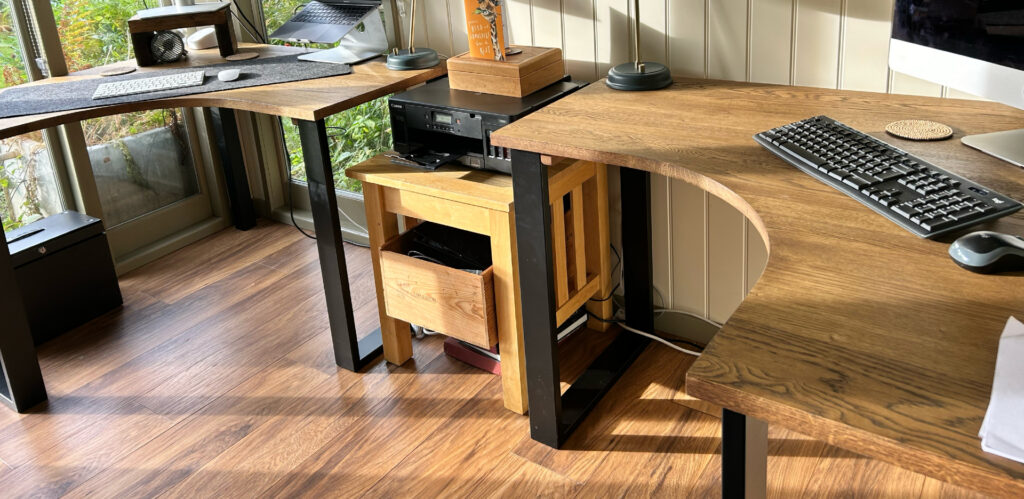
Understanding the Real Differences Between UK Workshop and Retailer Desk Tops
A desk top from a large retailer and one from a UK woodworking workshop can look similar in a product photo. The meaningful differences usually appear in the material, the way the top is built, the sizes available and what happens after a few years of use.
Here is the simplest way to compare them:
- Big retailers often sell standardised desk tops in fixed sizes, commonly made from veneered MDF, particleboard or laminated board.
- UK-made desk tops from workshops are more likely to be offered in solid wood, custom sizing and specifications that suit an existing frame or room.
- Mass-produced desk tops tend to be built for consistency at scale.
- Bespoke desk tops are usually built around a use case, such as a sit-stand frame, a narrow alcove or a dining table base being reused as a desk.
Perceived value can be misleading. A lower price at the start does not always mean lower overall cost, and a higher initial price does not always mean excess. If you need a top in a very specific width, want solid wood instead of MDF, or expect to keep the desk for years, the comparison shifts from simple price to practical fit and service life.
British manufacturing standards also shape the buying experience. A workshop is more likely to explain timber choice, finish, mounting method and expected wood movement in plain terms. Retail listings often focus on colour, dimensions and assembly, which suits many buyers, but leaves less room for adaptation.
Material Choices and Construction: What Lasts, What Doesn’t
A desk top is a bit like a door. A solid, well-built one feels stable in daily use, ages in a predictable way and can often be restored. A thinner panel with a decorative outer layer may look tidy at first, but damage usually goes more detailed than appearance because the surface is harder to repair.
Solid wood vs. MDF is the core distinction in many cases. A solid oak desk top, or one made from another hardwood, can usually be sanded and refinished if it picks up stains, scratches or wear. Veneered MDF has a thin real-wood layer over an engineered core, so repair options are more limited. Once the veneer is damaged through its depth, there is less material to work with.
Construction details matter just as much as material. In a good workshop build, you may see features such as:
- full-stave solid wood construction
- grain direction chosen with stability in mind
- straightening bars fitted across the grain to reduce cupping
- a hardwax oil finish that can be maintained and renewed
Wood movement is part of the picture, not a fault. Solid timber responds to changes in humidity, which means that careful joinery and sensible mounting are part of long-term performance. A workshop that understands desk top construction in the UK will usually talk openly about this, especially for wider tops or tops used in heated rooms with dry winter air.
Daily use brings these differences into focus. A mug mark, a dragged monitor arm or years of keyboard wear tend to affect surfaces in different ways. Solid wood generally shows use honestly and can often be refreshed. Engineered boards often stay neat for a time, then fail more abruptly at corners, edges or around fixing points.
Environmental claims are easy to oversimplify, so caution is sensible here. Still, a repairable desk top made from properly dried timber and kept in service for a long period usually sits in a different category from one that is likely to be replaced once the finish or substrate deteriorates.
Pro Tip: Be precise with your desk top measurements, especially around skirting boards and radiators, to ensure a flawless fit.
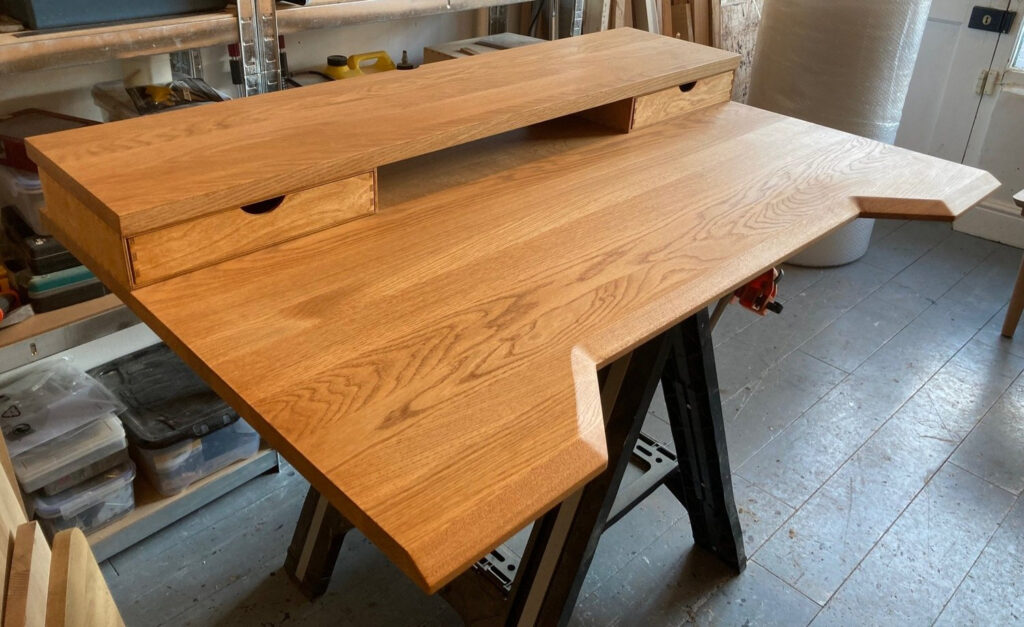
Pro Tip: Opt for an undrilled desk top if you are uncertain about your frame or future mounting needs, allowing greater adaptability.
Sizing, Fit, and Adaptability: Meeting Real-World Needs
Many desk problems begin with a standard size that is almost right. Almost right can mean a gap that wastes space, an overhang that blocks a drawer, or a top that sits awkwardly above a radiator.
Made-to-measure desk tops solve practical issues that retail dimensions cannot always cover. A workshop can often supply custom sizing in small increments, which is useful in box rooms, alcoves and shared workspaces where every centimetre counts. That matters just as much in a home office as it does in a studio or commercial setting.
Compatibility is another major point. Plenty of buyers already own a base they want to keep, especially with sit-stand frames. An undrilled desk top gives more flexibility because hole positions can differ between manufacturers. That approach also reduces the risk of buying a top that looks right but does not match the fixing pattern underneath.
Real-world adaptations often include the following:
- trimming depth to preserve walking space in a narrow room
- adjusting width so the top clears skirting boards or pipework
- allowing for cable access, monitor arms or wall-mounted shelves
- matching a top to an existing frame, trestle base or sit-stand mechanism
Future use matters as well. A desk that starts in a spare bedroom may later move into a larger office, or onto a different base. Adaptable desk tops are useful because they can move with those changes instead of being tied to one rigid setup. That is one area where custom furniture in the UK often proves its value in a very ordinary, practical way.
Lead Times, Delivery, and the Reality of Made-to-Order
Made-to-order does not always mean slow, and in-stock does not always mean simpler. The real difference is control.
A big retailer usually works from warehouse stock, broad delivery windows and standard packaging systems. That can be convenient if the size and finish you need are already available. A workshop follows a different model. The desk top is produced for your order, which allows more control over dimensions, finish and construction, but it also means the timeline includes actual production.
For many buyers, the useful comparison looks like this:
- In-stock retail desk top: faster dispatch if the product is available in the chosen size and finish.
- Workshop-made desk top: more time built into the process, but more scope to get the specification right from the start.
- Bespoke adaptation: longest route where non-standard details, unusual sizing or specific mounting requirements need to be worked through.
Production control can be an advantage. If the same workshop is selecting timber, preparing the top, finishing it and arranging dispatch, there are fewer handovers between supplier, warehouse and courier network. That does not remove every delivery risk, though it does mean the process is often easier to track in practical terms.
Tablemaker, for example, works on a made-to-order basis with most pieces produced within a relatively short timeframe, which shows that workshop production does not always involve the long waits people expect. The key point is less about speed alone and more about whether the desk top arrives in the right size, with the right fixing logic and finish for the room it is going into.
Delivery itself deserves attention. A solid wood top can be heavy, and access constraints matter. Staircases, lifts, narrow hallways and safe handling on arrival are all part of planning, especially for larger pieces. Those details can shape the buying decision just as much as the listed lead time.
Request a Bespoke Desk Top Quote
Receive tailored guidance for your space and needs from our UK workshop team.
Get a QuoteCost, Value, and the True Price of Longevity
Desk top cost in the UK often looks straightforward until you factor in replacement. A cheaper top can still be the right buy if you need something temporary, lightly used or standard in size. The calculation changes once the desk is used every day, carries expensive equipment or needs to fit a frame you already own.
Upfront price and long-term value are not the same thing. A mass-produced desk top may cost less at the beginning, but the lower figure can hide trade-offs in material thickness, edge durability, finish quality and lifespan. A workshop-made top can cost more because the timber, labour and finishing process are different, not because it is being sold as a luxury object.
Think about ownership over time:
- A laminated or veneered top may need full replacement if the surface chips badly, swells from moisture or fails around fixings.
- A solid wood top often allows maintenance, spot repair or full refinishing.
- A custom-sized top can save the cost of buying adapters, changing bases or compromising on room layout.
Repairability matters financially as well as practically. If a desk top can be sanded and re-oiled after several years, the useful life may extend well beyond that of a cheaper substitute. By contrast, replacing a low-cost top more than once can narrow the apparent saving.
Consumer rights and warranty terms still matter, of course. A retailer may offer a straightforward return framework for standard products, which suits some buyers. A workshop purchase may involve a more specific specification process, so the emphasis shifts to getting dimensions, finish and mounting details clear before production begins. That is a different kind of value, rooted in fit and longevity instead of shelf price alone.
Workshop Expertise and Problem-Solving: When Specialist Knowledge Matters
Some desk top decisions are simple. Others involve awkward rooms, reused bases, cable routes, radiator clearances or an old table that needs a second life as a desk.
Specialist knowledge matters most when a standard listing does not answer the practical problem. A workshop can often advise on timber thickness, span, fixing method and whether a top should be drilled at all before it reaches you. That sort of advice is especially useful with sit-stand frames, where stability and mounting positions affect daily performance.
Typical workshop problem-solving might include:
- adapting a desk top to fit an existing frame with non-standard fixing points
- resizing or refinishing an older solid wood top for a new workspace
- supplying a top for a commercial base that needs a specific footprint
- adjusting dimensions to work around alcoves, chimney breasts or wall projections
Restoration is another point of difference. A retailer usually sells a new product and stops there. A workshop may be able to refinish a worn surface, trim an existing top or modify a piece for a different use. That changes the relationship with the furniture itself. It becomes an object that can be maintained and adapted, rather than simply replaced.
In cases where buyers need practical advice before ordering, a workshop such as Tablemaker sits in a useful middle ground between fully bespoke joinery and standard retail stock. The appeal is not image or novelty. The appeal is having somebody think through the details before the timber is cut.
Common Misconceptions and What to Consider Before Deciding
A few common assumptions tend to distort this comparison.
“Bespoke is always expensive” is too broad. Custom sizing can add cost, but it can also prevent wasted space, awkward overhangs or the need to replace a perfectly good base.
“Retailers offer better warranties” is not automatically true. Warranty length, exclusions and what counts as fair wear differ across sellers, so the terms matter more than the label.
“Custom means long waits” is also unreliable. Some made-to-order workshops run on shorter timelines than people expect, particularly for straightforward desk tops.
Before choosing a desk top, use a simple buying framework:
- Measure the actual space, including skirting boards, radiators and door clearance.
- Check whether you need the top to fit an existing frame, especially a sit-stand base.
- Decide whether surface repairability matters to you.
- Compare materials honestly, including solid wood vs. MDF or veneered board.
- Read the finish and warranty details with care.
- Consider how long you expect the desk to stay in use.
The best choice depends on the job the desk has to do. For a temporary setup, a retailer option may be entirely sensible. For a long-term workspace, an awkward room or a base you want to keep, a UK workshop desk top often makes more sense because it solves the actual problem instead of approximating it.
Explore Solid Wood Options
See available timber types and finishes to customise your desk top’s look and durability.
View Timber Choices
Tablemaker
55 High St, London N8 7QB
02083416334
HVQM+58 London