

How to Choose Table Tops That Stay Stable Under Daily Heat Lamps and Hot Plates
What makes a table top stable under constant heat exposure?
A stable table top in a heated environment combines the right wood, construction, finish and base compatibility. Solid hardwoods like oak, when joined with precision and protected with durable finishes, provide resistance to warping and discolouration, especially when paired with heat-aware mounting and thoughtful maintenance.
Table of Contents
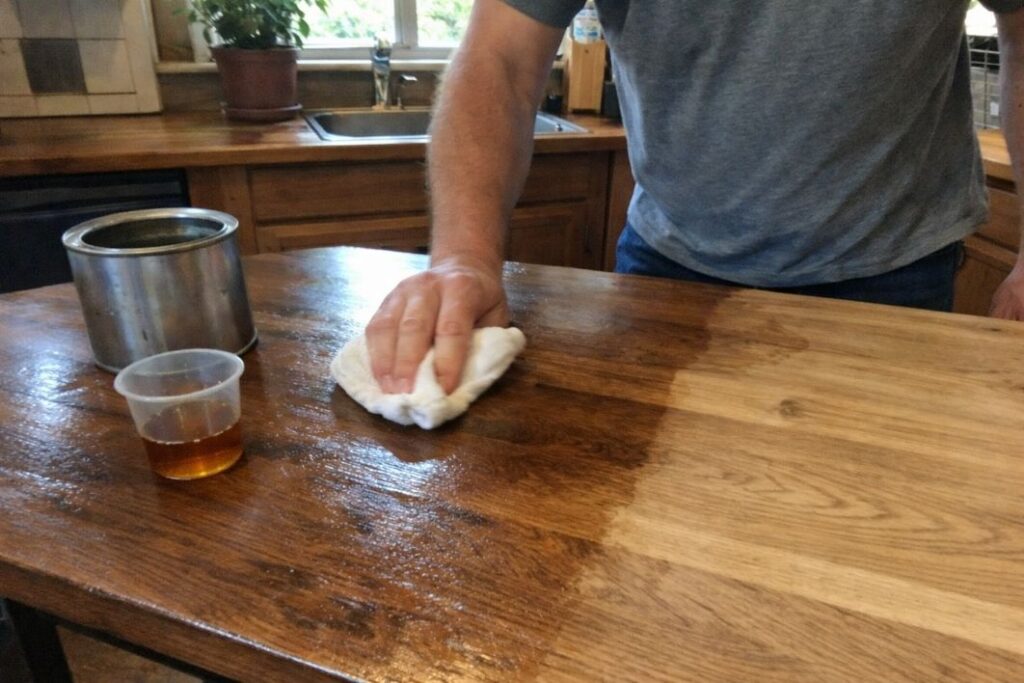
An AI photo of a solid oak table being treated.
Heat Exposure and Solid Wood: What Actually Happens
Heat changes wood. It may not always be visible straight away, but over time, daily exposure to hot plates and overhead heat lamps can alter how solid wood behaves. Knowledge this helps explain why some table tops warp, crack or degrade while others remain stable.
Here is what happens when heat is applied:
- Thermal expansion causes the fibres in the wood to stretch. Repeated heating and cooling can lead to distortion or cupping, especially if the grain direction is not aligned with the stress.
- Moisture loss from heated air or direct contact dries the wood at the surface faster than the middle, increasing internal tension.
- Surface checking (small cracks) or splits may form, particularly on poorly dried timber or coated finishes that don’t move with the wood.
- Delamination is common with veneered boards, which separate from their base as heat weakens the adhesive layer.
- Finish degradation, including bubbling, white rings or discolouration, tends to occur with heat-reactive coatings.
It is worth noting that ambient warmth is less damaging than direct heat. A table under a heat lamp for hours each day, or one that regularly holds hot pans, faces much greater stress than one placed in warm air.
Common misconceptions persist around hardwoods. While oak, ash and walnut are all durable, none are immune to heat improperly applied. Proper construction and finish choices matter just as much as wood selection.
Best Wood Species for Heat-Prone Table Tops
Oak remains one of the most reliable woods under thermal stress. Its density, grain structure and moisture retention balance make it a strong choice for both domestic and commercial settings.
Why oak performs well:
- Dense and stable grain reduces excessive movement when exposed to fluctuating temperatures.
- Consistent kiln-drying allows the wood to settle properly before fabrication.
- Good surface resilience against marking from hot plates or pans.
Other possible choices include:
- Ash, which is slightly more open-grained than oak but still adapts well when properly treated.
- Walnut, which offers natural density though costs and softness may limit suitability for very high-use zones.
Softwoods, such as pine or fir, struggle under repeated heat due to lower density and a higher tendency to mark or deform.
Engineered boards with wood veneers should also be approached with caution. These products often delaminate or trap steam beneath surface layers, particularly when adhesive bonds weaken through exposure.
Pro Tip: Position heat lamps at least 30 cm above wooden tops to avoid uneven drying and surface damage.
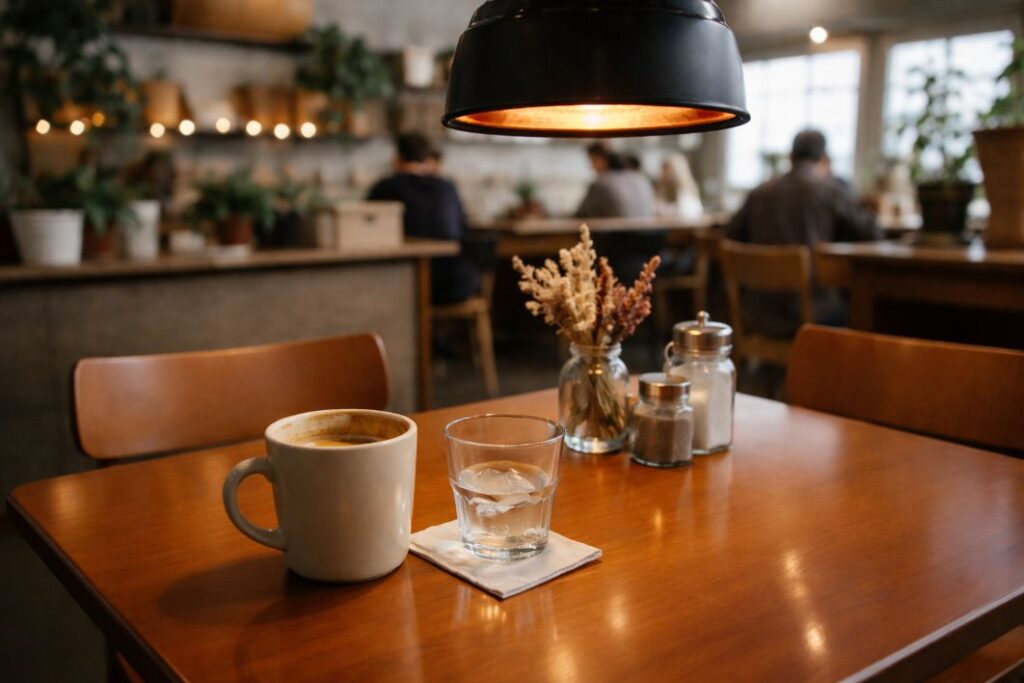
An AI photo displaying a solid oak cafe table.
Pro Tip: Use rubber grommets between metal bases and wood to reduce heat transmission and stress cracks.
Construction Details That Keep a Table Top Flat
How a table top is built affects its ability to stay flat over time. Material choice is important, but construction errors can still lead to cupping, bowing or cracking.
Several practices support stability under repeated heat:
- Full-stave boards, which use continuous strips of solid wood joined side by side, offer better long-grain stability than narrow offcuts or finger joints.
- Straightening bars, made from wood or metal, are fitted beneath the top across the grain. These help counter expansion forces without restricting movement.
- Grain direction is selected deliberately. Boards should run in a way that disperses tension evenly.
- Floating components, rather than rigid glue fixings or screws, allow slight movement as wood naturally expands and contracts.
At Tablemaker, full-stave solid oak is used as standard, with straightening bars fitted on the underside of each top. These bars are removable and can be repositioned during mounting, which supports longevity and adjustability.
Edge-glued panels, especially from smaller offcuts or mixed grain directions, tend to struggle in heated conditions. Over time, these may warp even if the surface appears stable at first.
Choosing a Finish That Resists Heat
The final layer matters more than many realise. Even well-built and well-mounted tops can show signs of wear if the finish reacts poorly to daily heat.
Hardwax oil is a preferred finish for heat-exposed furniture. It penetrates the surface rather than sitting as a sealed layer. This allows the wood to breathe and move naturally while offering protection against common forms of damage.
Benefits of hardwax oil:
- Resistant to peeling or bubbling when exposed to moderate heat.
- Easy to maintain with spot repairs or full re-oiling.
- Less likely to show heat rings from cups, bowls or equipment.
By contrast, sprayed lacquers and some polyurethane coatings often harden into layers that crack under expansion or show thermal blemishes.
Warning signs of poor finish performance include:
- White rings or patches after using hot plates or leaving warm mugs.
- Flaking at surface edges.
- Dull or sticky patches where heat has softened the coating.
Tablemaker uses hardwax oil across its range due to its balance of protection and repairability. This keeps tops looking consistent even as they age.
Matching Your Table Top to the Heat Equipment
Not all heat is delivered the same way. Knowledge how your equipment works makes a noticeable difference in surface durability.
Heat-generating elements behave differently based on type, focus and installation:
- Heat lamps produce radiant heat from above. Over time, they dry the top layer of wood unevenly if mounted too close.
- Hot plates and warming trays apply direct heat. If left on for hours, they create intense thermal zones that strain grain structure.
- Buffet setups often combine both, layering ambient and direct heat exposure.
To reduce risk:
- Maintain sufficient clearance between heat lamps and wood surfaces. Mounting height should allow even dispersal, not concentrated hotspots.
- Use heat diffusers or insulating pads under any electrical warming equipment that touches the wood.
- Rotate surface items to prevent permanent heat zones in one area.
For commercial settings like cafés or hospitality counters, consistent awareness of these variables helps avoid long-term damage.
Order a Heat-Ready Table Top
Choose a handcrafted solid oak top built to perform under daily heat exposure across commercial or domestic environments.
View Table Top OptionsGood Mounting: The Table Base Also Matters
Even the best top will suffer if mounted too rigidly or on a base that transmits heat inefficiently.
Important points to check include:
- Allow movement: Solid wood expands and contracts. Fixings should let the top breathe. Expansion slots or floating mountings reduce stress.
- Metal bases may conduct heat directly into the mounting zones. A thermal break, such as wooden cleats or rubber grommets, improves performance.
- Flatness and support across the entire surface help prevent sagging or shifting over time.
Pre-drilled tops may seem convenient, but they can limit how the piece integrates with various frame types. Tablemaker supplies desk tops undrilled for this reason, allowing precise positioning based on each base.
A checklist for assessing base compatibility:
- Does the mounting method allow for seasonal movement?
- Is there a thermal barrier between the base and the underside of the wood?
- Are screws or fixings centred in slotted brackets, not tight holes?
- Is the support structure rigid across the full length?
Planning for Repair, Maintenance and Change
With regular heat being part of the environment, maintenance becomes an embedded requirement. The advantage of solid wood is that it can be renewed.
Signs that maintenance is needed include:
- Dull or faded finishes
- Slight cupping or unevenness at corners
- Localised surface marks or stains
Fortunately, repair is usually straightforward:
- Re-oiling restores lustre and re-seals the surface. This is typically needed once or twice a year in high-use areas.
- Light sanding followed by fresh oil can erase minor scorch marks or heat damage.
- Adjustable construction, such as removable straightening bars, allows corrections to be made if wood movement appears.
Modular designs also make it easier to adapt the furniture as surroundings change. For example, if a new piece of equipment is larger or hotter, the table top can be rehung or repositioned without complete replacement.
Investing in solid wood made with thermal awareness provides a long-lasting surface that can evolve with needs. With careful pairing and upkeep, even heat-intensive environments can be managed with confidence.
Request Custom Mounting Advice
Ensure optimal performance by getting expert guidance on heat-aware base mounting and top compatibility.
Get Mounting Support
Tablemaker
55 High St, London N8 7QB
02083416334
HVQM+58 London