

Best Table Top Edge Profiles for Busy Venues (Comfort, Durability, Cleaning Reality)
Which edge profiles are most suitable for high-traffic venues like cafés and restaurants?
The most suitable edge profiles for high-traffic venues prioritise comfort, long-term durability and ease of cleaning. While the visual finish matters, function tends to dominate these settings due to intensive daily use and frequent contact from both staff and guests.
Practical impact of edge profiles in busy venues
In a busy café or restaurant, each table might be wiped clean over 30 times in a single day, while edges face constant contact from trays, chairs and guests’ clothing. This frequency of use reveals limitations that might not be obvious in a showroom or domestic setting.
Edge profiles directly influence:
- Wear resistance: Rounded or angled edges tend to mask wear better than crisp corners, which are prone to chipping.
- Comfort: Arm placement, chair movement and cleaning all interact with the edge, especially in close quarters.
- Cleaning efficiency: Crevices or sharp transitions can trap debris or resist cloth glides, slowing routine upkeep.
- Visual perception: A softer edge can come across as more informal or accessible, which may suit venues aiming for a relaxed feel.
Edge details are often overlooked, yet their performance plays a central role in the usability and upkeep of commercial surfaces.
Table of Contents
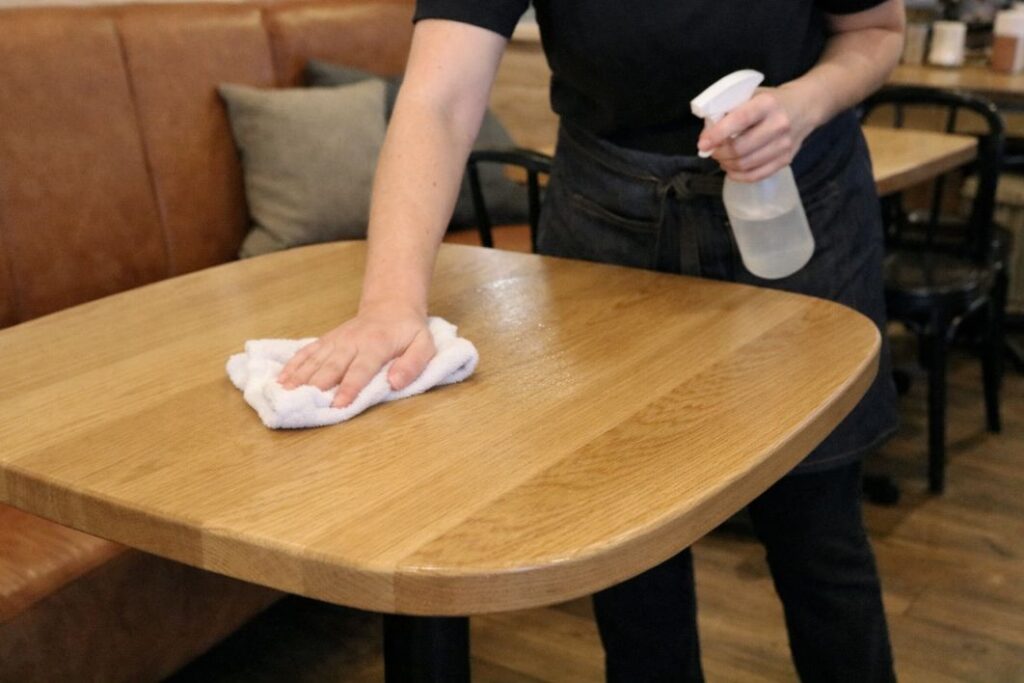
An AI photo of a commercial-grade solid oak table
Square Edge: Clean Look, Hard Corners
The square edge offers a sharp, modern profile that pairs well with minimal or industrial interiors.
Pros:
- Clear, defined lines that create a contemporary look
- Flat sides make surface cleaning straightforward
Cons:
- Corners are vulnerable to chipping, even with solid wood
- Elbows, thighs and tray edges frequently come into hard contact
- Less forgiving when chairs or stools knock into table sides
Square edges may suit fixed wall-mounted tables or counters with limited direct contact. Where aesthetics must take precedence and wear is lower, it remains a valid choice. Tablemaker can reinforce corners where needed to mitigate common impact points.
Radius Edge: Softened for Safety and Comfort
In a setting where children might run past tables or where staff move quickly between close-set seats, rounded edges offer peace of mind. A radius profile softens both the top and underside of the edge, removing harsh angles.
Functional benefits include:
- Reduced risk of knocks or grazes for guests and staff
- Easier cloth glide during cleaning, with no sharp corners
- Improved resistance to visible wear on high-contact points
- Widely compatible with family-oriented or informal venues
A smaller radius retains a relatively structured feel, while a larger radius leans toward a more casual and softened presence. Tablemaker can adjust the radius to suit both look and utility.
Some buyers may view this as less refined than a crisp square finish. However, when comfort, speed and safety guide the brief, the radius edge is often the most balanced option.
Pro Tip: In tight seating layouts, avoid undercut profiles like sharknose to reduce the risk of lower limb knocks.
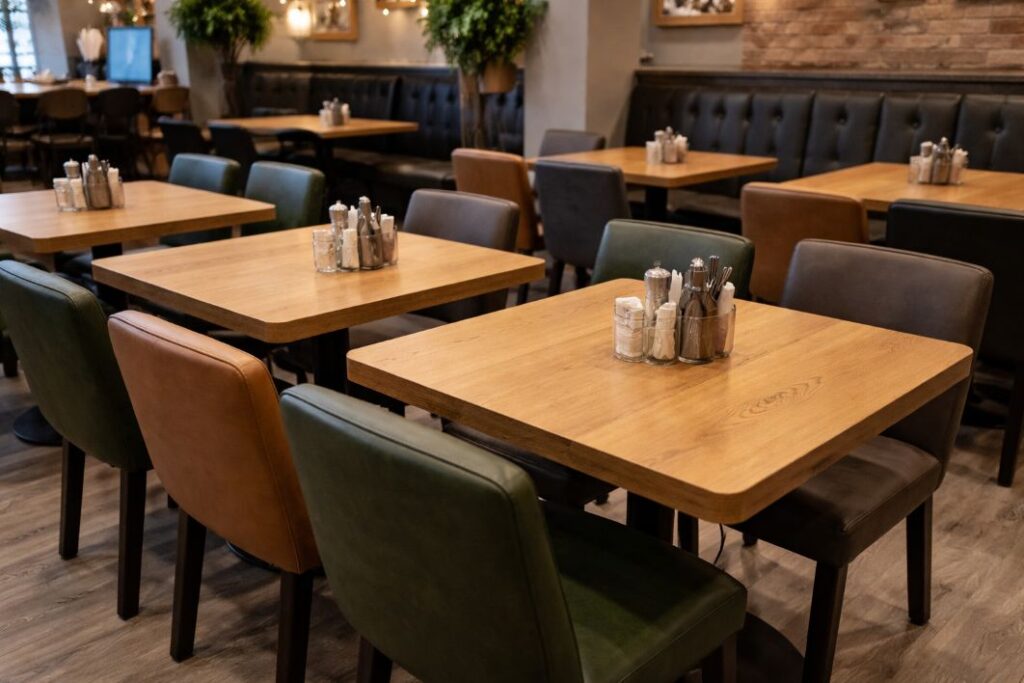
An AI photo displaying various solid oak cafe tables.
Pro Tip: For venues with rapid table turnover, a radius or hybrid edge can cut down daily cleaning time significantly.
Chamfer Edge: Subtle Angles, Mixed Results
A chamfer is an angled cut along the edge, typically about 30 to 45 degrees, which eases the transition between horizontal and vertical planes.
Benefits:
- Visually reduces the thickness of a table top
- Slightly softer to the touch than sharp edges
- Feels refined while remaining relatively subtle
Limitations:
- Can wear quickly at the angled plane if heavily impacted
- Not all chamfers are equal, depth and angle vary widely
- May hinder cleaning if cloths snag or skip over the bevel
Chamfers work well in formal dining settings or commercial interiors where table turnover is lower and presentation is important. Tablemaker adjusts chamfer depths to balance visual simplicity with daily use considerations.
Bullnose Edge: Fully Rounded, Fully Practical?
Imagine the edge of the table smoothed like a river-worn stone, rounded all the way from top to bottom. That image captures the bullnose profile.
Pros:
- Exceptionally forgiving on bumps, knocks and grazes
- Comfortable for seated users and high-contact environments
- Good fit for education spaces, informal dining or family pubs
Cons:
- Food and residue may collect beneath the underside curve
- Traditional styling may not suit modern or linear interiors
- Cleaning requires more attention to follow the curve fully
For comfort-first venues, particularly those catering to children or high seating turnover, bullnose edges have ongoing value. Tablemaker offers adaptations with reduced curvature to balance visual weight and practicality, especially where a fully rounded edge might appear overly soft.
Request a Bespoke Table Edge Design
Our team can tailor edge profiles to suit your venue’s layout, safety needs and cleaning routines.
Enquire NowSharknose Edge: Sleek but Serviceable?
The sharknose profile creates a dramatic, undercut bevel on the underside of the edge. Visually, it gives the illusion that the table top is floating, especially when viewed side-on.
Advantages:
- Creates a refined, architectural appearance
- Reduces visual thickness of heavier tops
Drawbacks:
- Underside angle can bruise knees or shins in tight spaces
- Cleaning cloths struggle to reach the full undercut
- Delicate edge may be more exposed to chips or scuffs
This profile belongs in lower-contact environments or where visual impact outweighs operational practicality. It can work for statement pieces, reception counters or quiet lounges. Tablemaker can produce modified versions that soften the underside cut to improve access and reduce edge fragility.
Custom Hybrid Profiles: Matching Use to Context
Standard options do not always meet the needs of complex or compact spaces. Some venues benefit from edge profiles that blend characteristics to suit their specific workflow, layout or audience.
Hybrid solutions may include:
- A radius top with a chamfered underside for comfort and clarity
- Shallow bevels that reduce sharp transitions without compromising cleaning
- Profiles tuned to match custom bases or minimise wall proximity gaps
Tablemaker specialises in adapting edge designs to real-world layouts, such as shared workspaces, joined tables or rooms with architectural constraints. The aim is not unnecessary challenge, but a precise function, edges that meet context with purpose.
In spaces where clients move through frequently, where bags might scrape past or where cleaning routines must be quick and thorough, these seemingly small adjustments make day-to-day operations smoother and safer.
Explore Commercial Table Top Options
Browse our table top finishes and edge styles made for busy cafés, pubs and restaurants.
View Range
Tablemaker
55 High St, London N8 7QB
02083416334
HVQM+58 London