
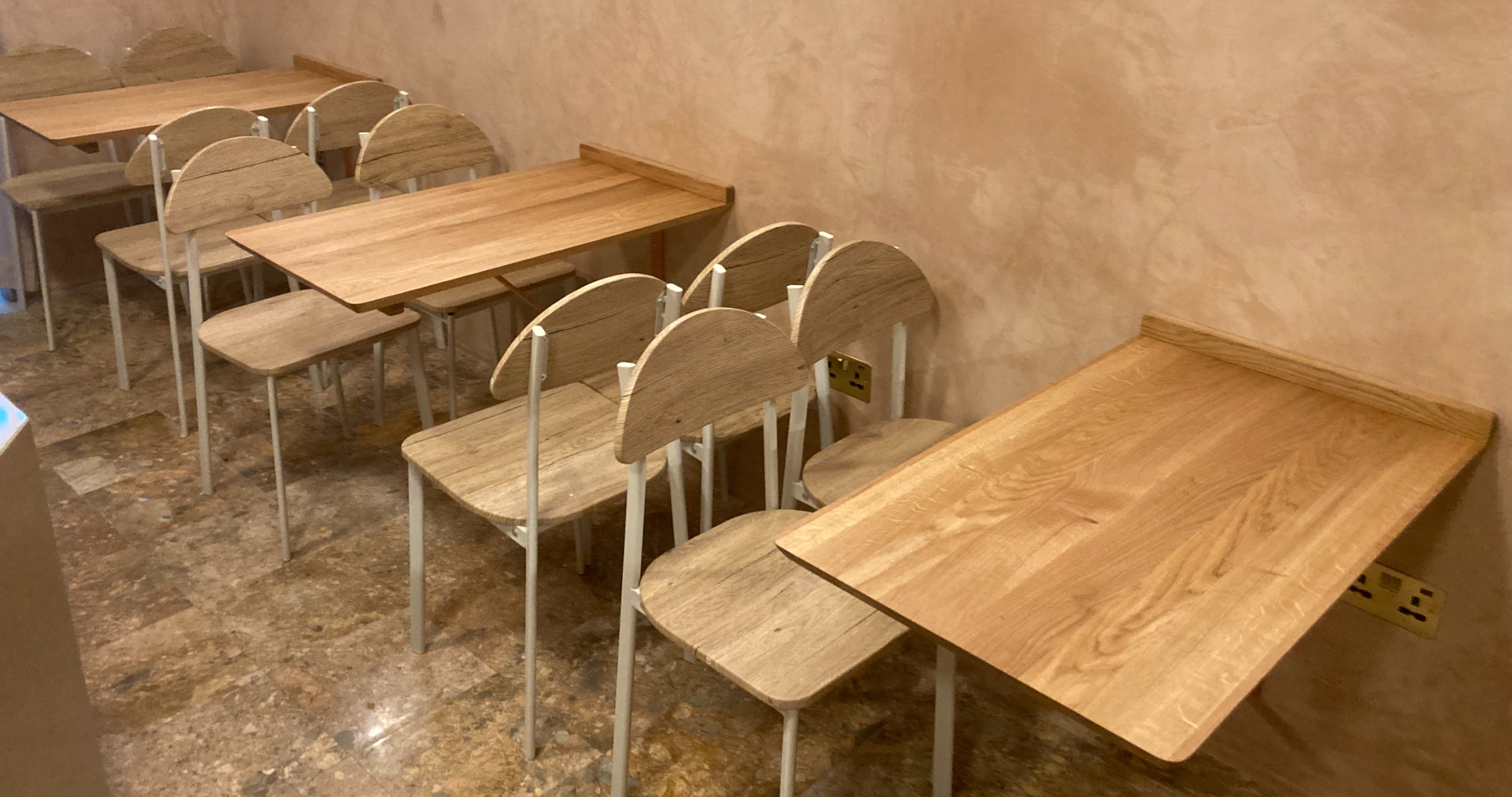
Do fixed and wall mounted tables really free up floor space in your café?
Yes, fixed and wall mounted tables can free up small café floor space by removing bases, legs and table feet from the route people use. The top still takes room, so the gain comes from cleaner floor lines, better chair control and fewer obstructions for staff, customers and cleaning.
Fixed and wall mounted tables free floor area by removing obstacles
People often look first at the size of the table top. We start with what sits on the floor. A loose pedestal table may have a compact top, yet the base still spreads into the route where chairs move, staff pass and customers stand up.
Fixed café tables and wall mounted café tables work differently. The café does not become larger, but fewer objects block the floor. A wall mounted table top can keep the usable eating surface while removing the central base that catches feet, mop heads and chair legs.
That control has a trade-off. Loose furniture lets you move tables for prams, wheelchair users, larger groups or events. Fixed furniture sets the room out more tightly and keeps it that way. For a busy small café, that can be useful, but it needs planning before anything is drilled, fixed or ordered.
At Tablemaker, we see many square and rectangular café tops used with wall brackets or cantilevered supports in tight layouts. The choice is practical first. A good café layout with wall mounted tables should make the room easier to run during service, as well as neater on a drawing.
Escape routes also need space. Home Office guidance for small non-domestic premises says escape routes must be kept clear where needed for safety, so fixed furniture needs to support that plan rather than work against it.
The saved space sits below and beside the table
A two-person loose table beside a main route can look small on paper but still be awkward in use. Put the same top on the wall, with the right support, and the floor beneath it becomes easier to pass, sweep and line up with the rest of the room.
The table edge still matters. Customers need room to sit, chairs need somewhere to go, and a walkway between tables must work in real use. Wall mounting shifts the problem from a base on the floor to the depth of the top and the space around the chairs.
Useful gains usually show up in these zones:
- Under the table. Removing a pedestal base or splayed legs can clear the area where feet and chair legs usually clash.
- Along the staff route, a fixed wall run can stop loose tables drifting into the path during service.
- Cleaning access. Fewer floor obstructions make it simpler to clean under and around the seating line.
- At the customer route, the table edge and chair backs still decide whether people can pass without squeezing.
Access dimensions need plain attention. Department for Transport Inclusive Mobility guidance says gangways between tables should be at least 1300 mm wide for wheelchair users and people with assistance dogs, with 900 mm only potentially acceptable where space is very limited. We treat those numbers as layout checks, not as decoration added after the furniture has been chosen.
Fire planning follows the same logic. Travel distance is about the route people actually take around tables and other obstructions, not a straight line drawn through them. In a small coffee shop seating layout, the route on the floor is the part that proves whether the plan works.

Mark the chair pull-out on the floor before you measure the top. A table that fits on paper can still block the route once chairs are in place.

Strength comes from the whole wall mounted system
The sensible worry is whether a wall mounted café table will be strong enough for commercial use. We do not treat that as a table top question alone, because the wall, bracket, fixing method and top all work together.
Table top, bracket and wall are separate checks
A wall mounted café table is not a top screwed to a wall. The top needs to suit the bracket. The bracket needs to suit the wall. The fixings need to suit the material they go into.
Solid oak can be a good choice for commercial café table tops because it is hard wearing and repairable. Café tops in our range include 24 mm and 30 mm thickness options, which gives room to choose a top that suits the look, the support and the use. If a fit-out involves structural change or a material change to the premises, the right professional or Building Control Body should be involved where needed.
Weight, depth and leverage matter
A deeper table puts more force through the bracket and fixing than a shallow one. The bracket may look tidy, but the real question is how it behaves once people lean on the table, bags hang from chairs and staff clean around it every day.
We do not guess bracket load ratings. Those need to come from the bracket manufacturer or, for a more involved installation, a structural engineer. Our part is to make the wall mounted café table top to the agreed size, thickness, edge and fixing requirements, so the support can be specified properly.
Repairability matters after opening day
Commercial furniture gets marked. Cup rings, edge wear and small dents are normal in hospitality, so durability includes what happens after the first season of use.
Solid oak with a hardwax oil finish can be sanded and recoated. Hardwax oil is a finish that protects the wood, stays food safe and can be repaired in a local area without replacing the whole top. That matters when a damaged corner would otherwise mean taking a table out of service or changing a full run of matching tops.
Before ordering wall mounted tops, the support plan needs to be checked as carefully as the size and finish.
Size and shape work best when they suit the wall line
Small café table size should come from the service, the wall line and the chair. A few centimetres can decide whether a compact seating plan feels workable or awkward.
Here is the simplest way we compare common shapes for tight café layouts.
| Shape | Where it works | What to watch |
|---|---|---|
| Square | Good for two-person tables along a wall or in a repeated fixed run | Corners and chair pull-out need checking on narrow routes |
| Rectangular | Useful for wall runs, alcoves and slim layouts where depth matters | Long runs can become inflexible for mixed group sizes |
| Round | Good around loose tables where people move past from different angles | A round top does not use a straight wall line as efficiently |
A 60 x 60 cm oak table top is a standard two-seater option for a more intimate café setting, but we would never treat that as the answer for every small café. Chair width, wall position and the route past the table can change the right size.
Made-to-measure café table tops are useful because awkward rooms rarely match standard furniture sizes. We can make café tops in 1 cm increments, which lets the table depth or width respond to an alcove, a narrow wall run or an existing base. Edge profile and corner shape also deserve attention, because a softened corner can matter beside a tight route.
Small does not automatically mean better. A table that is too shallow can be annoying for customers, and a table that is too wide can block the very route it was meant to improve.
Measure the wall section as a system, not just the table size. The bracket position, table depth and access space all affect whether a fixed run works in daily service.
A pre-order check keeps the layout honest
Before fixing anything to a wall, we work through the room in a clear order. The aim is to find the pinch points before the tops are made and the brackets are fitted.
- Start with the route. Mark the path customers and staff need to use, including the space around chairs. A wall mounted top only helps if that route becomes clearer.
- Check the wall. The wall structure decides what kind of bracket and fixing can be used. No café owner should assume every wall can take a fixed table.
- Match the support to the top. Depth, thickness and bracket position need to be agreed as one system, especially for cantilevered café tables.
- Test access before looks. Department for Transport guidance says accessible table legroom should extend to a height of 700 to 730 mm from the floor, with at least 600 mm width and 500 mm depth. The top of an accessible table should be no more than 750 mm high.
- Plan for cleaning and repairs. A fixed run should leave the floor easier to clean, and a repairable top gives you a better route if one table takes the wear before the others.
- Keep some flexibility where the room needs it. Fixed tables can bring order to a small café, but loose tables still earn their place where group sizes change.
Once you look at fixed and wall mounted tables this way, the decision becomes much less vague. You are no longer asking whether the furniture saves space in general. You are checking whether the base is gone from the route, the wall can take the support, the table height works and the top will stand up to daily café use.
That is the shift that matters. The plan stops being a gamble about tight space and becomes a set of checks you can brief clearly.
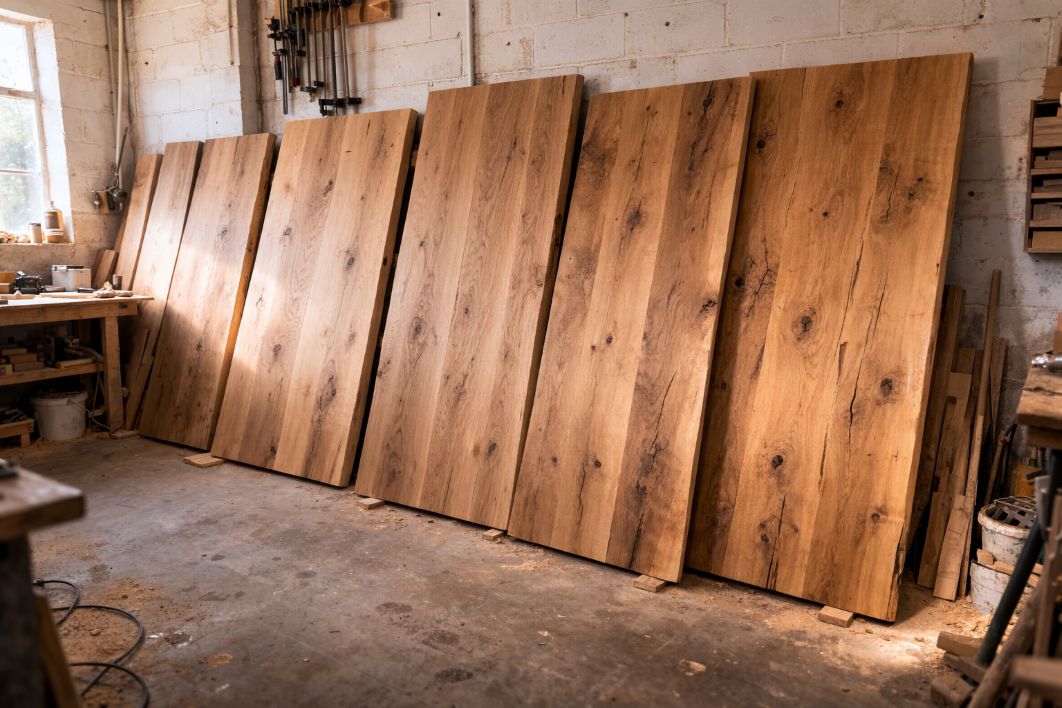 An illustrative image of oak table top leaning against a workshop wall – in progress
Questions we get asked about wall mounted café tables
Can new table tops be fitted to existing café bases?
Yes, new tops can often be made to suit existing café bases, provided the base is stable and the fixing points make sense for the new top. We supply desk tops undrilled as standard, and the same practical thinking applies when a top needs to work with a base or support you already have.
Are wall mounted café tables easier to clean under?
Wall mounted tables can make cleaning easier because there is no central base or set of legs under the table. Cleaning still depends on the table depth, chair position and how tightly the run is fitted to the wall.
Are square or round tables better for a small café?
Square and rectangular tops usually work better against walls because their straight edge uses the wall line well. Round tops can work well as loose tables where people pass from several angles.
Do wall mounted tables suit every wall?
No, wall mounted tables need a suitable wall, bracket and fixing method. The wall needs checking before the table top is made, especially in a commercial setting where the table will be used every day.
Can fixed tables still be accessible?
Fixed tables can be accessible when the height, legroom and route around them are planned properly. A fixed position removes flexibility, so access needs checking before the layout is finalised.
This is general information, not professional advice.