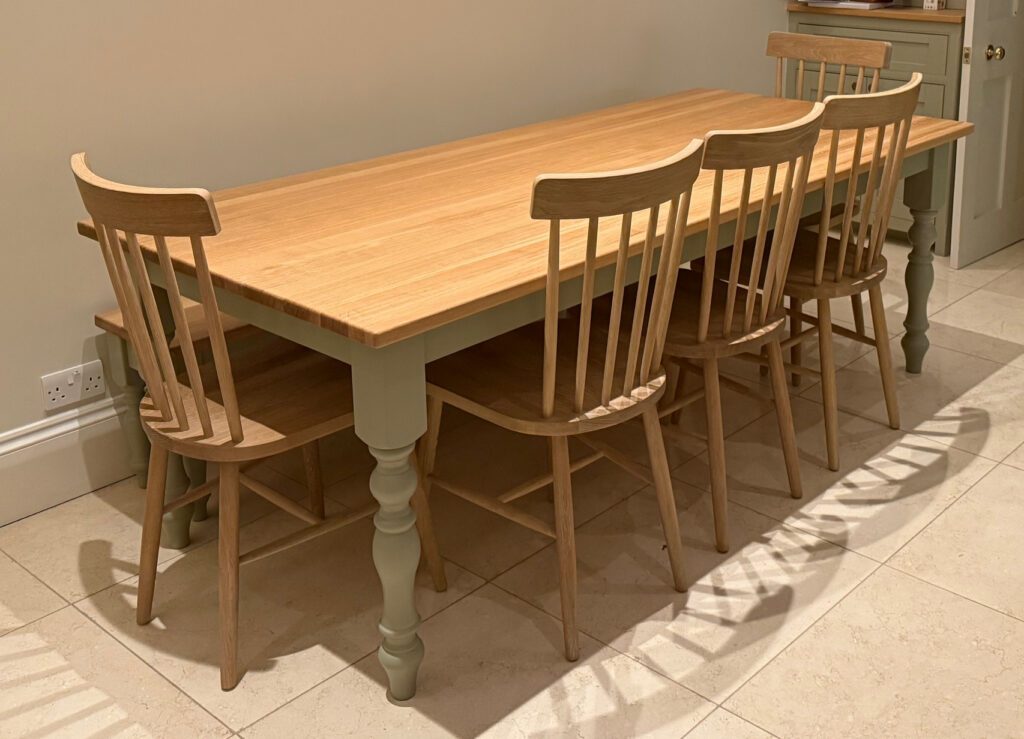
Quick answer: A custom solid oak dining table in the UK typically costs £800 to £1,200 for most standard designs. Highly customised or bespoke tables usually range from £1,000 to £2,500+, depending on size, materials and complexity.
A custom solid oak dining table in the UK can cost anything from around £800 to several thousand pounds, depending on the size, design, materials, construction and level of customisation.
At Tablemaker, most of our in-house solid oak dining table and desk designs fall broadly in the £800 to £1,000 range, depending on size and specification. Smaller pieces can cost less, while larger or more highly customised projects can cost more.

For more bespoke work, where the customer wants a unique design, unusual shape, special base, extra features or non-standard materials, the price range is much wider. Many custom tables and desks we make fall between £1,000 and £2,000, while more complex custom furniture projects can rise to £2,500 or more.
That is the short answer. The longer answer is that “custom table” can mean several different things. It might mean choosing the exact length and width of one of our existing designs. It might mean changing the edge profile, corner shape, colour, thickness or leg style. Or it might mean starting from a completely new brief.
This guide explains how custom table pricing works, what affects the cost, and how to get the best value if you want a handmade solid oak table built to fit your space.
Types of custom oak dining tables: in-house designs vs bespoke projects
At Tablemaker, our work generally falls into two categories:
- In-house designs
- Custom projects
Our in-house designs are shown in the Shop section of our website, divided into categories such as dining tables, desks, coffee tables, table tops, desk tops, benches and accessories.
Each design is shown in a specification that we think suits it well. For example, it may be shown with a particular edge profile, thickness, colour tint or leg style. But these designs are not fixed in the way many retail furniture products are fixed.
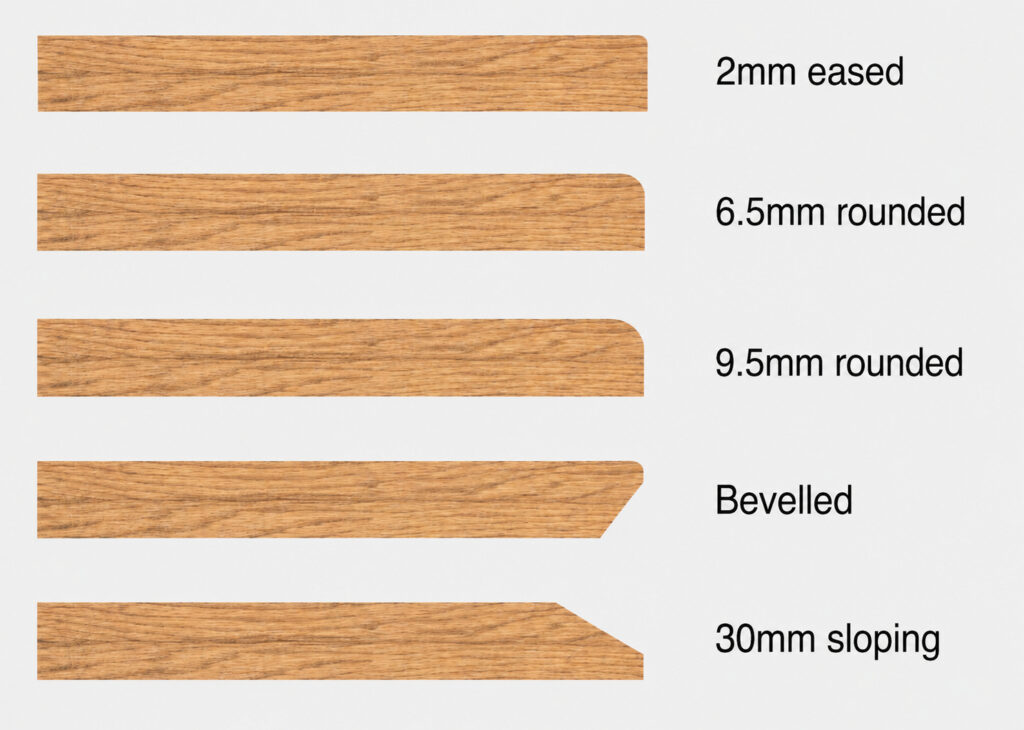
Most of our in-house designs are highly customisable. Customers can usually choose the size, edge shape, thickness, height, corner shape, colour finish and sometimes other details too. In most cases, sizes are available in 1cm increments, so the table can be made to fit the space properly rather than simply being the nearest standard size.
Because there are so many possible combinations, it is not practical to list a price for every version of every table. Instead, many of our product pages include a price calculator. You can enter the length and width you want, and the calculator gives a price based on the specification shown on that page.
That gives a strong guide price. If you then want to change the specification — for example, alter the edge, use a different thickness, change the legs or request a different finish — you can send us the details and we will provide a more precise quote.
Custom projects are different. These are pieces that sit outside our standard product range. They might include a completely bespoke table, an unusual desk shape, a shelving unit, a commercial fit-out element or furniture with built-in cupboards, drawers or cable management.

For those projects, there is no single useful price range. A small custom oak shelving unit might be possible for around £500, while a large, uniquely shaped office desk with cupboards, shelves and cable management could cost several thousand pounds.
As a general guide, many custom furniture projects we take on fall somewhere between £500 and £2,500, with bespoke tables and desks often sitting around £1,000 to £2,000 depending on complexity.
Example prices for custom oak dining tables (UK)
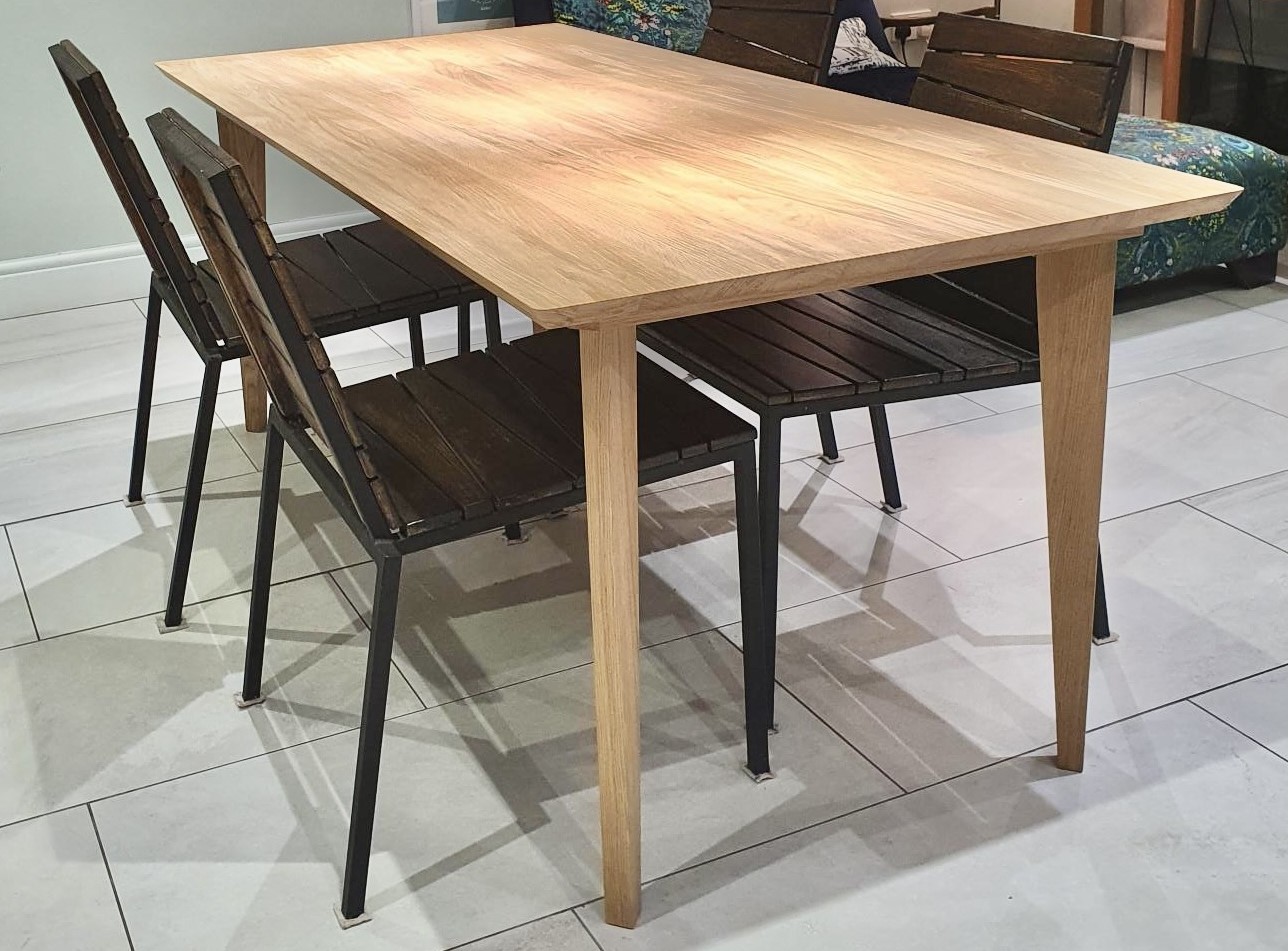
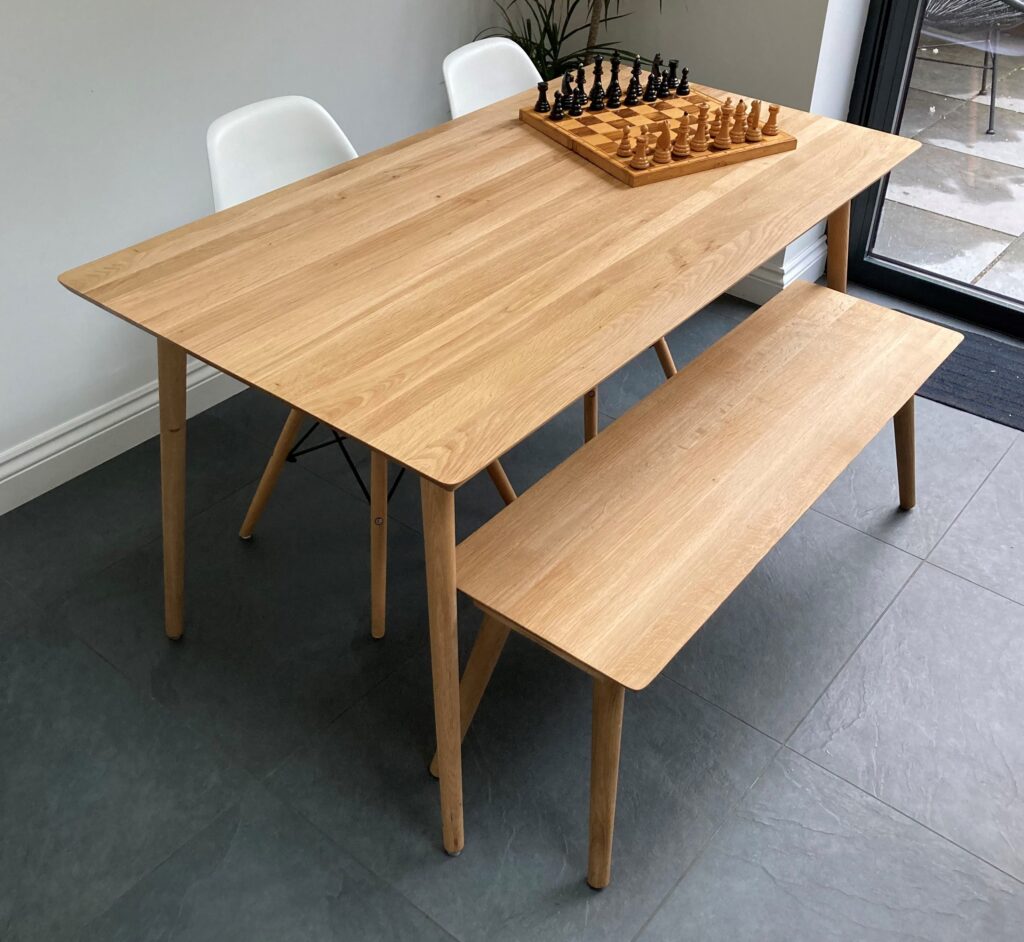
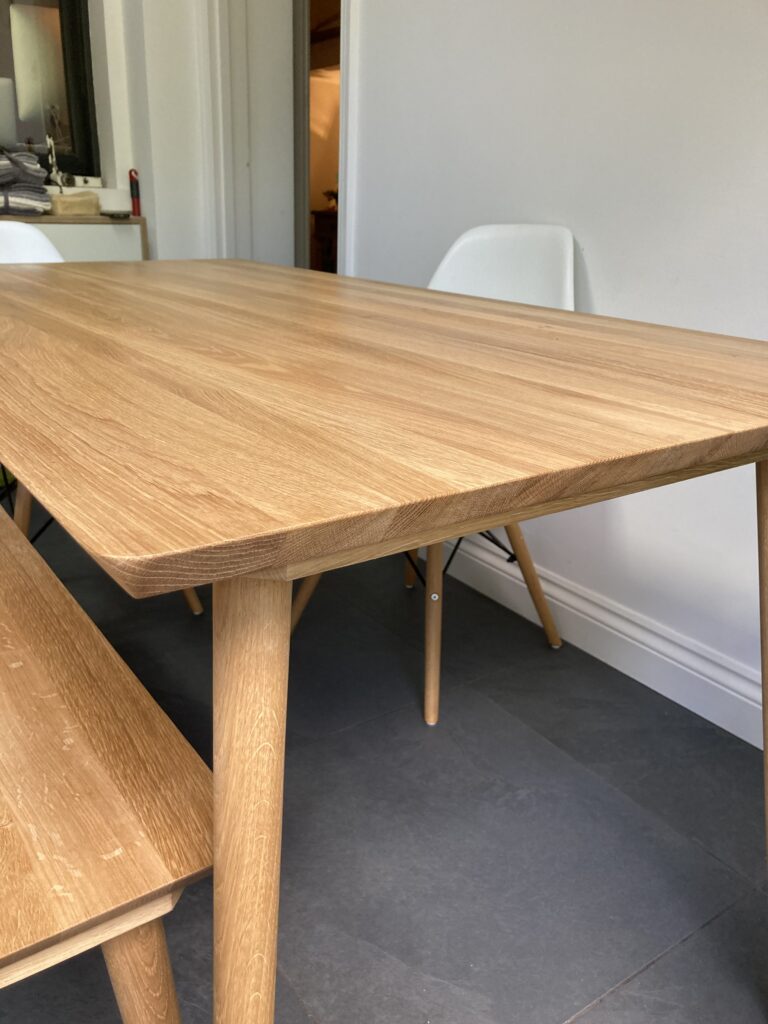
To give some real examples, one of our most popular in-house designs is the ATO 55 Dining Table/Desk. It is a solid oak table with a clean, Scandinavian-influenced design and tapered square legs.
At the time of writing in spring 2026, the online size range for the ATO 55 runs from 75cm × 40cm up to 210cm × 100cm. The smallest size costs around £753, while the largest listed size costs around £989 in the shown specification.
A typical dining table size, such as 190cm × 85cm, costs around £926.
Other example prices for in-house designs at around 190cm × 85cm include:
- Wing 200 Dining Table: around £981
- Stadium 300 Dining Table: around £996
- Radius 70 Dining Table / Desk: around £1,036
These are examples based on the product specifications shown online at the time of writing. Exact prices can change, and different sizes or custom features will affect the final quote.
What affects the cost of a custom oak dining table?
The main factors that affect the price of a custom oak dining table are:
- size
- tabletop thickness
- material choice
- design complexity
- leg or base style
- finish
- added features
- whether the design is based on an existing model or created from scratch.

People often assume that size is the biggest factor in affecting price. It certainly matters, but it is not always the most important one.
At Tablemaker, unlike many other furniture businesses, we do not mark up the cost of our timber in order to make a profit. In simple terms, what we pay for the material is very close to what the customer pays for it, with a small allowance to cover wastage. That means a larger tabletop does cost more, but the increase can sometimes be smaller than people expect.
The larger increases usually come from material thickness, unusual materials, design complexity and workshop time.
Size may not affect price as much as people think
A bigger table uses more timber, so it will cost more. However, with many of our in-house designs, the legs and bases are made separately and attached to the tabletop. That means increasing the table length or width does not always make the whole build dramatically more complicated.

For example, using our ATO 55 design again:
- A 140cm × 75cm ATO 55 costs around £852
- A 180cm × 85cm ATO 55 costs around £914
That is less than a 8% increase. It is noticeable, but arguably not a huge increase, considering the larger table has a much bigger footprint.
So yes, size affects price. But it is only one part of the equation. If you are trying to manage cost, simplifying the design or choosing an appropriate thickness may make as much difference as reducing the size.
Thickness can have a bigger effect than expected
Tabletop thickness has a very real effect on price.
Most of our designs use 24mm solid oak, which we think suits our general style very well: clean, modern, Scandinavian-inspired, and slightly mid-century in feel. It gives the table a strong, substantial surface without making it look too heavy.
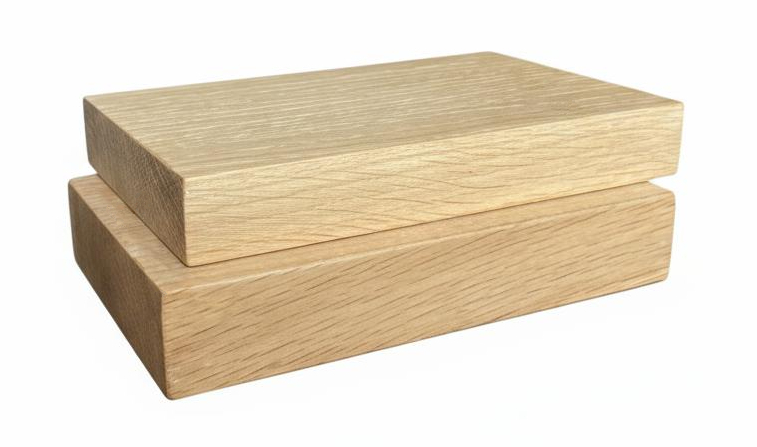
Some designs use 30mm solid oak, particularly those with a slightly more industrial or substantial feel, such as our Box 85 table, Industry 68 desk and Element 57 table.
The material cost difference between 24mm and 30mm oak can be significant. In some cases, the raw material difference can be around 50–60%, and that inevitably has to be reflected in the final price.
For example, using the ATO 55:
- A 150cm × 70cm table in 24mm oak (standard) costs around £852
- The same table in 30mm oak would cost around £956
That is an increase of about 12%.
At a larger size, such as 200cm × 80cm, switching from 24mm to 30mm has an even greater impact, with an increase of around 17%.
We can also make tabletops in other thicknesses, such as 19mm or 40mm, but these may involve higher costs if they are not standard material sizes. We can also create a built-up or “false” edge to achieve a specific visual thickness, such as 35mm, 40mm or more, without necessarily making the whole top that thick throughout.
That can be a very effective design solution, but it takes extra workshop time because the edge has to be made carefully and seamlessly.
Material choice makes a big difference
The choice of timber can have a major impact on the cost of a dining table.
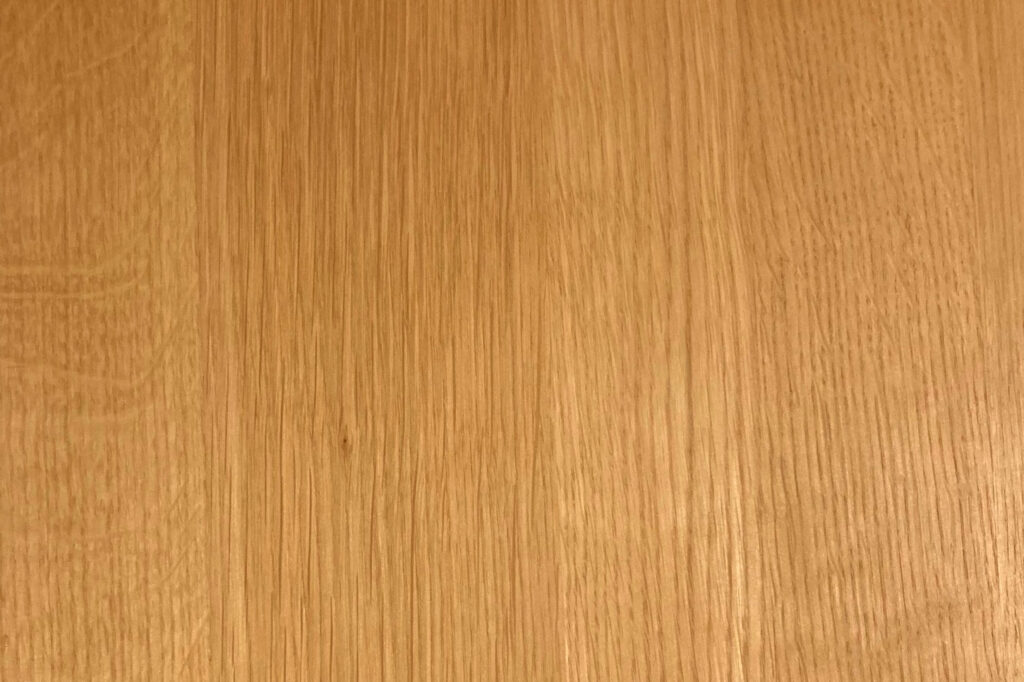
Our standard material is prime full-stave oak, usually American white oak or European oak. This is a premium choice for handmade furniture.

“Full-stave” means the tabletop is made from long boards running the length of the top, rather than the shorter “butcher’s block” pieces often seen in kitchen worktops. This gives a cleaner, more continuous grain pattern, with no short cross-grain joins interrupting the surface.
Prime oak is also generally well colour matched and mostly free of knots, splits or defects. You may see small pin knots here and there, but not the more dramatic knots and gaps associated with rustic or character-grade oak.
This kind of oak is not cheap, but it offers a very good balance of beauty, durability and value. We buy timber in quantity and do not apply a large material mark-up, so customers benefit from the quality of the material without paying excessive retail timber prices.
There are cheaper solid wood options. Ash and beech can be less expensive than oak. Softwoods such as pine, spruce or fir can reduce the cost further.
One of our favourite lower-cost softwoods is knotty pine. It can cost around a third of the price of oak and can still look very attractive, especially if you like a light, fresh, simple Scandinavian feel. The knots give it warmth and character, and it can also be stained for a more earthy or antique look.
The downside is that pine is much softer than oak. For a dining table or desk that will be used heavily every day, it will show dents and wear more quickly.
At the other end of the scale is walnut (either American black or European varieties). They are beautiful, dark, rich, luxurious hardwoods, but significantly more expensive. Solid walnut can be around 40% more expensive than oak, which is why many customers choose dark-stained oak if they want a deeper colour without the full walnut price.
Design complexity is often the biggest cost driver
Once material, size and thickness are accounted for, the biggest factor is usually complexity.
A straightforward table based on one of our in-house designs is much more cost-effective than a completely new design. That is because we have already developed the proportions, tested the structure, made the templates, worked out the tooling and refined the build process.
If a customer asks us to make a completely new base or leg design, we have to think through questions such as:
- will the table design they want be stable or will it wobble?
- how will the joints work – is it clear how they will be made?
- what templates or tooling are needed and how much will they cost?
- how long will the new process take – is the timescale predictable?
- are there unknown risks in the design?
That extra planning and testing has to be built into the price.

Complexity can also come from the tabletop itself. Special shapes, large rounded corners, cut-outs, unusual profiles or non-standard construction can all add time. Cable holes and socket cut-outs usually do not add a huge amount — often somewhere around £40 to £100, depending on the shape, size and quantity — but more involved custom features can cost more.
Added features with moving parts, such as drawers, sliding shelves or cupboard doors, can also increase the cost significantly. With solid wood, movement caused by changes in humidity always has to be considered. A drawer, door or sliding element needs to work not only on the day it arrives, but years later too.
This is one reason MDF, chipboard and plywood are widely used in large-scale furniture manufacturing: they are stable and predictable. Solid oak is a premium material, but it needs to be designed and built with care.
Where customers want built-in storage or complex moving parts, we are happy to help if the budget allows. But often it makes more financial sense to buy a ready-made drawer unit that works with the look of the table and fits underneath.
Finish can affect the cost too
Our standard finish is hardwax oil. It is durable, food-safe as a dining table top, repairable and well suited to solid wood furniture. It protects the wood while still allowing it to feel natural.
Most of the time, finishing with hardwax oil is efficient because it is a material and process we know very well.
Costs can rise when a customer requests a non-standard finish, especially if it involves testing unfamiliar products or techniques. Recent examples of more complex finish requests include ebonised wood, brushed wood, high-gloss finishes, epoxy resin and thick oil-based varnishes.
These finishes can require sample testing, multiple product trials, altered sanding methods, extra drying time and sometimes reworking if the product does not behave as expected. That time and risk has to be reflected in the quote.
In some cases, if someone wants a highly specialised finish — for example, a complex resin process or a factory-style gloss finish — we may suggest they work with a specialist in that area. Our usual strengths are hardwax oils, water-based varnishes and stains, and painted finishes for legs or bases where appropriate.
How custom oak tables compare to IKEA, John Lewis and Heal’s
A useful way to understand Tablemaker’s position is to compare us with broad UK furniture price ranges.
At the budget end, retailers such as IKEA offer tables for a few hundred pounds. They can look good and serve a purpose, but they are usually made from lower-cost materials such as chipboard, MDF, laminate or thin veneer. They are not designed to be repaired and refinished in the way solid wood furniture can be.
At the mid-range, retailers such as John Lewis often sell dining tables in the high hundreds to low thousands. Some use solid wood, but many are oak veneer, engineered timber or hybrid constructions, sometimes with metal legs.
At the high end, retailers such as Heal’s offer premium furniture, often associated with named designers or design houses. The workmanship and materials may be excellent, but the price can rise substantially, particularly when brand, design prestige and larger retail overheads are factored in.
Tablemaker generally sits in a similar price range to good mid-range retail furniture, but with a different proposition: solid wood, made to order, custom sizing and direct workshop production.
For example, our solid oak dining tables often sit around £800 to £1,000, while comparable fully solid oak customisable tables from larger premium retailers can cost significantly more.
This is largely because we work directly, build in-house, keep our designs efficient to produce, and allow customers to customise from a set of proven design foundations.
Why custom tables vary so much in price
Custom dining tables vary widely in price because the word “custom” can mean different things.
At one end, custom might simply mean choosing the exact size of an existing design. That can be very cost-effective.
At the other end, custom might mean designing a completely new piece of furniture from scratch, with unusual dimensions, a new leg structure, special finish, drawers, shelves, cable management and non-standard materials. That is a very different level of work.
The main reasons prices vary are:
- solid wood costs more than chipboard, MDF or veneer
- handmade furniture takes skilled workshop time
- custom work cannot be mass-produced in the same way as factory furniture
- UK labour costs are higher than overseas factory production
- unusual features introduce extra planning, testing and risk
Mass-produced furniture can be cheaper because it is designed around factory efficiency. The same parts can be made again and again, stored, shipped and assembled in large numbers.
Custom furniture is different. It is made to order, often in small quantities or as a one-off. That is exactly why it can fit your space and requirements so well, but it also means the pricing has to reflect the work involved.
Is a custom oak dining table worth it?
Whether a custom dining table is worth the extra cost depends on what you value.
If you simply need a low-cost surface for occasional use, a budget table may be perfectly reasonable. But if you want a table that fits your space properly, looks right, feels substantial and can last for many years, a custom solid oak table makes a lot of sense.
The main benefits are:
- exact sizing
- premium materials
- repairability
- long-term durability
- more control over style and finish
- a piece that suits your home rather than just fitting approximately
Exact sizing is often the biggest practical benefit. A dining table that is slightly too large can make a room feel cramped. One that is too small may not seat enough people comfortably. A table made in the right size can give you the seating you need without taking up unnecessary floor space.
In homes where every centimetre matters, that is a real advantage.
Solid oak also has a major repairability benefit. We sometimes repair existing dining tables for local customers, so we see the difference between materials very clearly. When a table is made from chipboard, MDF or laminate and the surface has chipped, swollen, peeled or blown, it is often effectively beyond economical repair.
A solid wood table is different. It can usually be sanded, repaired and refinished. Scratches, dents, heat marks and stains can often be removed or greatly improved. Even more serious damage can often be repaired using normal carpentry and joinery methods.
That makes a solid oak table a long-term object rather than a disposable one.
Cost per use: why a better table can be cheaper over time
One way to think about value is cost per use.
Imagine you buy a £300 budget dining table and use it twice a day for five years. That gives roughly 3,650 uses. The cost per use is about 8p.
Now imagine you buy a £750 Tablemaker table and use it twice a day for 20 years. That gives roughly 14,600 uses. The cost per use is about 5p.
That is a simplified example, of course. But it illustrates an important point: a cheaper table is not always cheaper in the long run.
If a solid wood table lasts longer, works better in your space and can be repaired rather than replaced, it may offer better value even if the upfront price is higher.
How to manage the cost of a custom table
If you want a custom table but need to keep the price under control, the best approach is usually to start with one of our in-house designs and customise the details that matter most.
The most cost-effective customisations are often:
- choosing the exact size
- selecting the right edge profile
- choosing the right finish colour
- adjusting the corner shape
- choosing an appropriate thickness
These changes can have a big visual and practical impact without requiring us to design the entire table from scratch.
A more expensive route would be to request a completely new leg or base design, an unfamiliar finish, unusual construction or added features such as drawers and cupboards.
Thickness is another useful cost lever. For many modern homes, 24mm oak is a very good choice. It looks clean, light and contemporary while still being strong and substantial. If you want a chunkier, more traditional or heavier look, 30mm may be more suitable, but it will cost more.

Material choice can also help. If solid oak is outside the budget, pine, ash or beech may be worth considering depending on the project. Pine in particular can offer a lower-cost route to custom sizing, though it is softer and less durable than oak for heavily used surfaces.
The simplest rule is this:
The closer you stay to an existing Tablemaker design, the more cost-effective your custom table is likely to be.
The more you move away from that — especially with new bases, unusual shapes, special finishes or added moving parts — the more the price is likely to rise.
Typical cost of a custom oak dining table in the UK (summary)
- Budget (mass-produced / veneer): £300–£600
- Mid-range solid wood (Tablemaker level): £700–£1,200
- High-end bespoke / designer: £1,500–£3,000+
Frequently asked questions
What is the average cost of a custom oak dining table in the UK?
There is no single average cost because it depends on the design, size, material, thickness and level of customisation. At Tablemaker, most in-house solid oak dining tables and desks fall broadly in the £700 to £1,000 range, although smaller items can cost less and larger or more complex pieces can cost more.
More bespoke custom tables and desks often fall between £1,000 and £2,000, depending on complexity.
Can you get a solid oak dining table for under £1,000?
Yes. Most of our in-house solid oak dining table designs are available for under £1,000 in many common sizes.
Each product page includes a price calculator based on the length and width you enter, usually in 1cm increments. If you want to change the specification, we can then provide a more detailed quote.
Why are custom oak dining tables more expensive than mass-produced ones?
Custom oak dining tables cost more because they are made from better materials and built to order rather than mass-produced in factories.
Many cheaper dining tables use chipboard, MDF, laminate or thin veneer. These materials can look good at first, but they are usually less durable and much harder to repair. Solid oak costs more, but it can last for decades and can usually be sanded, repaired and refinished.
Is a custom dining table worth the extra cost?
If you want exact sizing, solid wood construction, long-term durability and a design that suits your space properly, a custom dining table is often worth the extra cost.
If you only need a low-cost table for light use, a budget retail table may be enough. But for daily use, especially in a dining room, kitchen or home office, solid oak and custom sizing can offer much better long-term value.
What factors affect the cost of a custom oak dining table?
The main factors are size, thickness, material, design complexity, leg or base style, finish and added features.
At Tablemaker, size affects price, but complexity and thickness can sometimes have a bigger impact. A simple larger table may be cheaper than a smaller table with a complicated base, unusual finish or built-in features.
Does table size significantly affect the price?
Yes, but not always as much as people expect.
For example, as mentioned earlier, increasing an ATO 55 table from 140cm × 75cm to 180cm × 85cm increases the price by less than 8% at the time of writing. Other choices, such as moving from 24mm to 30mm oak or requesting a completely new base design, can have a similar or greater effect.
What is the difference between solid oak and oak veneer?
A solid oak table is made from real oak boards. An oak veneer table usually has a very thin layer of real oak applied over a core material such as MDF, chipboard or plywood.
Veneer can look good and has its place in furniture making, especially for cabinets and doors where stability is important. But for dining tables, solid oak is usually more durable, more repairable and longer lasting.
Why is solid oak more expensive than other materials?
Solid oak is a premium hardwood. It is stronger, harder and more durable than softwoods such as pine, spruce or fir, and much more substantial than chipboard or MDF.
The prime full-stave oak we use is generally well colour matched and mostly free from large knots or defects. It costs more than lower-grade timber, but it gives a cleaner, longer-lasting and more refined result.
How long should a solid oak dining table last?
A well-made solid oak dining table can last for many decades if it is cared for properly.
There is no natural expiry date. Even if the finish becomes worn or the surface is damaged, a solid oak table can usually be sanded, repaired and refinished. That is one of the main reasons solid wood is such a good material for dining tables.
Can I choose custom dimensions for my dining table?
Yes. Custom sizing is one of the main benefits of ordering from Tablemaker.
Most of our in-house table designs are available in 1cm length increments, and many are available in 1cm width increments too. We list minimum and maximum sizes online based on readily available material sizes and practical delivery limits, but if you need something outside the listed range, you can ask.
For example, if a design is listed up to 210cm but you need 230cm, it may still be possible. It may simply mean a slightly longer lead time.
What size dining table do I need?
As a general rule, allow at least 50cm per person for seating width. If you prefer a more spacious feel, or if your chairs are wider, allow more.
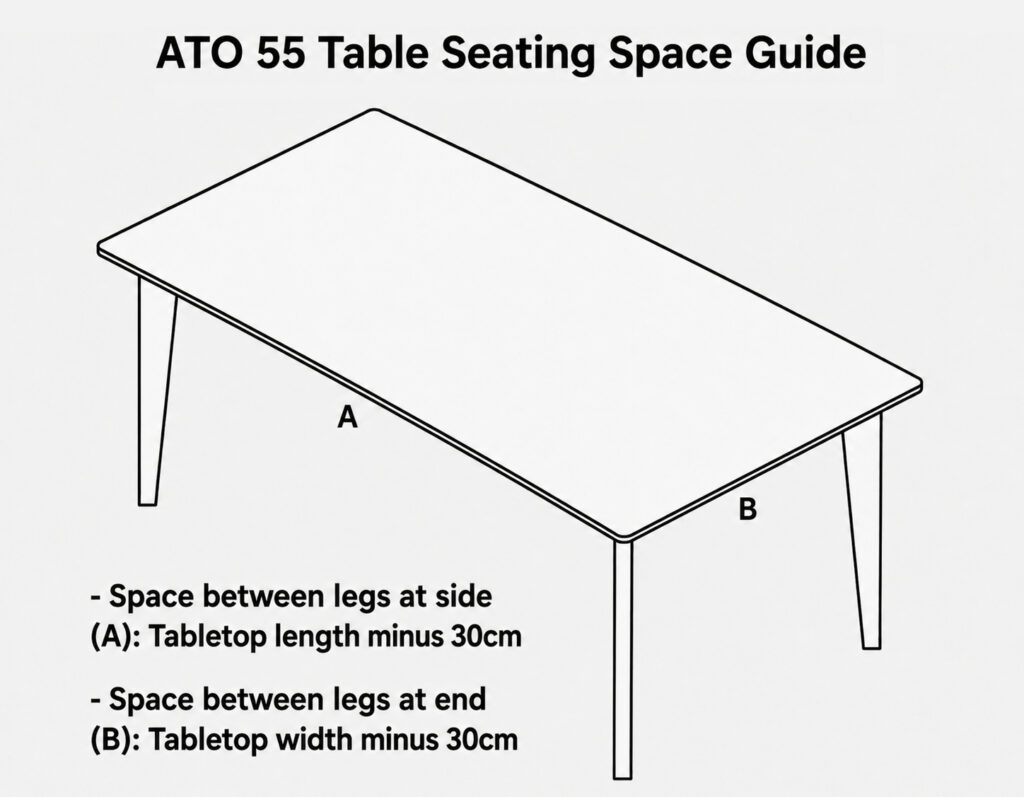
The space between the table legs matters as much as the tabletop size, because that determines how many people can sit comfortably along each side. Table width also matters, especially if people will sit at the ends.
As a rough guide, for our ATO 55 design:
- 4 seater: 80–129cm long × 80–100cm wide
- 6 seater: 130–179cm long × 80–100cm wide
- 8 seater: 180–190cm long × 80–100cm wide
For more detail, see our guide to choosing dining table sizes.

Can a solid oak table be repaired if damaged?
Yes, in almost all cases.
Scratches, stains, small dents, heat marks and surface wear can usually be improved by sanding and refinishing. More serious damage, such as splits or structural issues, can often be repaired using normal carpentry and joinery techniques.
This is a major advantage over chipboard, MDF, laminate and many veneer constructions, where damage often cannot be repaired economically.
Do solid wood tables require a lot of maintenance?
Not usually, provided they are well finished and looked after reasonably carefully.
Our standard finish is hardwax oil, which gives a good level of protection while keeping the wood natural and repairable. We recommend wiping up spills promptly and avoiding harsh cleaning chemicals.
Over time, the finish may eventually need refreshing, but because the table is solid wood, it can be brought back to excellent condition.
Final thoughts
A custom oak dining table is not the cheapest way to buy a table, but it can be one of the best-value options over the long term.
The price depends on size, thickness, materials, design complexity and the level of customisation. But if you choose carefully, start from a proven design and focus on the features that matter most, a made-to-order solid oak table can be surprisingly good value.
At Tablemaker, we specialise in solid oak tables and desks that are made to order, fairly priced and built to last. If you are trying to work out what size, style or specification would suit your space, we are always happy to help.