

Does sunlight fade oak table tops in a café window?
Yes, sunlight can fade or change oak table tops in a café window, especially when menus, planters or table numbers sit in the same place for months. The bigger issue is patchy colour, not instant failure. Solid oak still works well if you control exposure and choose a finish that can be repaired.
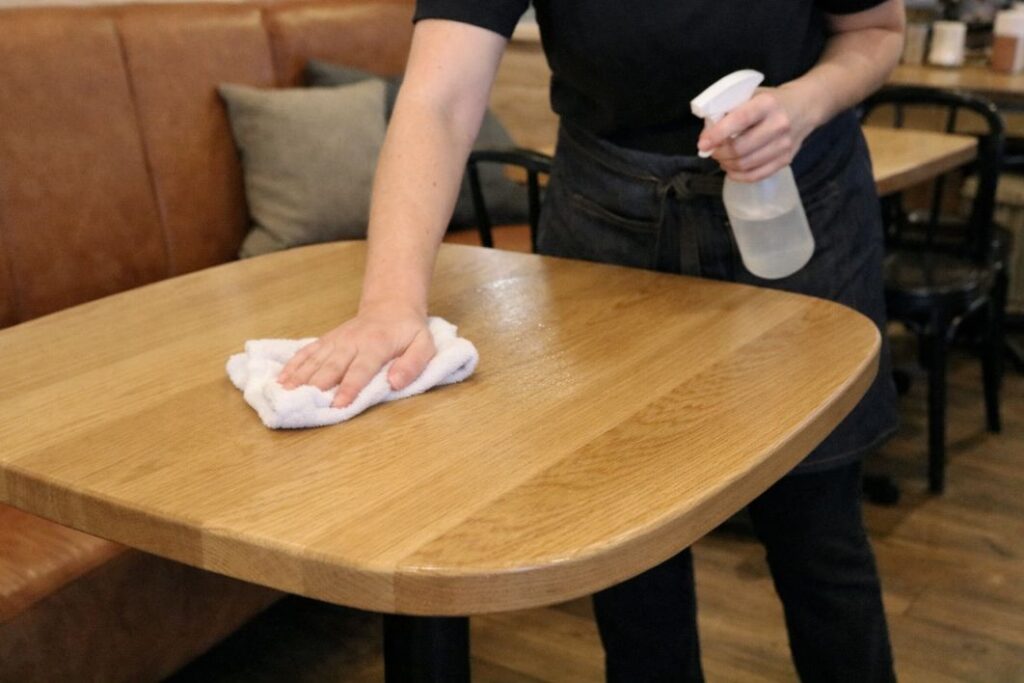 An illlustrative image of a cafe staff member wiping a wooden table with soft round edges
Sunlight changes oak colour before it causes obvious failure
A bright window seat can be hard on an oak table because small changes build up with daily exposure. Put a menu stand on the same corner every day and the covered patch gets less light than the rest of the top, so the colour can age unevenly.
Sunlight does not send oak in one simple colour direction. Research on oak and other woods has found that light-related colour change can vary, so we do not treat every sunny table as if it will always darken or always lighten. In practice, the thing you notice first is often the outline of an object, a paler square, or a darker area where one part of the surface has had more exposure.
Colour change also needs separating from other marks. A faded oak table top is different from a water ring, a heat mark, worn finish, or a crack caused by movement in the wood. Those problems can sit together on a busy café table, which is why we look at the surface, the finish and the way the table is used before deciding what has happened.
Solid oak is still a good material for café window seating. The sensible aim is to reduce harsh and uneven exposure, then choose a top that can be sanded, recoated and kept in use when the surface starts to show age.
Window glass lowers exposure, but it does not remove the risk
Window glass and UV film can reduce light damage, but they do not make an oak table by a window immune to fading. Ultraviolet radiation, usually shortened to UV, matters, and visible light also plays a part.
Here is the practical difference between the common controls.
| What helps | What it does | What it does not do |
|---|---|---|
| Ordinary window glass | It cuts some UV before light reaches the table. | It does not block all UV or stop visible light reaching the oak. |
| UV window film | It can reduce UV exposure where the right film is fitted. | It does not stop all fading, because visible light and exposure time still matter. |
| Blinds or shading | They reduce strong direct sun during the worst periods. | They only work when they are used consistently. |
| Moving fixed objects | It spreads exposure across the top more evenly. | It will not reverse an old patch without surface work. |
Canadian Conservation Institute measurements found that regular glass reduced UV by about 26 percent, with an 11 percent margin either way. That figure is useful because it stops the common assumption that glass alone solves the problem.
Product claims on window film need careful reading too. A claim about UV reduction means little unless it says which wavelength range was tested. For a café owner, the practical point is simpler: use glass, film and shade as layers, then manage what sits on the table.
 Round Top – example with cafe base
Move menus, table numbers and planters from time to time if they sit on the same oak top each day. Fixed objects create the kind of patchy colour that shows up first beside a bright window.

Café use makes uneven fading more likely
Daily café use makes sunlight marks more visible because the table is being wiped, used and rearranged all day. At Tablemaker, we look at how the top will be used as well as where it will sit, because a window table with fixed service items ages differently from a clear table in the same position.
Fixed objects create outlines. Menus, condiment trays, planters, card machines, till displays and table numbers all block light from part of the surface. Leave them in one place for long enough and the covered area may no longer match the exposed area around it.
Cleaning can confuse the picture. Regular wiping, spills and hot drinks wear the finish in high-use areas. A worn patch can look like fading at a glance, so the repair may be about sanding and recoating the finish rather than changing the colour of the timber itself.
Sunny windows can be harsher local spots. Heat and humidity changes near glass make life harder for wood and finish. Wood takes in moisture when the air is damp and gives it off when the air dries, and that movement can contribute to splits, cracks or finish damage.
The avoidable problem is the permanent shadow of a menu stand on an otherwise well-used top.
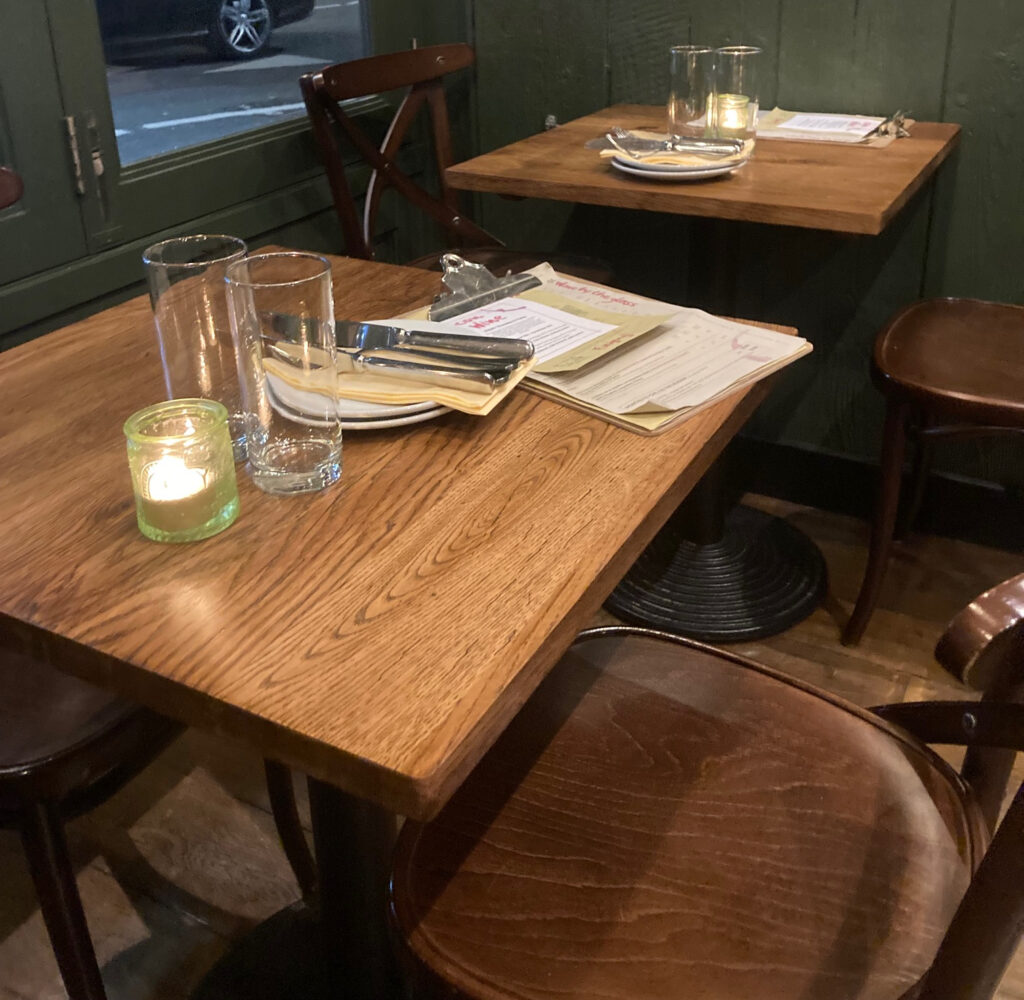 Commercial cafe table tops in use, London
Better specification reduces visible fading
When you specify oak café table tops for sunny window seats, judge the surface by repairability as well as appearance. A finish that looks good on day one still has to cope with wiping, light and the odd marked area.
Useful choices before ordering include:
- Choose a repairable finish. Hardwax oil suits working oak tops because marked areas can be lightly sanded and recoated.
- Avoid permanent displays on the sunniest tables. Move menus, table numbers and planters during the week, especially where strong light falls across one side.
- Use blinds or shade during the brightest periods if the window area allows it. That reduces the worst exposure without changing the whole layout.
- Think carefully about strong colour contrast. Natural and mid-tone finishes usually make gradual change easier to live with than very high-contrast choices.
- If tops are loose and the bases allow it, rotate their position from time to time so the same edge does not always face the window.
Because Tablemaker uses hardwax oil as standard, we treat future maintenance as part of the specification, not as an afterthought. Hardwax oil is water resistant, food safe and repairable, but it is not UV-proof. A solid oak table top in sunlight still needs sensible placement and care.
Our tops are solid wood, most often oak, and we do not use MDF, chipboard or veneered board for tops. That matters in a sunny café because the surface has real repair depth when it starts to show daily use.
Choose a finish you can repair when wear starts to show. Hardwax oil suits café tables because marked areas can be lightly sanded and recoated.
Solid oak gives you a longer-term answer
Some colour change belongs to a working café table, especially beside a bright window. The useful question is whether the top gives you options when that change becomes too obvious.
Solid oak can be sanded and refinished many times, which gives you a way to deal with fading, finish wear and patchy areas later. Veneered tops do not give the same repair depth, so they cannot be treated like solid timber when the surface has worn through or become uneven.
One approach is to buy for day-one sameness and hope the window does not alter the surface. Another approach is to plan for controlled ageing from the start, using solid oak, a repairable finish and a layout that avoids fixed shadows. The second approach works better over the long term because it accepts what sunlight and café use do, then leaves room to maintain the table instead of replacing it too soon.
 Oak tables for cafes – Bespoke – Illustrative Image
Questions we get asked about oak table tops in sunny windows
Should you move oak tables away from a sunny window?
You do not always need to move them away, but direct sun should be reduced where the layout allows it. Blinds, shade and changing object positions often matter more than moving every table out of the window area.
Does hardwax oil stop UV damage on oak?
Hardwax oil does not make oak UV-proof. We use it because it is water resistant, food safe and repairable, so marked areas can be lightly sanded and recoated.
Can a faded oak table top be fixed without replacing it?
A solid oak table top can often be improved by sanding and recoating, depending on how deep the mark or fading has gone. Veneered tops have much less repair depth, so the same repair approach may not be possible.
Why has the area under a menu stayed a different colour?
A menu left in the same place blocks light from part of the top. The uncovered oak keeps changing with exposure, so the covered area can stand out as a pale or dark patch.
Are darker finishes better for sunny café tables?
Darker finishes are not automatically better in a sunny window. We usually look at the whole setting, including light level, fixed objects and future repair, because strong contrast can make uneven change more noticeable.