

The Commercial Table Top Ordering Checklist: Measurements, Edge, Finish, Fixing
What must you consider before ordering a commercial table top?
To ensure your commercial table top fits, functions and lasts, you need to plan carefully across several dimensions. These include accurate measurements, edge selection, finish type, fixing method and allowances for solid wood behaviour. Each choice affects performance, appearance and ease of installation.
Table of Contents
An AI photo of a commercial-grade solid oak table
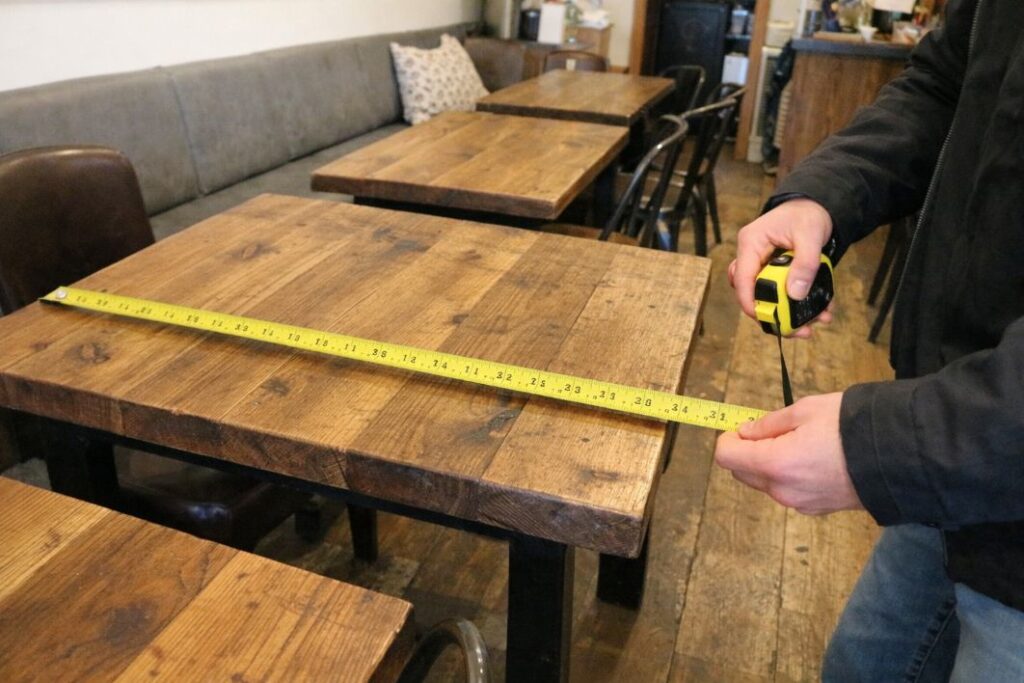
Confirming the Right Measurements for Your Space and Base
In high-traffic environments, measurements are non-negotiable. A few centimetres in either direction can mean the difference between efficient movement and persistent bottlenecks.
Before ordering, check the following:
- Table footprint: Measure both length and width based on available floor space, including nearby fixtures and access routes.
- Overhang and legroom: Ensure enough space for legs and chairs. Aim for 30cm of overhang on long sides when seating is planned.
- Clearances: Allow at least 90cm walkway behind seated diners in restaurants or cafés, and 120cm in areas used for circulation or accessibility.
- Base compatibility: Compare the footprint and fixing points of your base with the intended top dimensions.
- Seating vs. spacing: A six-seater setup may demand different dimensions in a co-working space than it does in a casual bistro.
Commercial layouts often require more precise planning than domestic ones. Fixed seating, shared working zones and fire regulations leave little room for guesswork. Where off-the-shelf increments do not sit comfortably within your available space, made-to-measure tops provide important flexibility.
Choosing the Right Edge Profile for Function and Feel
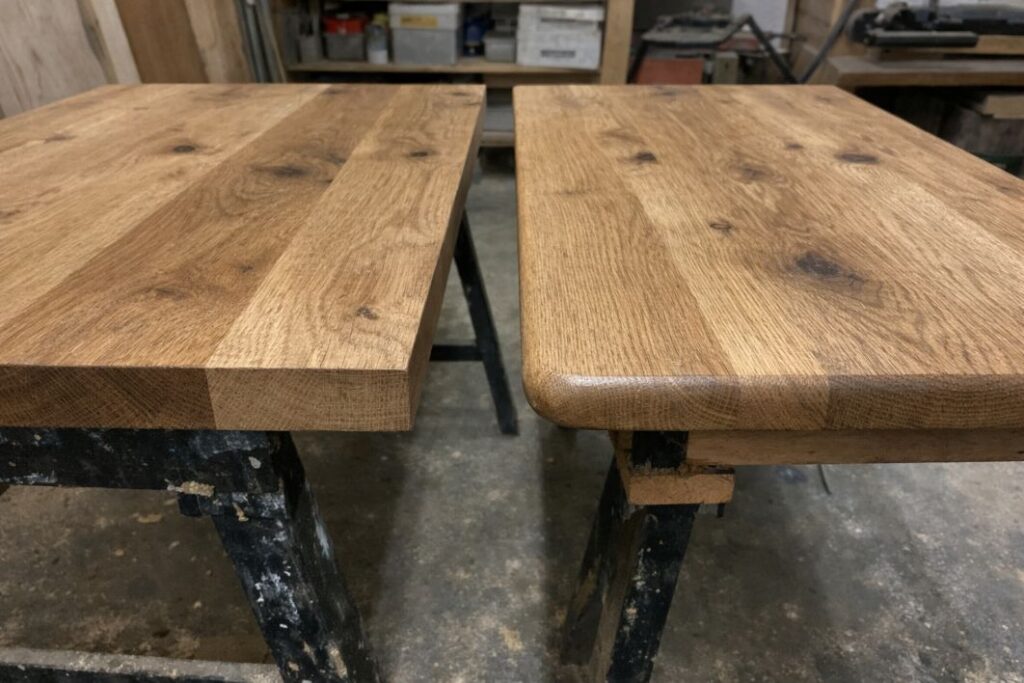
Edge selection is not just aesthetic; it shapes how a table feels in use and how it performs over time.
Common options include:
- Square edge Pros: Clean modern look, precise lines. Cons: Sharper corner feel, more prone to knocks.
- Chamfered edge Pros: Softens the visual weight, offers chip resistance. Cons: Slightly more complex to clean along the angle.
- Rounded edge (radius or bullnose) Pros: Safer in public or child-friendly spaces, smooth to touch. Cons: More relaxed appearance may not suit all interiors.
- Bevelled edge Pros: Adds refinement without bulk, reduces edge wear. Cons: Less tactile for high-traffic environments.
In a busy café, where tables are cleaned regularly and moved often, a chamfered or rounded edge reduces impact and wear. In a quieter workspace, a square or bevelled edge might suit minimal visual setups while maintaining usability. Consider how the table will be used, cleaned and approached daily.
Pro Tip: Use paper templates cut to size in your space to visualise overhang and movement areas before confirming table dimensions.
An AI photo displaying a solid oak table edge comparison
Pro Tip: If reusing an existing base, photograph the mounting points and bring dimensions to consultation to avoid misalignment issues later.
Selecting a Finish That Withstands Commercial Use
Finish influences appearance, yes, but more critically it governs how the wood responds over time.
Comparison of common finishes:
- Hardwax oil Resists spills, allows spot repairs, food safe. Suited to cafés, restaurants and offices needing cleanable yet repairable surfaces.
- Lacquer Glossy or matte, forms a protective film. Tough initial barrier but harder to renew locally once damaged.
- Polyurethane Highly water-resistant, plastic-like finish. Durable but often non-breathable, which can trap moisture and reduce repair options.
Many commercial clients expect water resistance but find later that a scratch or stained patch may require full refinishing. Hardwax oil achieves a practical balance, offering solid protection alongside the option to renew specific areas without heavy equipment or downtime. Tablemaker applies this finish as standard for that reason. It performs well while respecting the material beneath.
Understand Fixing Options and Base Compatibility
How your table top is secured to its base matters more than many expect. Poor fixing can result in cupping, instability or limits on future reuse.
Common methods include:
- Brackets: Often used with metal frames, these secure directly into the underside but may limit movement if positioned incorrectly.
- Threaded inserts: Allow for repeat fixings and reassembly, useful for relocatable furniture or modular layouts.
- Straightening bars: Supplied with many Tablemaker tops, these counteract wood movement. They may also influence where fixings can be placed.
Undrilled tops are often preferred in commercial contexts because they can be matched to existing or non-standard bases on site. Drilling in advance without precise base data risks misalignment or weakening the structure. Compatibility checks should happen early, especially if using a third-party frame or reusing existing bases.
Before ordering, check:
- Base size and mounting point positions
- Intended fixing method
- Movement allowance needs
- Whether the base accommodates straightening bars
- Delivery of top and base in the correct sequence for safe fitting
Factoring in Wood Movement and Stability Over Time
Solid wood tables respond to humidity and temperature. This is not a fault but a characteristic of the material.
How movement is managed:
- Grain direction is chosen to support long-term stability.
- Kiln-dried timber lowers the risk of excessive expansion.
- Straightening bars help resist cupping, especially on wider tops.
- Finish choice impacts moisture protection without sealing the wood too tightly.
- Fixing allowances are important to enable natural expansion and contraction.
Warpage concerns often arise when tops are rigidly fixed with no room to shift. This is especially problematic in heating-rich or air-conditioned interiors. Simply understanding that solid wood will move, and planning for it, avoids most issues before they occur.
Explore Made to Measure Table Tops
Choose a size, finish and edge profile that fits your exact space and specification. Designed and built for high-traffic commercial use.
Browse Made to MeasureMatching Table Tops to Commercial Use Cases
Every setting places different demands on a table top. What suits a fast-turnover coffee shop may not suit a shared hot-desk setup.
Use cases compared:
- Café / Restaurant: Needs a durable, easy-clean top with edge protection. A 32mm thickness gives a sturdy impression. Hardwax oil suits frequent wipe-downs.
- Co-working / Offices: Prioritises leg space, cable clearance and minimal edges that allow for close seating. Rounded or bevelled edges improve comfort. Tops must work with sit-stand frames or mobile legs.
- Formal dining venues: Often choose wider tops with generous overhangs. A bevelled or square edge maintains visual definition without being aggressive.
- Multi-use spaces: Flexibility and easy repositioning matter most. Lighter finishes and standard base compatibilities become desirable.
Thickness plays both structural and visual roles. A 26mm or 32mm board offers strength and heft. For longer spans or thicker looks, tops at 36mm or above may suit, especially where presence matters.
Clarifying Lead Times, Delivery and Installation Readiness
Made-to-order furniture demands a little planning. Nearly all Tablemaker commercial orders are produced and delivered within two to three weeks, but the whole process benefits from early clarity.
To prepare for installation:
- Confirm base specifications and ensure they arrive on time.
- Measure access routes including lifts, doorways and stairwells.
- Arrange suitable storage if installation will not happen immediately.
- Decide who is responsible for drilling and fixing on site.
- Inform delivery contacts about commercial access issues or timing restrictions.
Undrilled tops mean greater adaptability but do require forethought. Installation is smoother when fixing methods are decided in advance, particularly when using bespoke or imported bases. If a table is needed for an event or opening, build in margin for fixing and levelling.
Few businesses enjoy surprises during a fit out. Accurate information, shared early, prevents delay and damage, making the entire process smoother from workshop to workspace.
Talk to a Specification Adviser
Unsure about measurements, fixing or finish? Our team can guide your order to ensure perfect fit and lasting performance.
Request a Consultation
Tablemaker
55 High St, London N8 7QB
02083416334
HVQM+58 London