

Custom Table Top with Rounded Corners UK: Options and Measuring Tips
Why consider a custom table top with rounded corners?
Rounded corners on a custom table top improve safety and comfort, reduce wear, and help the piece sit more harmoniously in high-traffic or family-focused spaces.
Rounded corners are often chosen for practical reasons that extend beyond appearance. In households with small children, they reduce the risk of sharp impacts. In shared offices or tight dining areas, they allow easier movement around the table without snagging on clothing or bumping into corners. Aesthetically, a soft corner table introduces a sense of calm and flow, particularly in interiors with gentle proportions or organic shapes.
Certain table frames or leg placements also visually benefit from curved corners, creating better alignment with rounded metal legs or tapered timber details. Over time, softened corners reduce the likelihood of chips or impact damage since there’s no sharp angle to bear the brunt of wear.
Rounded corners can also complement other visual elements, such as curved back chairs, oval pendant lamps or other pieces with softened proportions. For clients seeking functional elegance without harsh edges, this detail often makes a subtle but satisfying difference.
Table of Contents
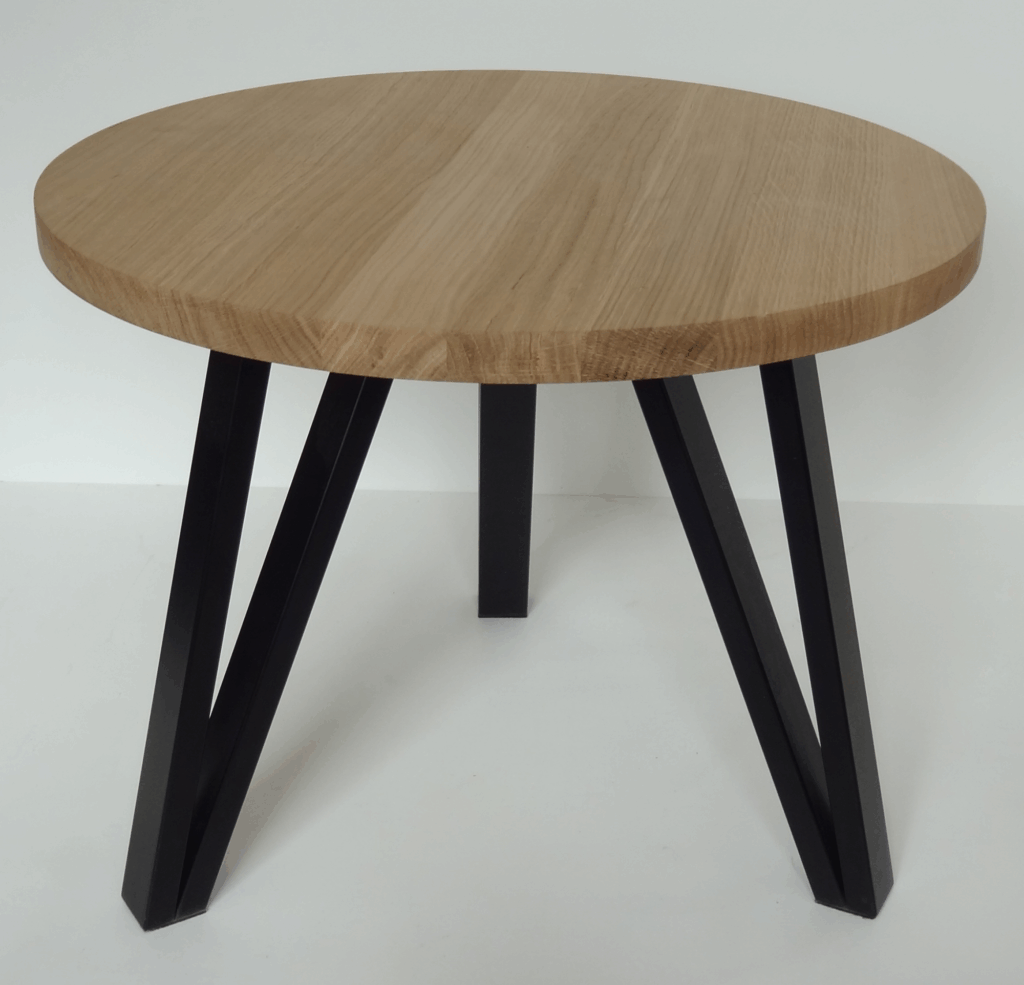
Types of Rounded Corners: Radius Options and Visual Impact
The radius of a corner refers to the size of the curve forming the corner. Even small differences in radius size can shift a table’s look and feel significantly.
A small radius (10 to 20mm) offers a subtle soften. It takes the edge off the corner without changing the overall square form too much. These work well for modern, minimalist interiors that need a touch of approachability without losing structure.
A medium radius (30 to 60mm) strikes more of a balance. At this size, the curve becomes a visible part of the design without appearing exaggerated. It feels deliberate and blends nicely with rounder elements or lightly tapered legs.
A large radius (70mm and above) introduces a broader sweep. This is closer to a softened rectangle or even oval in perception, especially noticeable on smaller tables or desks. Some clients opt for this in areas with tight turning circles or where the table sits in a passageway.
The table’s overall size impacts how a radius appears. For instance, a 50mm radius on a small square table will feel much stronger than the same on a large dining top. Matching the corner radius to the leg shape or considering the combined effect with the top’s edge profile also helps keep the design cohesive.
Material Considerations for Rounded Corner Table Tops
Solid wood responds differently to shaping, and that behaviour matters when planning curved corners.
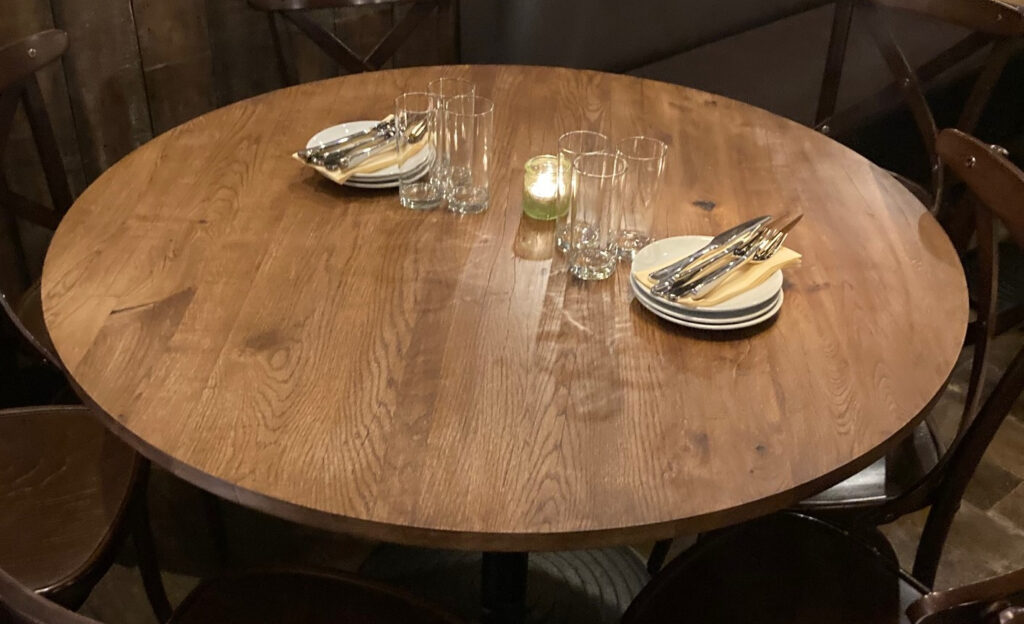
Oak, commonly used in the Tablemaker workshop, is a favoured choice for rounded edges. Its combination of hardness and stability means curves can be shaped cleanly and hold their form well. Oak’s grain also sands to a fine finish, which gives a smooth feel around the curve without fuzziness or splintering.
Ash has a slightly more open grain and a lighter tone. When rounded, the grain movement becomes a design feature, revealing arcs and lines that highlight the shaping. It is easier to work than oak, which sometimes makes it a cost-effective option for wide curves or complex profiles.
Walnut adds warmth and contrast, but its grain structure and natural oil content can make shaping a bit more involved. It accepts curves well but requires experienced handling to avoid chipping near the edges.
In all woods, the grain direction matters. Corners shaped across the grain require careful attention to avoid tear-out or weak spots. A high standard of sanding and a well-chosen hardwax oil finish help protect and deepen the tactile quality, allowing rounded details to hold up under daily use and still be refinished easily if needed.
Pro Tip: Use a flexible curve ruler or printable templates to measure corner radius accurately before ordering.
Pro Tip: When fitting to tight areas like alcoves or near radiators, make a cardboard mock-up to test the footprint.
Measuring for a Custom Table Top with Rounded Corners
Accurate measuring is especially important when corners are curved, as the overall footprint and usable space can differ from a standard square-corner top.
- Measure full length and width Define the total footprint of the table, edge to edge, including where the curved corners begin. For example, a 140cm x 80cm top with curved edges still needs those base dimensions confirmed.
- Confirm the corner radius If replacing an existing top or matching it to nearby furniture, measure the current corner radius with a template, ruler curve, or even a coin if the curve is small and subtle. On new tops, decide the desired radius and ensure it is clearly noted.
- Account for overhangs or fixed points If placing the table top against a wall or fitting it around skirting boards, measure the gap and note any wall obstacles. Similarly, cafe or office installations may need to allow for radiator clearance or socket access.
- Fit to a base or legs If mounting to an existing frame, ensure the leg placements do not interfere with the planned corner shaping. Wide curved corners can affect where feet or support brackets attach.
- Avoid rounding assumption errors A common mistake is to subtract the radius from the overall table size. On most builds, the corner radius is a cut taken from the corner of the rectangle, not an addition. This affects both aesthetics and fitting.
If submitting measurements for a custom build, provide diagrams or sketches where possible. Even a photo with marked-up dimensions helps clarify your intent, especially when fitting into tight spaces or working with pre-purchased frames.
Compatibility with Existing Bases and Frames
One of the main advantages of a made-to-measure top is its ability to work with your specific base. However, a few elements need checking to ensure a smooth fit.
Leg Placement Some bases, particularly those with corner legs or pedestal supports, may require adjustment to match wide corner curves. A strong radius can bring the leg too close to the curve, limiting screw placement or affecting visual balance.
Overhang and Clearance If the base is already installed, consider how the rounded corners affect overhang. In smaller configurations, a curve may change where the edge appears to finish, altering the comfort clearance for seating.
Drilling Tablemaker supplies tops undrilled by default, which gives clients flexibility in positioning the top to suit their base. This is particularly useful with sit-stand frames or custom brackets.
Sit-Stand Compatibility Curved corners work well with desk frames, but users should verify that monitor arms or clamping accessories have enough flat edge space. The front edge is rarely curved, but on compact setups, positioning matters.
In some cases, small adjustments to leg placement or support brackets avoid conflict with corner shaping. The key is to plan ahead based on the full table footprint and the working area of the base.
Start Your Custom Table Top Order
Share your measurements and wood preferences to begin a tailored build with our team.
Request a quoteEdge Profiles and Finishing Options for Rounded Tops
Once corners are curved, the choice of edge profile affects both comfort and visual flow.
Chamfered Edge A bevelled cut along the edge creates a crisp line while relieving the sharpness. It pairs well with smaller-radius corners and gives a modern but not harsh appearance. Cleaning is straightforward, though the edge can show wear faster than rounder profiles.
Rounded Edge (Radius Edge) A uniform round-over along the edges creates soft continuity with the rounded corners. This profile is especially comfortable for forearms and suits casual dining or shared working environments. Dust is less likely to collect along the edge, and finish longevity tends to be higher.
Bullnose Edge More deeply curved than a standard radius, the bullnose wraps the full edge thickness with a semicircular form. This has a strong presence and works well on chunkier tops. It is comfortable, traditional in feel, and lower-maintenance, though it may draw visual attention depending on context.
Matching the edge profile to the corner radius ensures a smooth line throughout the piece. In some cases, subtle transitions are introduced to balance a strong corner curve with a lighter edge detail. Sanding quality and oil selection further influence how the profile looks and feels in use.
When to Choose a Fully Bespoke Solution
Standard corner options and sizes cover needs. However, certain situations call for a custom approach from the outset.
Examples include:
- Irregular spaces such as under-stair nooks, alcoves or loft eaves
- Fixed obstacles like radiators, beams or cable trays that require shaping or cut-outs
- Matching existing furniture with non-standard proportions, especially leg spacing or materials
- Cable management requirements for offices or shared home desks
- Commercial layouts where multiple sizes need to align or join across a continuous space
- Combined challenges, such as integrating a sit-stand frame, shared users and a defined corner radius
In these cases, commissioning a made-to-measure piece ensures nothing is compromised for the sake of standardisation. A well-briefed workshop can advise on trade-offs early, supply the top ready for fitting, and guide adaptations along the way.
At Tablemaker, many bespoke projects begin with a sketch or constraint, not a fixed design. The process is practical, not precious, and focused on solving fit, function and finish without unnecessary challenge.
Need Help Measuring Your Space?
Send us photos or a sketch and we will assist with radius choices and fit guidance.
Get measuring support
Tablemaker
55 High St, London N8 7QB
02083416334
HVQM+58 London