

Office Desk Tops for Fit-Outs: How to Standardise Sizes Across Teams and Floors
Why is standardising desk tops important in office fit-outs across multiple teams?
Standardising office desk tops creates consistency that simplifies planning, reduces long-term maintenance, and supports flexible workspace changes. In team-based fit-outs, it also streamlines procurement and avoids friction during reconfigurations.
Inconsistent sizing across floors can lead to cluttered floorplans, incompatible layouts, and increased difficulty when rearranging teams. Standard desk sizing helps align furniture with operational needs, supports clear space planning, and creates a more coherent visual identity across departments.
Some practical benefits of desk top standardisation include:
- Faster procurement processes and simplified supplier coordination
- Easier floorplan updates during team moves or expansions
- Improved compatibility with shared furniture components
- Reduced visual clutter in open-plan environments
- Lower cost of reordering, repair or replacement due to common dimensions
When managing large workplace fit-outs, standardisation becomes a tool for longevity, not restriction. It allows desks to support hybrid working models, clustering, and modular reconfiguration without needing a full redesign each time a layout changes.
Table of Contents
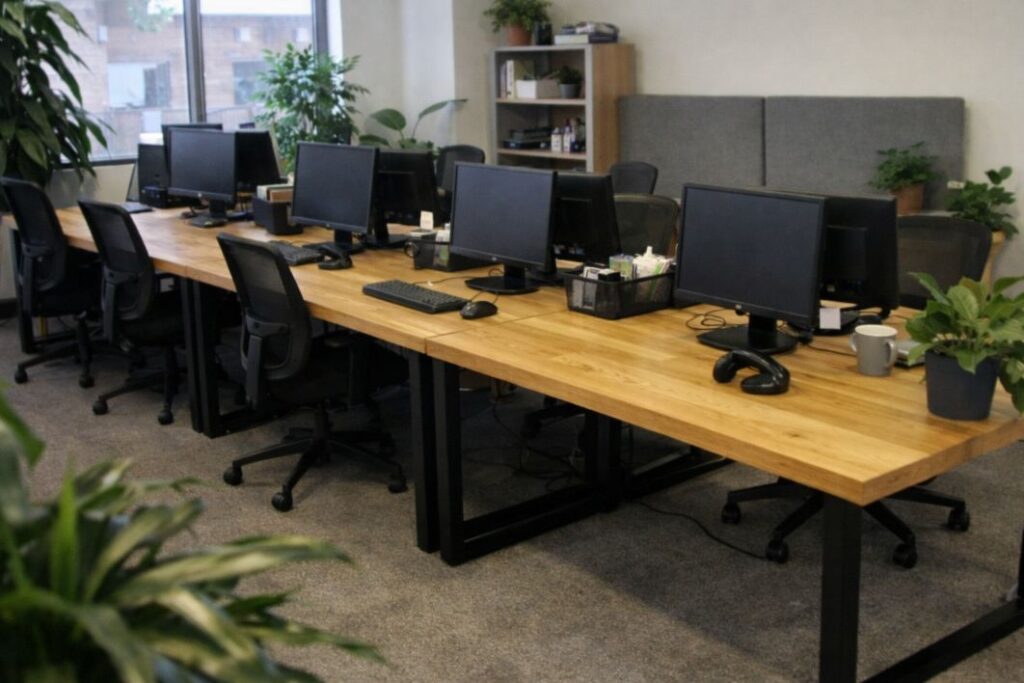
An AI photo of a commercial-grade solid oak table
Choosing a Core Size: What Dimensions Work Across Teams?
Finding a core size means balancing team requirements with spatial limitations. A single solution is rarely ideal for every situation, but most offices benefit from defined starting points.
Typical standard widths include:
- 120cm: Suitable for hot desking, compact setups, or areas with circulation limits.
- 140cm: A common compromise between usability and floor space.
- 160cm: Frequently used by design or tech teams with dual-monitor setups or peripheral-heavy tasks.
- 180cm: Appropriate for leadership roles or workstations with extensive layout needs.
Standard depths typically range from:
- 60cm: Suitable for narrow areas or when screens are wall-mounted.
- 70cm: Allows for comfortable use of laptops and monitors with some document space.
- 80cm: Preferred where additional depth is needed for personal equipment or desk sharing.
Depth affects posture, storage and screen positioning. Too shallow, and users struggle with monitor distance. Too deep, and circulation or reach becomes difficult. Common office guidelines recommend a depth of 70 to 80cm for full-time desk use.
When planning across teams, the goal is not to eliminate variety entirely, but to define enough consistency that space planning remains predictable. The base size should support 80 to 90 percent of users, allowing exceptions where justified.
Managing Variations Without Losing Uniformity
Consistency does not mean every desktop must be identical. Flexibility is often needed, particularly when dealing with legacy bases, spatial constraints or leadership workspaces.
Effective strategies that retain coherence include:
- Fixing depth across the office, while allowing width to vary by team or room
- Keeping materials and finishes identical, even when slight size adjustments are made
- Using fixed mounting locations to allow interchanging of tops within a shared system
- Allowing well-defined exceptions, such as executive desks or corner units, while keeping bulk orders standard
Visual coherence comes from alignment, finish and material rather than perfect replication. A “family” of desk tops, with shared materials and detailing but slightly differing dimensions, allows usability without compromising the overall fit-out design.
Modular furniture systems often use consistent fixing and leg positions to make this easier. Planning for such variation in advance reduces on-site improvisation and costly replacements later.
Pro Tip: Fixing a consistent desk depth across all departments, even when widths vary, creates visual alignment and helps with space planning.
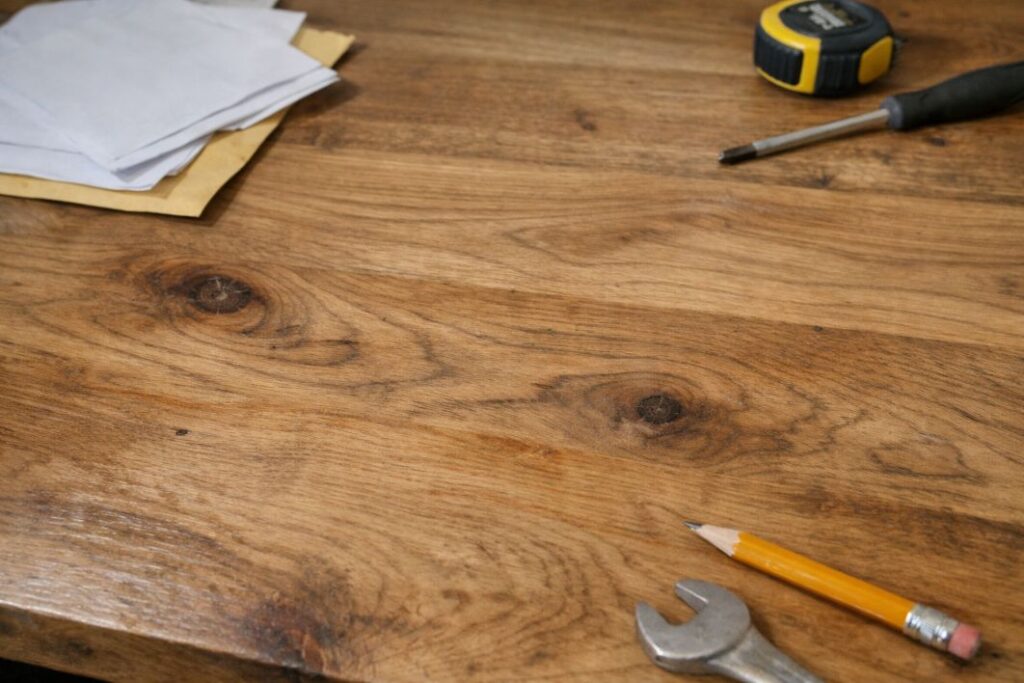
An AI photo displaying a solid oak table top
Pro Tip: By sourcing undrilled desk tops, you can reduce installation errors and maintain flexibility across different base designs.
Accounting for Base Compatibility and Fixing Methods
Desk tops must interface seamlessly with the frames beneath them. Fixing approach, compatibility and stability are just as important as dimensions.
To ensure flexibility during installation, many fit-outs opt for undrilled desk tops. This allows each top to be matched precisely to its base, whether fixed height, sit-stand or custom fabricated.
Key considerations for base compatibility include:
- Mounting holes: Different base models require distinct fixing patterns. Pre-drilling limits flexibility.
- Frame width: Desk tops should accommodate a range of frame spans without structural compromise.
- Sit-stand adjustability: Tops should support active movement while remaining stable and rigid.
- Cable management: Plan ahead for tray routing, grommets and capability access.
- Straightening bars: These are used to resist wood movement and should be positioned to avoid interfering with brackets and mounts.
At Tablemaker, mounting flexibility is maintained by supplying undrilled tops by default. This simplifies fit-outs involving varied or third-party bases and reduces error during installation. Straightening bars are removable and positioned with both stability and installation in mind.
Material and Finish Consistency Across Floors
Finish can have as much impact on perception as layout. In open plan or multi-storey offices, inconsistent materials or tones lead to visual disconnection and uneven wear.
Choosing solid wood helps ensure long-term consistency. Unlike veneered panels, which cannot be refinished, solid tops can be sanded and re-oiled to maintain uniform appearance across teams and over time.
To maintain finish consistency:
- Select a single species and board width pattern for all tops
- Specify grain direction for each layout grouping
- Use hardwax oil to allow spot-repair and low-gloss finish continuity
- Avoid mixing batches of tops from different manufacturers or suppliers
- Plan for touch-up kits or professional refinishing during cleaning cycles
Maintaining consistent sheen levels and grain orientation helps create a unified feel between different zones. Over time, the ability to refresh finishes in place means fewer tops need replacing due to appearance alone.
Plan Your Office Fit-Out with Confidence
Speak with our team to streamline your next fit-out using scalable, standardised desk solutions tailored for modern workplaces.
Book a Planning CallPlanning for Growth and Reconfiguration
Offices evolve. Teams grow, layouts shift, and hybrid models increase desk sharing frequency. Choosing a standardised, compatible desktop dimension upfront means future expansion does not require starting again.
Some longer-term advantages of standard desk sizing:
- Easier to add new desks using existing specs
- Common tops can be moved between floors or rooms as needs change
- Cluster configurations can be updated without disrupting visual layout
- Shared workstations and hotdesks can be introduced without standalone furniture
For example, if a team of 12 expands to 18 in the same area, standard-sized tops allow new desks to slot into the layout rather than requiring a full redesign. The same applies to team combinations, room conversions or temporary relocations.
In these scenarios, investing in uniform, modular sizing avoids waste and speeds up transitions, particularly in leased or flexible workspaces.
Coordinating Procurement and Lead Times
Even with made-to-order furniture, predictable lead times and batch planning are achievable. In fact, standardised sizing often accelerates production, since fabrication setups can be repeated efficiently.
To coordinate effectively:
- Choose core sizes early in the fit-out planning to avoid last-minute changes
- Group orders by floor or phase to simplify delivery and on-site handling
- Share frame compatibility details with the supplier to avoid rework
- Clarify finish specification at batch level to avoid tone mismatches
- Allow buffer time for any bespoke exceptions or layout-driven variations
At Tablemaker, the workshop model is built around consistent throughout. Most standard desk top orders are produced within two to three weeks, even at volume. Early alignment between procurement and the workshop supports smoother delivery and faster fit-outs.
Where variations are needed, clearly separating standard lines from bespoke ones avoids confusion during production. Choosing one primary size, supported by limited variations, keeps procurement simple and timelines predictable.
Explore Made-to-Order Desk Tops
Browse our desk top range and discover flexible options that support layout changes, growth and hybrid working.
View Product Range
Tablemaker
55 High St, London N8 7QB
02083416334
HVQM+58 London