
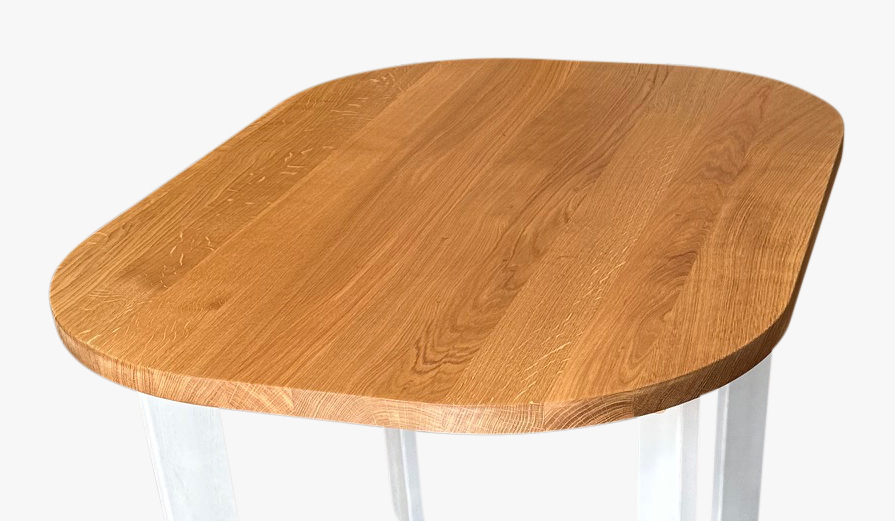
What part of your café or restaurant table top wears out first?
We usually look at the finish first, because that layer meets spills, hot plates, wiping, cleaning products and abrasion before the wood beneath it. Early marks do not always mean the table has failed. Costlier trouble starts when edges, fixings or wood movement make the top hard to clean or keep stable.
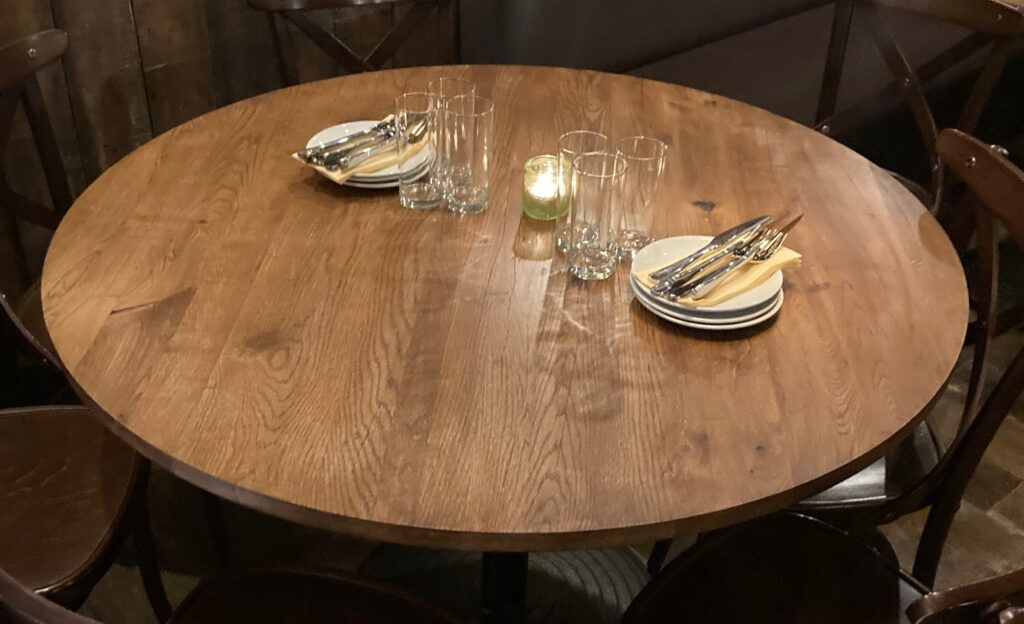 Restaurant Table Top
The finish usually wears first
People often expect the timber to fail first. In daily service, the restaurant table top finish takes the first hit because it is the working surface between the customer, the plate, the cloth and the cleaning product.
A marked finish and damaged timber are different problems. Scratches, dull patches, water rings and light heat marks can sit in the finish. Deep cuts, open edges or rough timber need a closer look because they affect how easily the top can be cleaned and kept in use.
At Tablemaker, we normally make café and restaurant tops in 24mm solid oak and use food-safe hardwax oil because one damaged area can be spot repaired without stripping the whole top. That finish is repairable. It is not a promise that marks will never happen.
Here is the usual order we look for when checking café table top wear.
| Wear point | What the reader sees | What it usually means |
|---|---|---|
| Finish | Dull patches, light scratches, water rings, sticky residue | Surface wear that may be cleaned, sanded lightly or recoated |
| Edges and corners | Scuffs, chips, exposed timber at impact points | Repeated knocks from chairs, trays or tight customer movement |
| Staining or water marks | Pale rings, darker patches, marks around drink areas | Liquid has sat long enough to affect the finish or timber surface |
| Fixing points | Wobble, loose screws, stress around the base plate | The top and base may not be working together properly |
| Movement or cupping | A top curving across its width | Solid wood movement has not been allowed for well enough |
Durable table tops for cafés are judged after service has started. A hard surface matters, but a repairable surface gives you more control when marks appear.
The edges and corners show damage early
In a small café with tables set close together, corners get clipped all day. Customers move between seats, chair backs catch the edge, and trays meet the same few points again and again.
Edge wear is easy to see because it breaks the outline of the top. A scratch in the middle can look like normal use. A chipped corner stands out, and a rough edge can become harder to wipe clean because cloths catch on it.
Shape matters here. A square, sharp corner can mark sooner in a tight layout because impact lands on a small point. Rounded corners for café tables can reduce sharp-corner knocks and make movement around the table easier. However, no corner shape makes a commercial table top damage-proof.
For some trade restaurant tops, we use rounded corners where the layout is close and people need to move around the tables often. Edge profile is a durability choice as much as a style choice, especially when the room is doing more work than the floor plan first suggests.
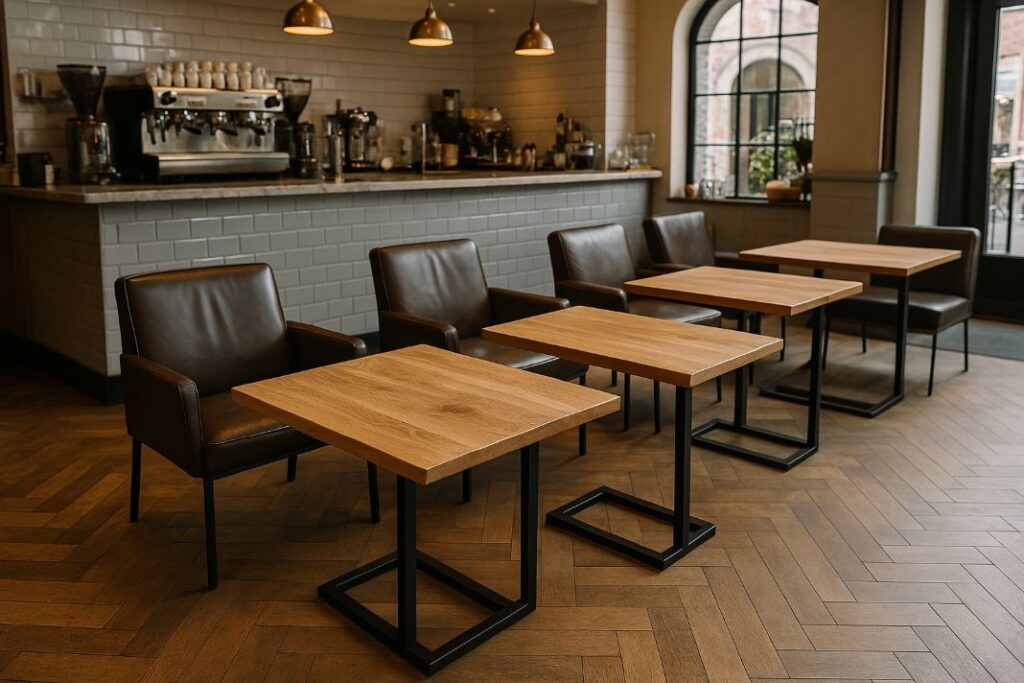 Tables for trade – cafe and restaurant – Illustrative Image
If your tables are marked mostly at the edges, check the corner shape and the amount of space between tables before you blame the finish. Tight layouts often cause the first visible damage.

The cleaning routine decides how marks develop
Cleaning is part of service, and the table top has to cope with it. Wet wiping, product residue and repeated cloth abrasion can change how a finish behaves over time, especially where staff wipe the same areas many times a day.
GOV.UK says food businesses must be able to prove they are cleaning effectively. A cleaning schedule sets out what needs cleaning or disinfecting, how often that happens and which products are used, so the finish on your table tops has to suit the routine your team follows.
Watch the marks that come back after normal wiping:
- Dull patches where cloths pass most often
- Sticky areas that remain after the surface has been wiped properly
- Pale rings or darker water marks around glasses and cups
- Finish thinning on table edges
- Rough areas that catch cloth fibres and need attention
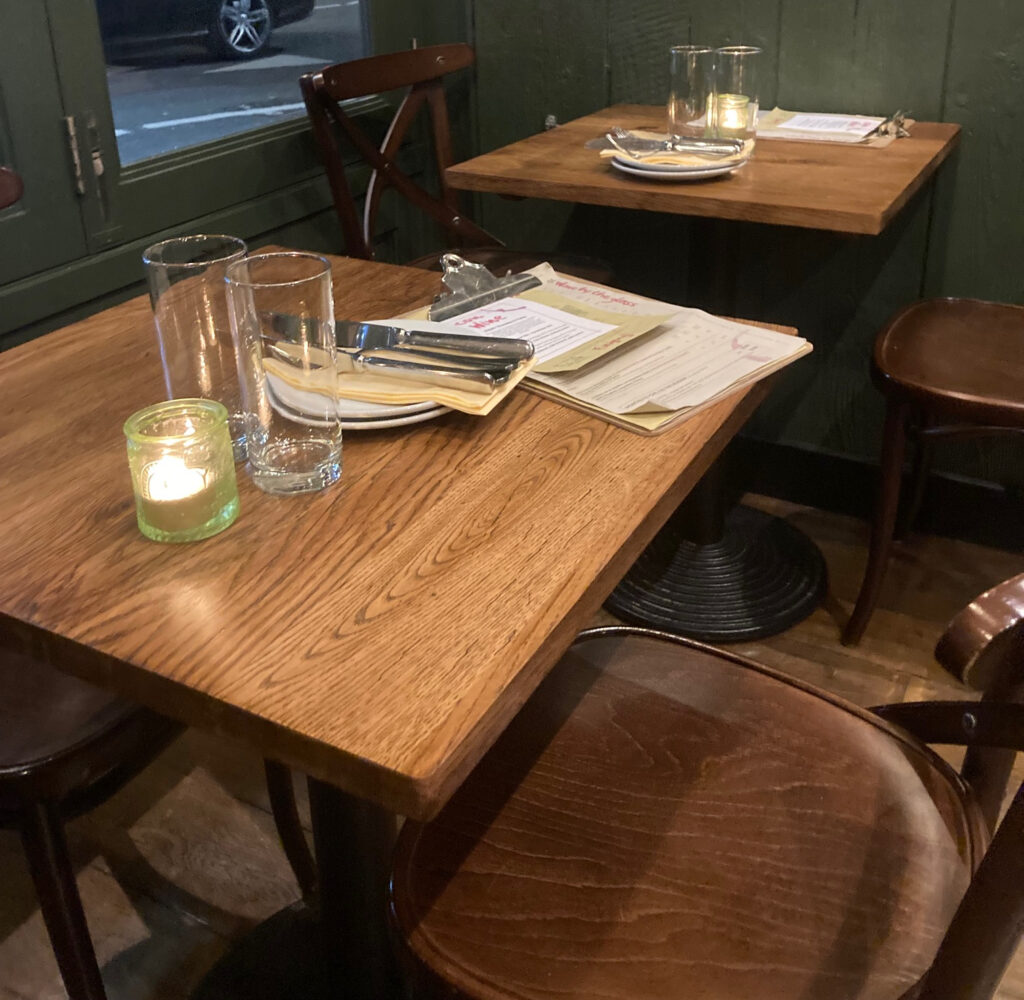
Sticky wooden restaurant tables do not have one single cause. Residue from cleaning products can sit on the surface, a worn finish can feel tacky, and standing water can leave marks if the finish is already tired.
Product choice matters because one cleaner is not right for every table top finish. GOV.UK tells food businesses to check disinfectant labels for the standard codes BS EN 1276 or BS EN 13697, but being right for hygiene does not automatically mean it suits every wood finish. Those two things need to line up in your cleaning routine.
The fixing points and movement cause deeper faults
Surface marks are the first thing you see, but faults underneath the top can shorten its useful life. Solid wood moves across its width as moisture changes, and the underside fixing has to allow for that movement.
BSI lists British Standard BS EN 15372:2023 as the current standard for strength, durability and safety requirements for non-domestic tables. That matters for commercial furniture, but the same standard does not cover resistance to ageing or degradation, so it does not tell you which surface will mark first in service.
Fixings that fight the top
A solid wood restaurant table top should not be trapped so tightly that it has nowhere to move. Poorly placed fixings can strain the area around the screws, and a base that is not matched to the top can create wobble even when the surface still looks sound.
We pay close attention to existing bases because many commercial buyers are replacing the top, not the whole table. A top that fits the base properly gives the fixing points a better chance of staying sound through daily use.
Movement that needs planning
Cupping means a table top curves across its width. Solid wood movement is normal, but poor fixing, poor board layout or lack of support can turn normal movement into a fault you have to deal with.
Straightening bars are bars fitted across the grain to help keep wide tops flat. At Tablemaker, we use them as part of the build where they are needed, along with grain direction and dried timber choices that support stability without turning the underside into a woodworking puzzle for you.
If a top feels sticky after cleaning, inspect the cleaner, the wiping pattern and the finish together. Residue and worn hardwax oil can create the same surface feel.
The repairable top is the safer long-term choice
Repairability is the deciding factor once wear appears. A finish mark, an edge chip and a deep gouge do not ask for the same answer, so buying a commercial table top by day-one appearance alone leaves you with fewer options later.
With a repairable hardwax oil finish, a local mark can be sanded lightly and recoated. Widespread wear across the whole surface calls for a fuller sand and recoat, because patching every small mark soon stops making sense. Deep damage into the timber needs a different judgement, especially if the surface has become rough or hard to keep clean.
Solid wood gives you sanding depth. Veneered medium-density fibreboard, often called MDF, and chipboard usually cannot be sanded back in the same way, because the usable surface is thin and the core beneath is different. We do not use medium-density fibreboard, chipboard or veneered board for tops because our work is built around repair, refinishing and keeping furniture in use.
A good top for service is the one whose common wear points can be dealt with before replacement becomes the only answer. Prioritise the second life of the top, because daily service will mark the first one sooner than most buying guides admit.

Questions we get asked about café and restaurant table tops
Are solid wood table tops good for restaurants?
Solid wood table tops can work well in restaurants when the finish, edge shape, fixing method and cleaning routine suit commercial use. The main benefit is repairability, because solid wood can be sanded and refinished rather than treated as disposable.
Can a hardwax oil table top be spot repaired?
A hardwax oil table top can be spot repaired when the damage is local and has not gone too deep into the timber. The marked area is usually sanded lightly and recoated, which is why we use hardwax oil for many café and restaurant tops.
Are rounded corners better for café tables?
Rounded corners can be a good choice in tight café layouts because customers and staff move close to the table edges. They reduce some sharp-corner impact and make circulation easier, but they do not stop all corner damage.
How do you stop wooden restaurant tables getting sticky?
Sticky wooden restaurant tables need the cleaning routine and finish checked together. Residue, worn finish or repeated wet wiping can all play a part, so the answer is to use products that suit the finish and refinish the surface when cleaning no longer solves it.
Does a commercial table standard mean the surface will not wear?
A strength and safety standard does not prove that a table top surface will resist ageing, stains or visible wear. Surface life still depends on the finish, cleaning routine, edge design and how the top is fixed to its base.